Annapurna Sanctuary
Walk
The heart of the Himalaya.
Duration
10 days
Route distance
110.0km
Vertical Gain
+4,800m
Max Altitude
4,130m
Mission Brief
The heart of the Himalaya.
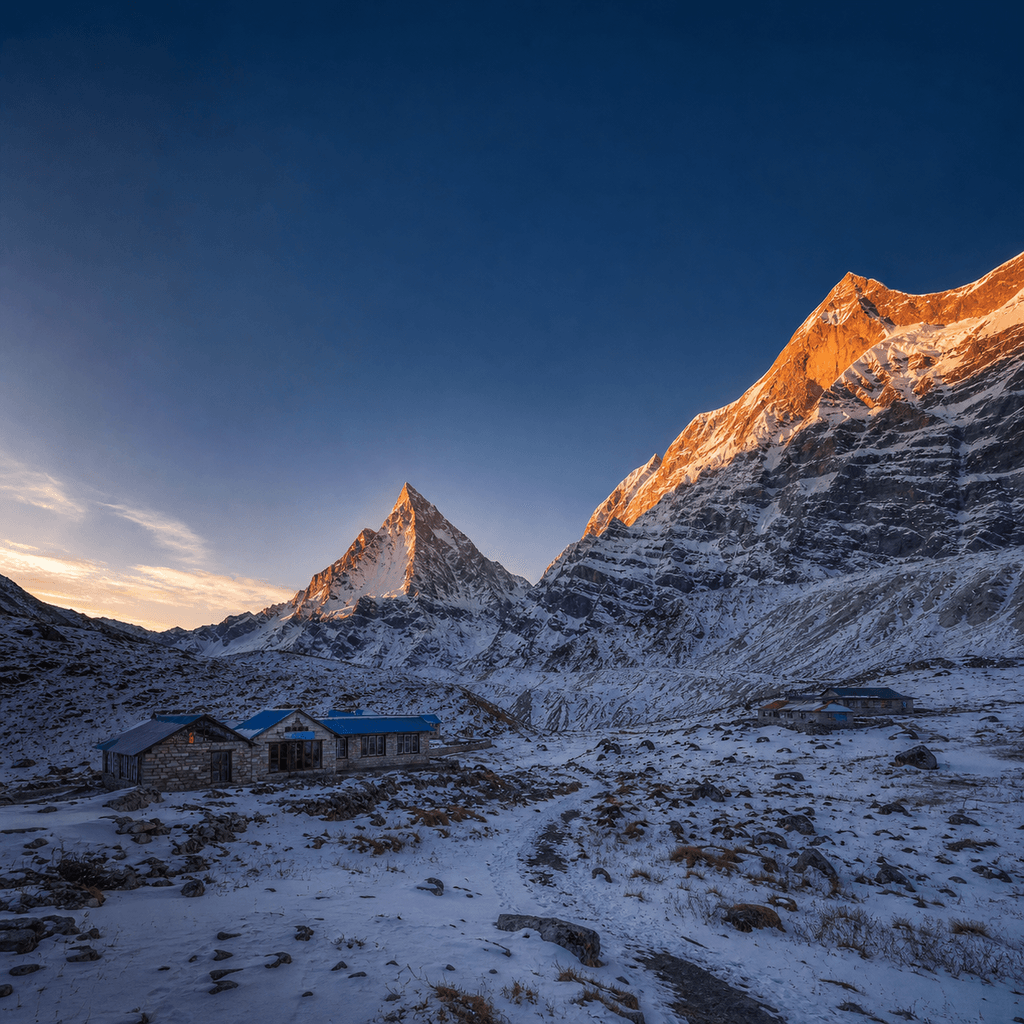
The Annapurna Sanctuary Walk, often simply called the Annapurna Base Camp (ABC) Trek, is a spectacular journey into a natural amphitheater surrounded by a ring of 7,000 and 8,000-meter peaks. Starting from the lush, sub-tropical foothills near Pokhara, the trail winds through terraced rice paddies, dense rhododendron forests, and bamboo thickets before entering the narrow Modi Khola gorge. The climax is the 'Sanctuary' itself—a high-altitude glacial basin where you stand at the foot of the massive south face of Annapurna I (8,091m) and the iconic, sacred peak of Machhapuchhre (Fishtail).
Standing inside the Sanctuary at Sunrise. The 'X-Factor' here is the 360-degree wall of white giants. Unlike many Himalayan treks that follow a linear path past individual peaks, the ABC hike leads you into a deep bowl…
Mission Snapshot
Intensity Breakdown
Understanding what drives the overall route demand
Physical
79
Technical
32
Commitment
50
Primary driver: Physical load
- Sustained Physical Output
- Significant Vertical Gain
- High Altitude Environment
- Multi-day Endurance Load
Advanced multi-day effort: heavy fatigue, logistics, or movement friction—not necessarily alpine exposure.
Full Route Breakdown
Complete stage overview with transparent route metrics. Values are shown as recorded in the route dataset and source links.
Distance
110.0 km
Ascent
4,800 m
Highest point
4,130 m
Start
Nayapul
Finish
Annapurna Base Camp (ABC)
Use the KM / MI toggle in the main menu to switch units.
Route Profile
Fixed backcountry campground structure for this route
Route Considerations
This route is generally safe, but these are the main factors to be aware of.
Avalanche risk in the modi khola gorge
The section between Dovan and MBC (Machhapuchhre Base Camp) is a narrow valley with steep walls prone to avalanches, especially after heavy winter snow or during the spring melt.
Impact
Route-specific
Likelihood
Context-dependent
Tip
Check local conditions at the checkpoint in Chhomrong; avoid trekking this section during or immediately after heavy snowfall; if risk is high, wait for reports from guides coming down.
Acute mountain sickness ams
The ascent from the bamboo forests to ABC is relatively fast, and the altitude of 4,130m is high enough to cause serious symptoms.
Impact
Route-specific
Likelihood
Context-dependent
Tip
Spend an extra night at a lower altitude like Himalaya or Deurali to acclimatize; stay hydrated; walk slowly and monitor for headaches or nausea.
Altitude Warning
Potential altitude-related conditions include AMS, HAPE, and HACE. Adequate acclimatization is essential.
Impact
Route-specific
Likelihood
Context-dependent
Tip
Strict adherence to hydration and gradual ascent protocols (climb high, sleep low).
Why hike this route?
LANDSCAPE
The unique experience of being 'inside' the mountains in a massive glacial sanctuary.
VARIETY
The incredible transition from tropical jungle with monkeys to the high alpine glacier in just a few days.
CULTURE & PLACE
The hospitality of the Gurung and Magar villages in the lower foothills.
STANDOUT
Standing inside the Sanctuary at Sunrise. The 'X-Factor' here is the 360-degree wall of white giants. Unlike many Himalayan treks that follow a linear path past individual peaks, the ABC hike leads you into a deep bowl where the mountains completely surround you. Watching the fi…
Expert Verdict
“The ABC trek is the best 'effort-to-reward' ratio in the Himalaya. Within 4 days of starting, you are deep in the heart of the high mountains. Experienced hikers often suggest combining it with Poon Hill if you have the time; the view from the top of the sanctuary is great, but the panorama from Poon Hill is legendary. Also, don't miss the hot springs at Jhinu Danda on the way down—it's the perfect way to reward your legs after the stone steps. For most fit trekkers the steady stone-step gain is manageable with sensible pacing—typically around 3-4 km/h on standard trail days.”
Who This Is For
- INTERMEDIATE — For active walkers who want a 'Big Mountain' experience without the 3-week commitment of the classic circuits. You should be comfortable with 5-6 hours of walking per day and able to handle thousands of stone steps.
- PHYSICAL — Moderate to High. The real challenge is the 'Nepali Flat'—a never-ending sequence of up and down. The cumulative elevation gain is significant, even if the net gain is not extreme.
- WATCH FOR — Ascending too quickly from Deurali to MBC/ABC.
- WATCH FOR — Not accounting for the avalanche risk in the gorge during spring.
Plan This Hike
Key things to arrange before starting this route—practical tips first, then buttons that open curated picks (gear, maps, stays) where we list them.
Essential Gear
Recommended preparation for this route:
A stair-heavy tea-house trek that finishes in a cold glacial basin.
- Waterproof boots for stone steps and wet forest sections
- Warm jacket for ABC sunrise
- Rain shell for the Modi Khola gorge
Stay Connected
Explore accommodation options for this trail:
Lower villages are easier to connect from than the sanctuary itself.
- Download offline maps around Pokhara
- Carry a power bank for ABC/MBC lodge nights
- Do not rely on signal in the gorge
Getting There
Travel and trail access for this route:
Pokhara is the usual staging point, with several roadhead choices.
- Drive from Pokhara to Nayapul, Ghandruk or Siwai
- Confirm ACAP and guide requirements before departure
- Build flexibility around avalanche or snow closures
Where to Stay
Explore accommodation options for this trail:
Tea houses are frequent, but ABC and MBC can fill in peak windows.
- Plan busy nights around Chhomrong, Deurali, MBC and ABC
- Carry cash for meals, charging and hot showers
- Keep a lower-altitude fallback if ABC conditions deteriorate
Compare This Route
See how this route compares to similar hikes in overall demand and terrain profile.Compare routes by the shape of the effort, not only the headline score.
Alpe Adria Trail
Closest overall match in demand profile
The Alpe Adria Trail is a long-distance hiking route from Kaiser-Franz-Jose...
Intensity
Slightly lower intensityThorsborne Trail
Lower overall intensity, similar terrain type
The Thorsborne Trail is a 32km point-to-point trekking route along the east...
Intensity
Lower intensityTravessia Petrópolis-Teresópolis
Higher physical or technical demand
The Travessia Petrópolis-Teresópolis is a premier multi-day traverse within...
Intensity
Higher intensityExplore Alternatives
Broaden the picture with easier, harder, and nearby options.
Looking for something easier?
Lower intensity — helpful if this route feels like a stretch right now.
Want more challenge?
Higher intensity — for when you are ready for a bigger physical or technical step.
More hikes in this region
Nearby and regionally relevant routes for the next step in your search.
Langtang Valley Trek
langtang-national-park · nepal
Distance
70.0 km
Ascent
2,400 m
Upper Mustang
mustang-western-nepal · nepal
Distance
125.0 km
Ascent
2,200 m
Annapurna Circuit
annapurna-conservation-area · nepal
Distance
230.0 km
Ascent
4,500 m
Three Passes Trek
khumbu-everest · nepal
Distance
170.0 km
Ascent
7,000 m
Tsho Rolpa Trek
rolwaling-valley · nepal
Distance
120.0 km
Ascent
3,200 m
Manaslu Circuit
manaslu-conservation-area · nepal
Distance
180.0 km
Ascent
4,200 m
Compare with any route
Pick any hike worldwide and open a full side-by-side comparison.
What You Need to Know
Essential answers about the demands, risks, and logistics of this route.
Q.How hard is this hike really?
Q.Do I need technical gear?
Q.Is water available on the route?
Q.What is the main risk?
Ready to hike Annapurna Sanctuary Walk?
A final decision point after reviewing the route, risks, logistics, and alternatives.
This route is a strong match if you're comfortable with the effort level implied by an Intensity Score around 69/100 (Very Hard), sustained hiking where this route requires it, and the terrain and exposure described in this guide.
Build your itinerary, stages, and logistics.
Looking for something easier, more challenging, or a different terrain profile?
Compare routes by intensity, terrain, and region.
Data: official trail documentation and topographic sources · About