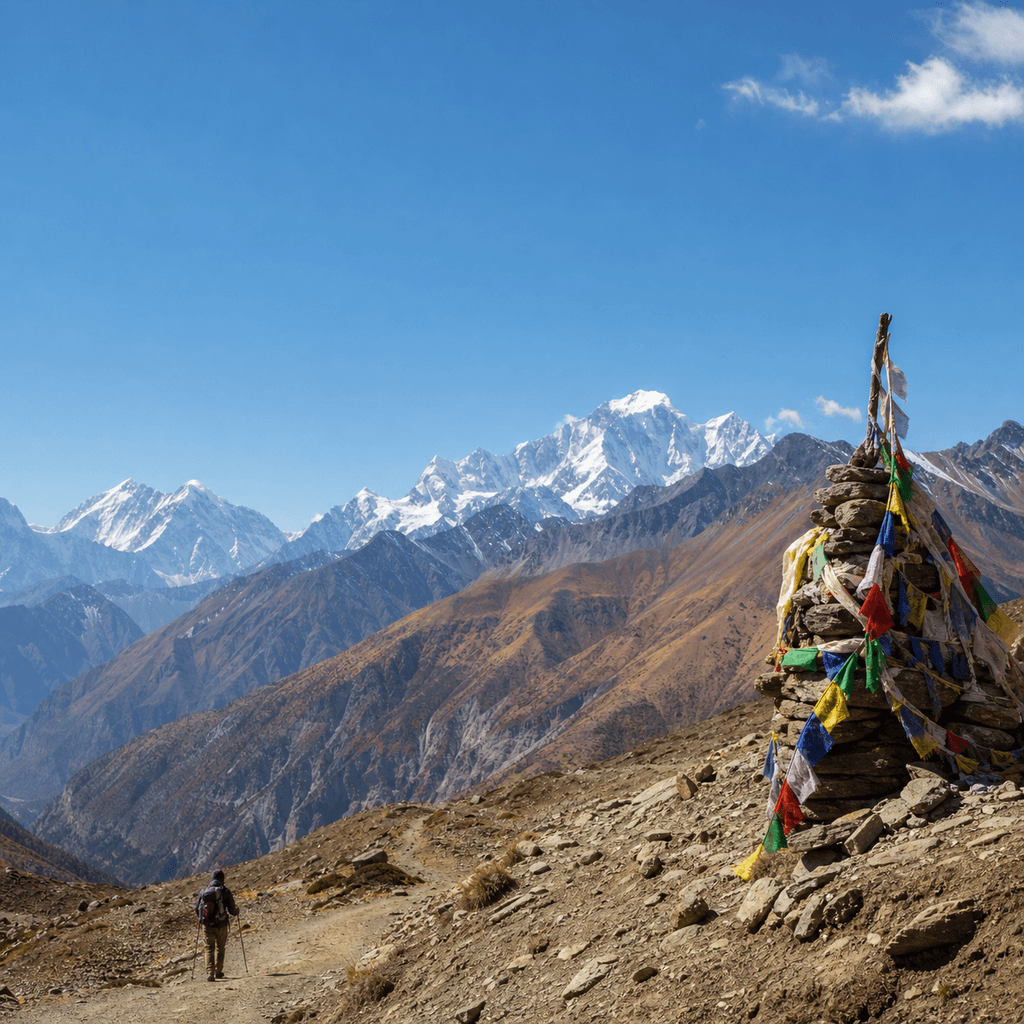
Annapurna
Circuit
Widely regarded as one of the most diverse treks in the Himalaya, the Annapurna Circuit is a legendary 230km (143 mile) journey that circumvents the massive Annapurna…
Duration
15 days
Route distance
230.0km
Vertical Gain
+4,500m
Max Altitude
5,416m
Mission Brief
Widely regarded as one of the most diverse treks in the Himalaya, the Annapurna Circuit is a legendary 230km (143 mile) journey that circumvents the massive Annapurna Massif.
What makes this trek unique is its incredible ecological diversity—transitioning from lush tropical jungles and terraced rice paddies to pine forests, and finally to the stark, arid, Tibetan-like landscape of the Manang valley. The physical and spiritual climax is the crossing of Thorong La (5,416m), one of the highest trekking passes in the world, before descending into the sacred site of Muktinath.
The Thorong La Crossing and the Kali Gandaki Gorge. The 'X-Factor' is the sheer scale of the landscape transformation. One day you are walking under massive waterfalls in a humid forest, and three days later you are on…
Mission Snapshot
Intensity Breakdown
Understanding what drives the overall route demand
Physical
82
Technical
36
Commitment
50
Primary driver: Physical load
- Sustained Physical Output
- High Altitude Environment
- Multi-day Endurance Load
High commitment routes with serious consequence, remote terrain, or sustained objective hazard.
Full Route Breakdown
Complete stage overview with transparent route metrics. Values are shown as recorded in the route dataset and source links.
Distance
230.0 km
Ascent
4,500 m
Highest point
5,416 m
Start
Through the Gorge
Finish
Thorong La & Muktinath
Use the KM / MI toggle in the main menu to switch units.
Route Profile
Fixed backcountry campground structure for this route
Route Considerations
This route is generally safe, but these are the main factors to be aware of.
Acute mountain sickness ams
Thorong La is over 5,400 meters. Many trekkers push too fast from Manang and risk severe AMS on the pass day.
Impact
Route-specific
Likelihood
Context-dependent
Tip
Spend at least 2-3 nights in Manang (3,500m) for acclimatization; drink 4L of water; start the pass crossing at 4 AM to avoid afternoon winds; descend immediately to Muktinath after reaching the summit.
Weather on the pass
Blizzards and extreme cold can occur on Thorong La at any time of year, sometimes trapping trekkers.
Impact
Route-specific
Likelihood
Context-dependent
Tip
Check weather reports in Manang before attempting the crossing; never cross alone; carry a high-quality down jacket and windbreaker; if snow is heavy, wait at Thorong Phedi or High Camp.
Altitude Warning
Potential altitude-related conditions include AMS, HAPE, and HACE. Adequate acclimatization is essential.
Impact
Route-specific
Likelihood
Context-dependent
Tip
Strict adherence to hydration and gradual ascent protocols (climb high, sleep low).
Why hike this route?
LANDSCAPE
Massive peaks (Annapurna, Dhaulagiri, Machhapuchhre) and the dramatic Kali Gandaki gorge.
VARIETY
From lush bamboo forests and tiered rice paddies to the high-alpine desert of Mustang.
CULTURE & PLACE
The deep blend of Hindu and Buddhist cultures in the villages of the Manang and Mustang regions.
STANDOUT
The Thorong La Crossing and the Kali Gandaki Gorge. The 'X-Factor' is the sheer scale of the landscape transformation. One day you are walking under massive waterfalls in a humid forest, and three days later you are on a high-altitude desert plateau surrounded by 8,000-meter pea…
Expert Verdict
“The Annapurna Circuit is a cultural and geological masterpiece. Don't let the road sections deter you; use the 'NATT' (Natural Annapurna Trekking Trail) markers to stay on the best paths. Spend an extra day in Manang to acclimatize—it is non-negotiable for a safe crossing of Thorong La. Thorong La (5,416 m) is typically a single 10–12 hour push from Thorong Phedi; start before dawn and descend quickly if weather closes in.”
Who This Is For
- INTERMEDIATE TO ADVANCED — For trekkers who want the 'classic' Himalaya experience. You should be comfortable with multi-day high-altitude walking (8-10 days) and have basic understanding of AMS (Altitude Sickness) symptoms.
- PHYSICAL — High. The climb to Thorong La Pass (5,416m) is a slow, oxygen-deprived slog that requires significant cardiovascular endurance.
- WATCH FOR — Ascending too quickly from Manang to Thorong Phedi.
- WATCH FOR — Spending too much time on the newly built roads instead of using the natural trails (NATT).
Plan This Hike
Key things to arrange before starting this route—practical tips first, then buttons that open curated picks (gear, maps, stays) where we list them.
Essential Gear
Recommended preparation for this route:
High-pass tea-house trek with hot valleys and freezing mornings.
- Warm down layer and windproof shell for Thorong La
- Trekking poles for long descents
- Water treatment backup for village refills
Stay Connected
Explore accommodation options for this trail:
Valley coverage improves near towns, but the pass day is not phone-reliable.
- Download offline maps before leaving Pokhara or Kathmandu
- Carry a power bank for cold high-camp nights
- Treat mobile data as convenience, not safety infrastructure
Getting There
Travel and trail access for this route:
Most itineraries start from Besisahar or nearby roadheads and finish toward Muktinath/Jomsom.
- Bus or jeep from Kathmandu or Pokhara to Besisahar
- Use NATT alternatives to avoid dusty road sections where practical
- Check ACAP and guide rules before booking
Where to Stay
Explore accommodation options for this trail:
Tea houses make logistics simple, but pass-side beds can tighten in peak season.
- Reserve ahead around Manang, Yak Kharka and Thorong Phedi when busy
- Carry cash for meals, charging and hot showers
- Use rest days for acclimatization rather than speed
Compare This Route
See how this route compares to similar hikes in overall demand and terrain profile.Compare routes by the shape of the effort, not only the headline score.
Yading Nature Reserve
Closest overall match in demand profile
The 'Big Kora' is an advanced outer circumambulation route rarely undertake...
Intensity
Higher intensitySunshine Coast Trail
Lower overall intensity, similar terrain type
Canada's longest hut-to-hut hiking trail and a hidden gem of the West Coast...
Intensity
Lower intensityIllampu Circuit
Higher physical or technical demand
The Illampu Circuit is a demanding 6-to-7-day trek that circumnavigates the...
Intensity
Higher intensityExplore Alternatives
Broaden the picture with easier, harder, and nearby options.
Looking for something easier?
Lower intensity — helpful if this route feels like a stretch right now.
Want more challenge?
Higher intensity — for when you are ready for a bigger physical or technical step.
More hikes in this region
Nearby and regionally relevant routes for the next step in your search.
Three Passes Trek
khumbu-everest · nepal
Distance
170.0 km
Ascent
7,000 m
Tsho Rolpa Trek
rolwaling-valley · nepal
Distance
120.0 km
Ascent
3,200 m
Upper Mustang
mustang-western-nepal · nepal
Distance
125.0 km
Ascent
2,200 m
Manaslu Circuit
manaslu-conservation-area · nepal
Distance
180.0 km
Ascent
4,200 m
Everest Base Camp
khumbu-everest · nepal
Distance
130.0 km
Ascent
2,700 m
Gokyo Lakes & Cho La Pass
khumbu-everest · nepal
Distance
120.0 km
Ascent
3,200 m
Compare with any route
Pick any hike worldwide and open a full side-by-side comparison.
What You Need to Know
Essential answers about the demands, risks, and logistics of this route.
Q.How hard is this hike really?
Q.Do I need technical gear?
Q.Is water available on the route?
Q.What is the main risk?
Ready to hike Annapurna Circuit?
A final decision point after reviewing the route, risks, logistics, and alternatives.
This route is a strong match if you're comfortable with the effort level implied by an Intensity Score around 81/100 (Severe), sustained hiking where this route requires it, and the terrain and exposure described in this guide.
Build your itinerary, stages, and logistics.
Looking for something easier, more challenging, or a different terrain profile?
Compare routes by intensity, terrain, and region.
Data: official trail documentation and topographic sources · About