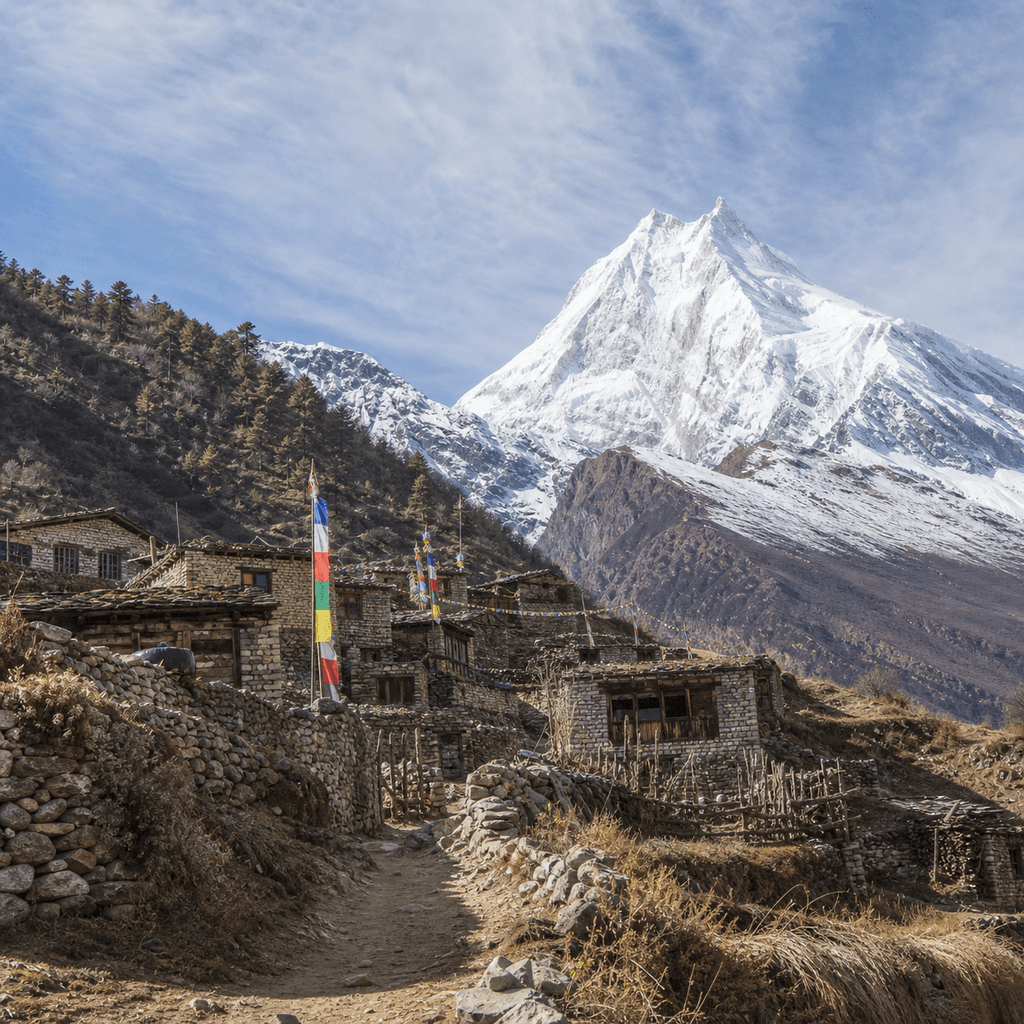
Manaslu
Circuit
Around the Mountain of the Spirit.
Duration
14 days
Route distance
180.0km
Vertical Gain
+4,200m
Max Altitude
5,160m
Mission Brief
Around the Mountain of the Spirit.
The Manaslu Circuit is a scenic 180km (110 mile) journey that circumvents Mount Manaslu (8,163m)—the eighth-highest peak in the world. This restricted-area trek offers a perfect blend of diverse landscapes, from lush subtropical jungles and deep river gorges to high-altitude glaciers and Tibetan-style villages. It is often favored as a wilder and more culturally authentic alternative to the more crowded Annapurna Circuit, culminating in the crossing of the formidable Larkya La (5,160m).
The Larkya La and the Gorkha Heritage. The 'X-Factor' is the transition from the Gurung lands of the lower valley to the Tibetan-influenced culture of the 'Nupri' region. Reaching the village of Samagaon, where thousand…
Mission Snapshot
Intensity Breakdown
Understanding what drives the overall route demand
Physical
82
Technical
51
Commitment
100
Primary driver: Commitment
- Sustained Physical Output
- Significant Vertical Gain
- Technical Terrain Exposure
- High Remote Commitment
High commitment routes with serious consequence, remote terrain, or sustained objective hazard.
Full Route Breakdown
Complete stage overview with transparent route metrics. Values are shown as recorded in the route dataset and source links.
Distance
180.0 km
Ascent
4,200 m
Highest point
5,160 m
Start
Through the Gorge
Finish
Larkya La Crossing
Use the KM / MI toggle in the main menu to switch units.
Route Profile
Fixed backcountry campground structure for this route
Route Considerations
This route is generally safe, but these are the main factors to be aware of.
Acute mountain sickness ams
The ascent to Samagaon and Dharmasala is rapid; the Larkya La pass (5,160m) is high enough to cause life-threatening symptoms.
Impact
Route-specific
Likelihood
Context-dependent
Tip
Take two acclimatization days (at Lho and Samagaon); walk slowly; stay hydrated; carry emergency oxygen or a portable altitude chamber (usually handled by the trekking agency).
Landslides and steep drop offs
The lower Buri Gandaki gorge has sections with very narrow paths and high exposure to landslides during and after rain.
Impact
Route-specific
Likelihood
Context-dependent
Tip
Always check for fresh rockfall; follow your guide's instructions; cross landslide zones quickly and individually; avoid trekking during heavy monsoon rains.
Altitude Warning
Potential altitude-related conditions include AMS, HAPE, and HACE. Adequate acclimatization is essential.
Impact
Route-specific
Likelihood
Context-dependent
Tip
Strict adherence to hydration and gradual ascent protocols (climb high, sleep low).
Why hike this route?
LANDSCAPE
The constant, looming presence of 'The Mountain of Spirit' (Manaslu) and the crossing of the wild, high Larkya La.
VARIETY
Passing from sub-tropical bamboo forests to the high, arid alpine environment of the Tibetan borderlands.
CULTURE & PLACE
Entering the 'Nupri' region, where Tibetan Buddhism is preserved in its purest form, far from the influence of roads.
STANDOUT
The Larkya La and the Gorkha Heritage. The 'X-Factor' is the transition from the Gurung lands of the lower valley to the Tibetan-influenced culture of the 'Nupri' region. Reaching the village of Samagaon, where thousands of ancient mani stones line the path and the massive east…
Expert Verdict
“This is the 'Annapurna Circuit of 20 years ago'. It is culturally richer and visually more dramatic because you are circling a single, massive 8,000m peak. Experienced hikers often suggest including the acclimatization day in Samagaon. Take the side trip to Manaslu Base Camp or Birendra Lake—it’s the best way to supercharge your red blood cells before the pass. Larkya La (5,160 m) is the crux day—most groups need a full alpine start from Dharamsala and 8–10 hours on the pass section alone.”
Who This Is For
- ADVANCED — For veteran trekkers who have completed high-altitude hikes (like EBC or Annapurna) and want a 'rawer' Himalayan experience with fewer crowds. You should be comfortable with long days (7+ hours) and basic, remote tea houses.
- PHYSICAL — High. The trek involves a sustained climb through a deep gorge, meaning lots of uphill and downhill before you even reach the high plateau. The Larkya La (5,160m) is a long, physically demanding pass crossing.
- WATCH FOR — Trying to rush the Buri Gandaki gorge; the heat and humidity in the first few days can be draining.
- WATCH FOR — Underestimating the Larkya La; it’s a much longer day than most expect, often taking 10-12 hours from Dharmasala to Bimthang.
Plan This Hike
Key things to arrange before starting this route—practical tips first, then buttons that open curated picks (gear, maps, stays) where we list them.
Essential Gear
Recommended preparation for this route:
High-pass tea-house trek with cold, remote days.
- Warm down layer and waterproof shell for Larkya La
- Broken-in boots and poles for long moraine sections
- Water purification; bottled water is discouraged
Stay Connected
Explore accommodation options for this trail:
Remote valleys mean signal cannot be assumed.
- Download Manaslu offline maps before leaving Kathmandu
- Carry power bank or solar backup for long lodge stretches
- Insurance with helicopter evacuation cover is standard advice
Getting There
Travel and trail access for this route:
Road access starts from Kathmandu into the Buri Gandaki.
- Arrange jeep or bus transfer to Machha Khola or Soti Khola
- Restricted-area permit requires guide and agency handling
- Build buffer days for road, landslide, or pass delays
Where to Stay
Explore accommodation options for this trail:
Tea houses cover the circuit, but high villages are basic.
- Reserve key high stops through your guide in peak season
- Carry cash for lodges, charging, and hot water
- Use Samagaon as a deliberate acclimatization base
Compare This Route
See how this route compares to similar hikes in overall demand and terrain profile.Compare routes by the shape of the effort, not only the headline score.
Vale do Pati
Closest overall match in demand profile
Vale do Pati is a remote multi-day trekking destination within the Chapada ...
Intensity
Slightly higher intensityDientes de Navarino Circuit
Lower overall intensity, similar terrain type
Often described as one of the southernmost established multi-day trekking c...
Intensity
Lower intensityCopper Canyon
Higher physical or technical demand
Deeper and wider than the Grand Canyon. The Copper Canyon (Barranca del Cob...
Intensity
Higher intensityExplore Alternatives
Broaden the picture with easier, harder, and nearby options.
Looking for something easier?
Lower intensity — helpful if this route feels like a stretch right now.
Want more challenge?
Higher intensity — for when you are ready for a bigger physical or technical step.
More hikes in this region
Nearby and regionally relevant routes for the next step in your search.
Everest Base Camp
khumbu-everest · nepal
Distance
130.0 km
Ascent
2,700 m
Gokyo Lakes & Cho La Pass
khumbu-everest · nepal
Distance
120.0 km
Ascent
3,200 m
Makalu Base Camp
sankhuwasabha-eastern-nepal · nepal
Distance
150.0 km
Ascent
4,200 m
Three Passes Trek
khumbu-everest · nepal
Distance
170.0 km
Ascent
7,000 m
Tsho Rolpa Trek
rolwaling-valley · nepal
Distance
120.0 km
Ascent
3,200 m
Kangchendzonga Himal
taplejung-eastern-nepal · nepal
Distance
200.0 km
Ascent
5,500 m
Compare with any route
Pick any hike worldwide and open a full side-by-side comparison.
What You Need to Know
Essential answers about the demands, risks, and logistics of this route.
Q.How hard is this hike really?
Q.Do I need technical gear?
Q.Is water available on the route?
Q.What is the main risk?
Ready to hike Manaslu Circuit?
A final decision point after reviewing the route, risks, logistics, and alternatives.
This route is a strong match if you're comfortable with the effort level implied by an Intensity Score around 89/100 (Severe), sustained hiking where this route requires it, and the terrain and exposure described in this guide.
Build your itinerary, stages, and logistics.
Looking for something easier, more challenging, or a different terrain profile?
Compare routes by intensity, terrain, and region.
Data: official trail documentation and topographic sources · About