Jebel
Akhdar
~4.3 km linear route connecting Al Aqur, Al Ayn, and Ash Shirayjah villages.
Duration
1 day
Route distance
4.3km
Vertical Gain
+200m
Max Altitude
2,000m
Mission Brief
The emerald of the Hajar.
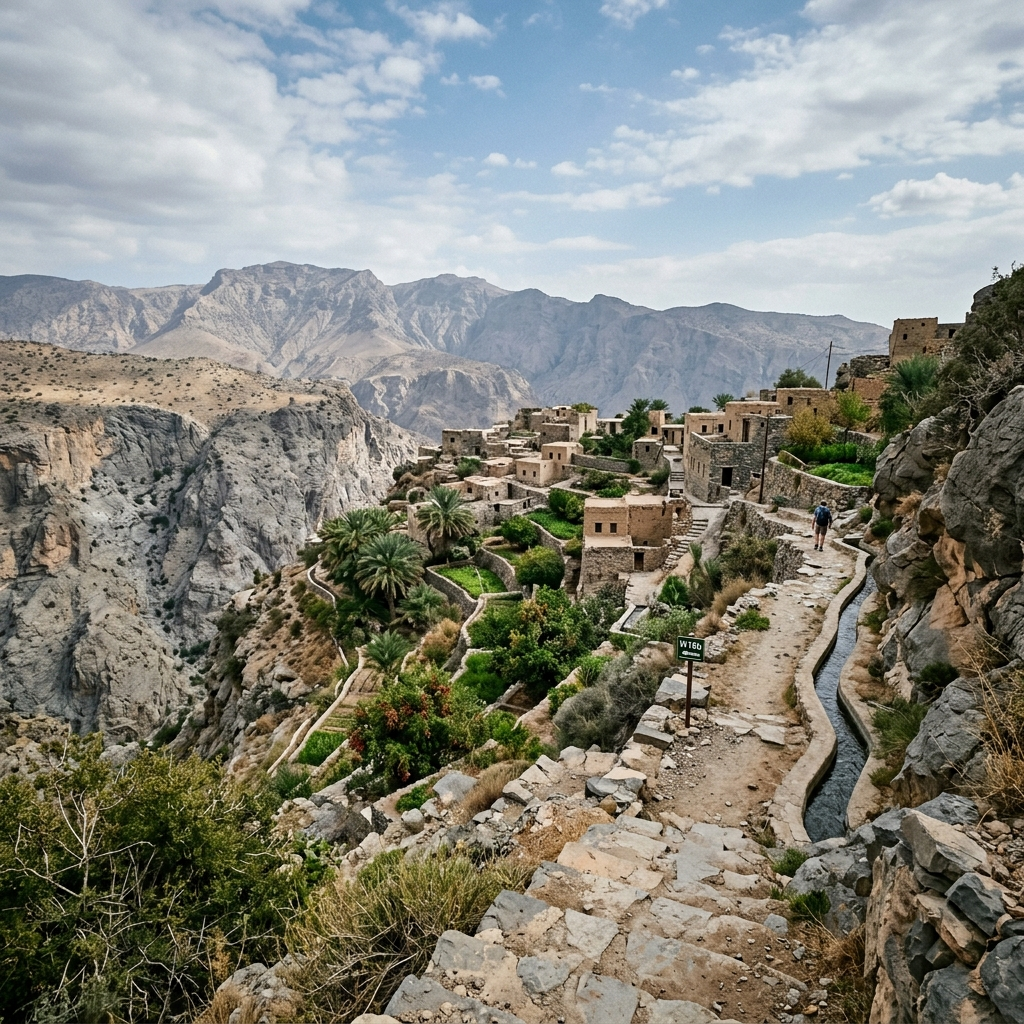
Jebel Akhdar (2,000m+) is a cool, oasis-like plateau known for its ancient agricultural terraces and rose water production. The W18b trail, also known as the Three Villages Walk, is the region's most famous path. It connects the traditional stone villages of Al Aqur, Al Ayn, and Ash Shirayjah, clinging to the edge of a massive canyon.
Walking here involves following the thin stone ledges of the 'Falaj' irrigation channels, passing through pomegranate orchards, and witnessing a way of life that has remained unchanged for centuries in the high mountains of Oman.
A cliffside stroll through three ancient mountain oases, walking along UNESCO-listed falaj irrigation channels and rose terraces.
Mission Snapshot
Intensity Breakdown
Understanding what drives the overall route demand
Physical
16
Technical
9
Commitment
11
Primary driver: Physical load
- Standard Recreational Effort
Safe, accessible, and family-proof. Low physical and technical demand.
Full Route Breakdown
Complete stage overview with transparent route metrics. Values are shown as recorded in the route dataset and source links.
Distance
4.3 km
Ascent
200 m
Highest point
2,000 m
Start
Al Aqur
Finish
Ash Shirayjah Village
Use the KM / MI toggle in the main menu to switch units.
Route Profile
Single-day stage structure
Operational Reality
Itinerary details the standard 4.3 km trail between the three villages; walking within terraces or returning via the road adds mileage. Not survey-grade GPS.
Route Considerations
Exposure to high cliff drops along unfenced falaj walls; loose steps and intense Arabian sun.
Steep unfenced drop offs
Much of the path follows the narrow edge of the irrigation channels with high exposure to the canyon below.
Impact
Route-specific
Likelihood
Context-dependent
Tip
Avoid walking here if you suffer from vertigo; stay on the marked path; keep a close eye on children; wear shoes with excellent grip (rock can be polished and slippery).
Temperature fluctuations
While much cooler than the coastal plains, Jebel Akhdar can still reach 30°C in the sun during the day and drop to 5°C at night in winter.
Impact
Route-specific
Likelihood
Context-dependent
Tip
Wear layers with a windbreaker; use high-SPF sun protection even in winter; carry at least 2L of water per person.
Terrain & conditions
Conditions change quickly on the ground. Slow down on wet rock and pay more attention where paths narrow or exposure increases.
Impact
Moderate
Likelihood
Variable
Tip
Refer to stage notes and expert briefings; maintain focus on slick or exposed sections.
Why hike this route?
LANDSCAPE
The startling contrast between the lush green terraces and the bone-dry, jagged grey mountains of the Hajar range.
VARIETY
The transition from narrow stone alleys to open cliff-top paths and shaded fruit orchards.
CULTURE & PLACE
A direct, un-staged look at ancient Omani agriculture and architecture that has survived for over a millennium.
WHY GO
A cliffside stroll through three ancient mountain oases, walking along UNESCO-listed falaj irrigation channels and rose terraces.
Expert Verdict
“The 'Three Villages Walk' is one of the most aesthetically pleasing short walks in the world. It’s less of a hike and more of a vertical garden tour. Experienced hikers often suggest starting at Al Aqur and walking through to Ash Shirayjah, but time your walk for late afternoon when the golden light hits the limestone mountains. If you visit in early April, you will see the rose distillation in progress—ask the elders in the villages if you can peek into the small smoke-filled rooms where they make rose water; it’s an incredible sensory experience. Also, respect the dress code; this is a deeply traditional community—covering shoulders and knees is often required for all genders. Finally, don't just stare at the canyon; look down at the irrigation system. The 'Falaj' is a UNESCO-listed ancient technology that still works perfectly today—it is the biological life-support system of the mountain.”
Who This Is For
- EASY TO MODERATE — Ideal for families, cultural aficionados, and photographers who want to experience the 'authentic' Oman without a grueling physical challenge. You don't need previous hiking experience, but you should be comfortable with heights, as the best path is often the narrow stone wall o…
- PHYSICAL — Low. The total distance is short, and the terrain is mostly leveled. The main effort comes from navigating the frequent stone stairs that connect the village levels and the mental focus required for the narrow 'cliff-si…
- WATCH FOR — Trying to go up in a 'Saloon' car; you will be turned back at the checkpoint, ruining your day trip.
- WATCH FOR — Wearing inappropriate footwear; flip-flops are common among tourists but the stone steps are often polished and can be surprisingly slick.
Plan This Hike
Key things to arrange before starting this route—practical tips first, then buttons that open curated picks (gear, maps, stays) where we list them.
Essential Gear
Recommended preparation for this route:
Modest clothing and walking shoes for stone steps.
- Lightweight, modest clothing covering shoulders and knees
- Sturdy shoes with good grip—polished steps can be slick
- Sun protection—polarized sunglasses and high-SPF sunscreen
Stay Connected
Explore accommodation options for this trail:
Good signal across the plateau villages.
- Ooredoo or Omantel cellular coverage is highly reliable
- Download offline maps of the Jebel Akhdar area
- Offline translation apps help communicate with villagers
Getting There
Travel and trail access for this route:
Muscat to Jebel Akhdar via 4WD checkpoint.
- A 4WD vehicle is strictly required to pass the police checkpoint
- 2.5-hour drive from Muscat via Nizwa and Birkat Al Mouz
- Ensure tires and brakes are in excellent condition for descent
Where to Stay
Explore accommodation options for this trail:
Luxury canyon-edge resorts or local mountain guesthouses.
- Luxury resorts like Anantara and Alila are situated nearby
- Local guesthouses in Al Aqur or nearby plateau villages offer authentic stays
- Book well ahead for spring rose harvest season (April)
Compare This Route
See how this route compares to similar hikes in overall demand and terrain profile.Compare routes by the shape of the effort, not only the headline score.
El Camino Real
Closest overall match in demand profile
Route Typology: Historic Colonial Heritage Walk. Part of the broader 'Camin...
Intensity
Slightly lower intensitySalto El Limón
Lower overall intensity, similar terrain type
Route Typology: Tropical Waterfall Access. Salto El Limón is a 40-meter (13...
Intensity
Lower intensityLiechtensteinklamm — The Helix Chasm
Higher physical or technical demand
One of the longest, deepest, and most impressive gorges in the Alps. The Li...
Intensity
Higher intensityExplore Alternatives
Broaden the picture with easier, harder, and nearby options.
Looking for something easier?
Lower intensity — helpful if this route feels like a stretch right now.
Want more challenge?
Higher intensity — for when you are ready for a bigger physical or technical step.
More hikes in this region
Nearby and regionally relevant routes for the next step in your search.
Compare with any route
Pick any hike worldwide and open a full side-by-side comparison.
What You Need to Know
Essential answers about the demands, risks, and logistics of this route.
Q.How hard is this hike really?
Q.Do I need technical gear?
Q.Is water available on the route?
Q.What is the main risk?
Ready to hike Jebel Akhdar?
A final decision point after reviewing the route, risks, logistics, and alternatives.
This route is a strong match if you're comfortable with the effort level implied by an Intensity Score around 16/100 (Easy), sustained hiking where this route requires it, and the terrain and exposure described in this guide.
Build your itinerary, stages, and logistics.
Looking for something easier, more challenging, or a different terrain profile?
Compare routes by intensity, terrain, and region.
Data: official trail documentation and topographic sources · About