The
Narrows
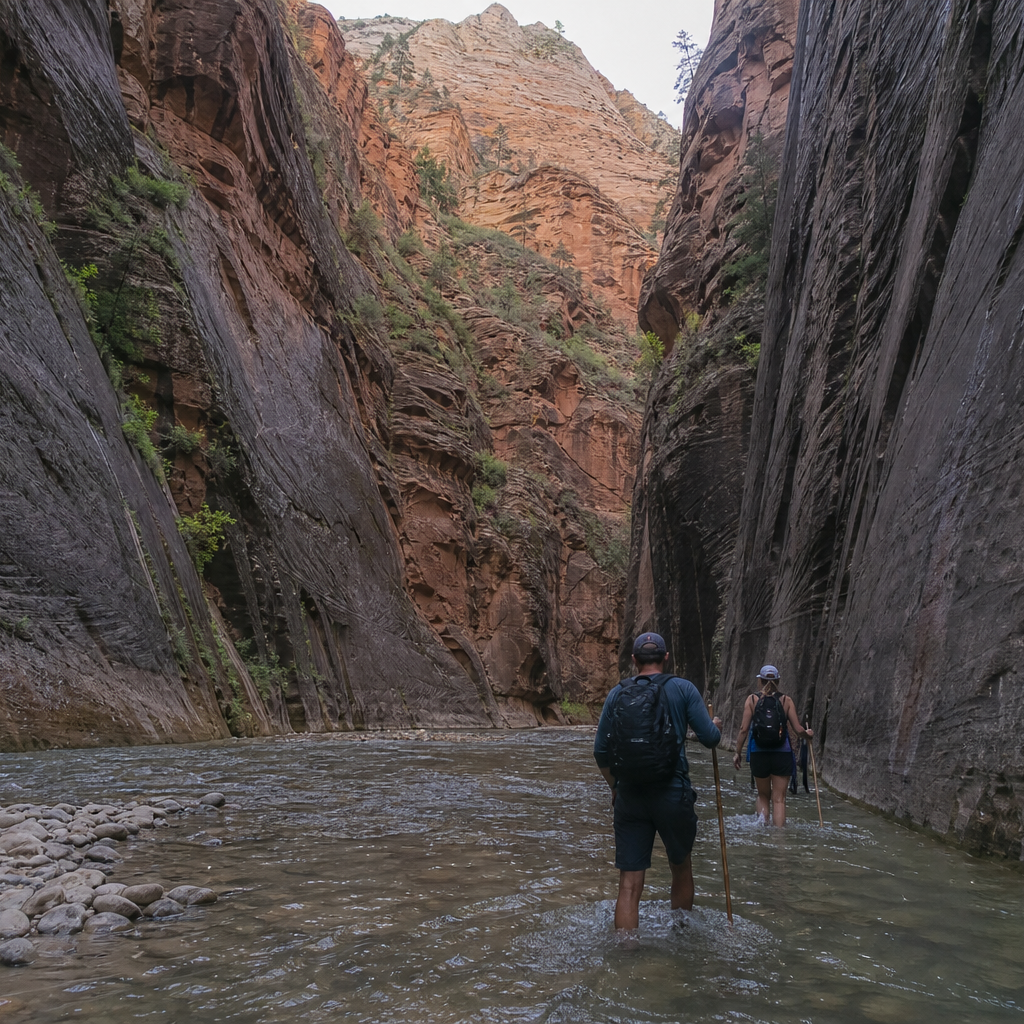
The Narrows in Zion National Park is one of the most unique and famous 'hikes' in the world because there is no trail—the Virgin River itself is the trail.
Duration
1 day
Route distance
16.0km
Vertical Gain
+150m
Max Altitude
1,400m
Mission Brief
The Narrows in Zion National Park is one of the most unique and famous 'hikes' in the world because there is no trail—the Virgin River itself is the trail.
Taking place inside a spectacular slot canyon where sweeping, striated Navajo sandstone walls rise perfectly vertically up to 1,000 feet (300m) above a river sometimes only 20 feet wide, hikers wade, walk, and occasionally swim upstream against the current. The classic 'Bottom-Up' route starts at the Temple of Sinawava, offering a choose-your-own-adventure experience where you can turn back whenever you wish. The visual drama of the deep, twisting canyon, illuminated by reflected golden light bouncing off the water and canyon walls, creates an otherworldly environment.
Wall Street. The 'X-Factor' is reaching the section known as 'Wall Street.' About two miles upstream, the canyon dramatically constricts. The river takes up the absolute full width of the canyon floor, the colossal red…
Mission Snapshot
Intensity Breakdown
Understanding what drives the overall route demand
Physical
34
Technical
22
Commitment
18
Primary driver: Physical load
- Standard Recreational Effort
Active effort required, but no significant risk. Suitable for recreational hikers.
Full Route Breakdown
Complete stage overview with transparent route metrics. Values are shown as recorded in the route dataset and source links.
Distance
16.0 km
Ascent
150 m
Highest point
1,400 m
Start
Riverside Walk
Finish
Big Spring and Return
Use the KM / MI toggle in the main menu to switch units.
Route Profile
Single-day stage structure
Route Considerations
This route is generally safe, but these are the main factors to be aware of.
Flash floods
This is a slot canyon. Rain falling miles away can send a serious wall of muddy water and debris surging through the Narrows with zero warning.
Impact
Route-specific
Likelihood
Context-dependent
Tip
ALWAYS check the localized flash flood potential at the Visitor Center before entering. Never enter if rain is forecast.
Hypothermia
Even in summer heat, the water and the total lack of direct sun in the canyon can lead to rapid chilling.
Impact
Route-specific
Likelihood
Context-dependent
Tip
Rent a dry-bib or wet-suit package from local outfitters in spring/fall; wear high-quality neoprene socks; move constantly.
Cyanobacteria
The Virgin River frequently experiences toxic cyanobacteria (blue-green algae) blooms.
Impact
Route-specific
Likelihood
Context-dependent
Tip
Do not submerge your head. Do not allow children to play in the water or swallow it. Filtered water remains toxic; carry all your own drinking water.
Why hike this route?
LANDSCAPE
The stunning 'Wall Street' section where the vertical walls seem to almost touch.
VARIETY
The total immersion of being in the water rather than just walking next to it.
CULTURE & PLACE
It's a highly social hike; everyone slips and falls in the river, creating a fun, communal atmosphere.
STANDOUT
Wall Street. The 'X-Factor' is reaching the section known as 'Wall Street.' About two miles upstream, the canyon dramatically constricts. The river takes up the absolute full width of the canyon floor, the colossal red walls close in, blocking out the sky, and you are wading che…
Expert Verdict
“The Narrows is a completely paradigm-shifting hike. Unlike climbing a mountain, the grandeur of the Narrows is oppressive and claustrophobic; you are hiking deep into the earth, dwarfed by sheer cliffs that block out the sun. Renting proper river-hiking gear from a Springdale outfitter transforms it from a miserable slog into a joyful adventure. Check the flash-flood board every morning — this is non-negotiable in a slot canyon.”
Who This Is For
- INTERMEDIATE — No navigation skills needed. However, wading waist-deep in a fast-flowing river over slippery unseen rocks requires excellent core balance and strong ankles.
- PHYSICAL — High. Hiking in water is twice as exhausting as hiking on dry land.
- WATCH FOR — Attempting it in old sneakers and cotton socks. Your feet will blister within an hour, and your toes will freeze. Rent the neoprene gear.
- WATCH FOR — Ignoring the flash flood warning board at the Visitor Center.
Plan This Hike
Key things to arrange before starting this route—practical tips first, then buttons that open curated picks (gear, maps, stays) where we list them.
Flash Flood Check
Practical next step for this hike:
Slot canyon — rain miles away can flood the Narrows.
- Check Visitor Center flash flood board before entering
- Do not enter if rain is forecast upstream
- Turn back immediately if water rises or muddies
River Gear
Recommended preparation for this route:
Rent neoprene socks and sturdy poles in Springdale.
- Neoprene socks + river shoes beat old sneakers
- Wooden walking stick improves balance on slick rocks
- Dry bag for phone and layers in deep sections
Water Carry
Practical next step for this hike:
No potable water — toxic cyanobacteria in river.
- Carry 3–4 L per person for summer bottom-up
- Do not filter Virgin River water
- Canyon shade is limited — hydrate before Wall Street
Bottom-Up Route
Practical next step for this hike:
Classic Temple of Sinawava start — no permit needed.
- Turn around anytime — customize distance
- Wall Street section ~2 miles upstream
- Shuttle to Temple of Sinawava in peak season
Compare This Route
See how this route compares to similar hikes in overall demand and terrain profile.Compare routes by the shape of the effort, not only the headline score.
Monastery Trail & Treasury Views
Closest overall match in demand profile
Beyond the Siq. While most visitors to Petra stick to the flat main valley,...
Intensity
Higher intensityCirque de Gavarnie
Lower overall intensity, similar terrain type
The Cirque de Gavarnie is a monumental glacial amphitheater located in the ...
Intensity
Lower intensitySulphur Skyline
Higher physical or technical demand
The hike to the summit of Sulphur Skyline is a pure test of steady cardiova...
Intensity
Higher intensityExplore Alternatives
Broaden the picture with easier, harder, and nearby options.
Looking for something easier?
Lower intensity — helpful if this route feels like a stretch right now.
Want more challenge?
Higher intensity — for when you are ready for a bigger physical or technical step.
More hikes in this region
Nearby and regionally relevant routes for the next step in your search.
McAfee Knob
Virginia (Appalachian Trail) · usa
Distance
12.6 km
Ascent
520 m
Cascade Canyon Trail
Wyoming (Grand Teton National Park) · usa
Distance
14.5 km
Ascent
350 m
The Mist Trail
California (Yosemite National Park) · usa
Distance
11.0 km
Ascent
600 m
Moro Rock
California (Sequoia National Park) · usa
Distance
0.8 km
Ascent
90 m
Hurricane Hill
Washington (Olympic National Park) · usa
Distance
5.1 km
Ascent
213 m
Angels Landing
Utah (Zion National Park) · usa
Distance
8.7 km
Ascent
453 m
Compare with any route
Pick any hike worldwide and open a full side-by-side comparison.
What You Need to Know
Essential answers about the demands, risks, and logistics of this route.
Q.How hard is this hike really?
Q.Do I need technical gear?
Q.Is water available on the route?
Q.What is the main risk?
Ready to hike The Narrows?
A final decision point after reviewing the route, risks, logistics, and alternatives.
This route is a strong match if you're comfortable with the effort level implied by an Intensity Score around 30/100 (Moderate), sustained hiking where this route requires it, and the terrain and exposure described in this guide.
Build your itinerary, stages, and logistics.
Looking for something easier, more challenging, or a different terrain profile?
Compare routes by intensity, terrain, and region.
Data: official trail documentation and topographic sources · About