The John
Muir Trail
The finest mountain trek in America.
Duration
21 days
Route distance
340.0km
Vertical Gain
+14,000m
Max Altitude
4,421m
Mission Brief
The finest mountain trek in America.
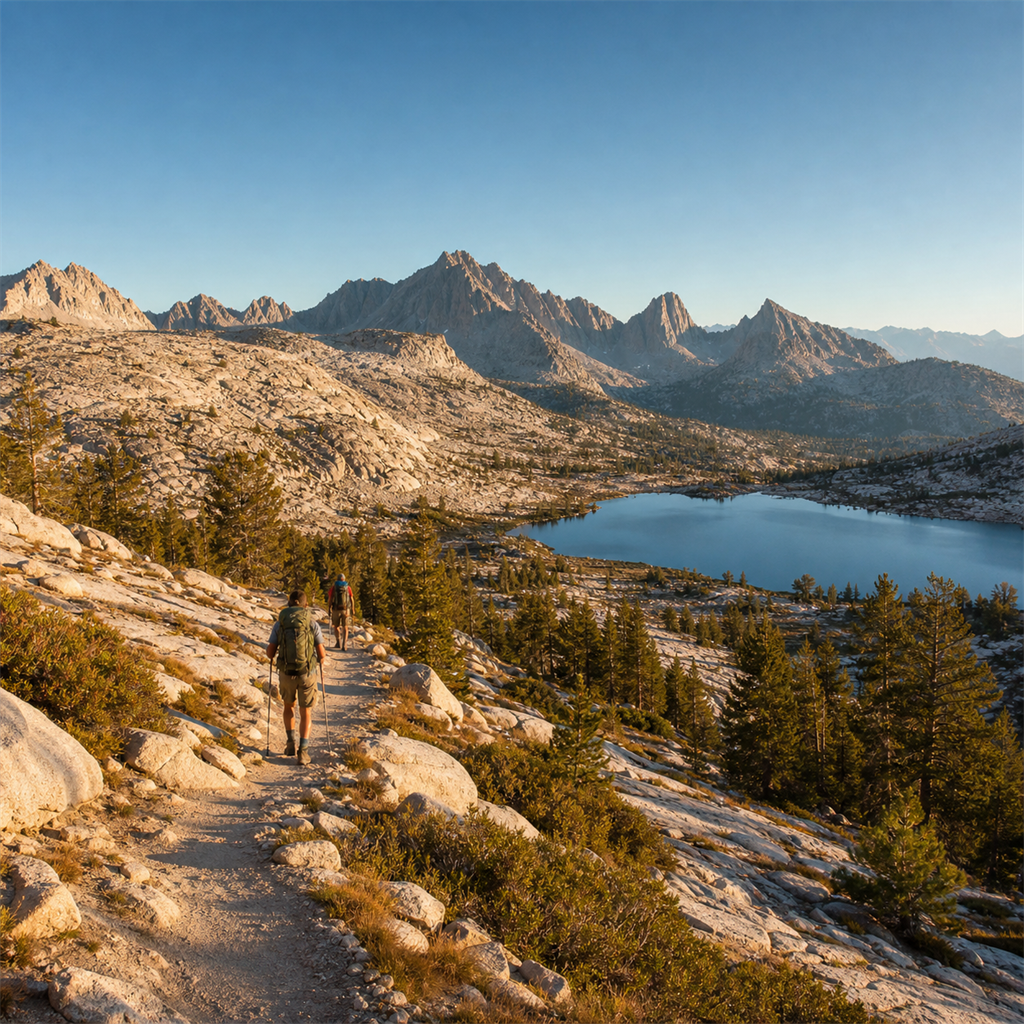
The John Muir Trail (JMT) passes through what Muir called the 'Range of Light'—the High Sierra of California. Over 340km, the trail traverses Yosemite, Ansel Adams Wilderness, Devils Postpile, and Kings Canyon, ending at the summit of Mount Whitney (4421m). It is a world of granite cathedrals, thousands of alpine lakes, and high mountain passes that stay snow-capped well into summer.
This is pure, high-altitude wilderness at its most spectacular.
The Solitude of the High Sierra. Long sections of the JMT are over two days' walk from the nearest road. Reaching Muir Pass (3644m) and its stone 'Muir Hut' in the middle of a vast granite basin feels like being on the…
Mission Snapshot
Intensity Breakdown
Understanding what drives the overall route demand
Physical
81
Technical
73
Commitment
100
Primary driver: Commitment
- Sustained Physical Output
- Significant Vertical Gain
- Technical Terrain Exposure
- High Remote Commitment
Major expeditions for elite teams. Sustained isolation and technical mastery required.
Full Route Breakdown
Complete stage overview with transparent route metrics. Values are shown as recorded in the route dataset and source links.
Distance
340.0 km
Ascent
14,000 m
Highest point
4,421 m
Start
Yosemite Valley
Finish
Kings Canyon to Whitney
Use the KM / MI toggle in the main menu to switch units.
Route Profile
Fixed backcountry campground structure for this route
Route Considerations
This route is generally safe, but these are the main factors to be aware of.
Altitude sickness
Much of the trail stays above 3,000 meters. Altitude sickness (AMS) is a real risk.
Impact
Route-specific
Likelihood
Context-dependent
Tip
Acclimatize for 2-3 days before starting; stay hydrated; if symptoms persist, descend immediately.
Bear encounters
The Sierra is home to persistent and intelligent Black Bears.
Impact
Route-specific
Likelihood
Context-dependent
Tip
Bear canisters are strongly advised and strictly enforced; never keep food in your tent.
Altitude Warning
Potential altitude-related conditions include AMS, HAPE, and HACE. Adequate acclimatization is essential.
Impact
Route-specific
Likelihood
Context-dependent
Tip
Strict adherence to hydration and gradual ascent protocols (climb high, sleep low).
Why hike this route?
LANDSCAPE
Granite cathedrals, thousands of alpine lakes, and the indigo skies of the High Sierra.
VARIETY
Transitions from the massive waterfalls of Yosemite to the high glacial basins of Kings Canyon.
CULTURE & PLACE
The 'thru-hiker' community and the shared goal of reaching the summit of the lower 48's highest peak (Whitney).
STANDOUT
The Solitude of the High Sierra. Long sections of the JMT are over two days' walk from the nearest road. Reaching Muir Pass (3644m) and its stone 'Muir Hut' in the middle of a vast granite basin feels like being on the moon. The clarity of the light and the reflection of the jag…
Expert Verdict
“The JMT is the 'Crown Jewel' of American trails. It follows the most scenic spine of the Sierra. A practical recommendation: Go SOBO (Southbound) to finish on Mt. Whitney—it's the cinematic ending the trail deserves. Get an inReach or satellite messenger; you will be days from the nearest road. The safer benchmark for The John Muir Trail is its own sheet: 340km (211 miles) through-hike, 8-10 walking hours, 14000 m gain.”
Who This Is For
- ADVANCED — Experienced thru-hikers who can manage 3 weeks of high-altitude wilderness. You should be proficient in UL (ultralight) backpacking and bear safety.
- PHYSICAL — Very High. 21 days of continuous movement with 46,000+ feet of cumulative gain. The elevation is constant, mostly above 3,000m.
- WATCH FOR — Starting with a pack that's too heavy; 3 weeks is a long time to carry excess weight.
- WATCH FOR — Underestimating the 'Mosquito Season' in July; they can be psychologically damaging without a headnet.
Plan This Hike
Key things to arrange before starting this route—practical tips first, then buttons that open curated picks (gear, maps, stays) where we list them.
Essential Gear
Recommended preparation for this route:
Long food carries and bear rules drive the kit list.
- Carry an approved bear canister and know the food-storage rules before entering Yosemite.
- Pack rain protection, sun protection and warm layers for high Sierra passes.
- Use a lightweight system that still handles 7-10 day food carries.
Stay Connected
Explore accommodation options for this trail:
The High Sierra has long no-service sections.
- Do not expect phone coverage between trailheads and resupply points.
- Carry offline maps and consider a satellite messenger for multi-day remote sections.
- Share resupply and exit plans before entering Yosemite or Inyo wilderness.
Getting There
Travel and trail access for this route:
The permit and shuttle puzzle needs early planning.
- Apply early for southbound Yosemite permits or plan a northbound Inyo alternative.
- Arrange transport between Yosemite Valley, Lone Pine and Whitney Portal.
- Keep weather and smoke flexibility for late-season starts.
Where to Stay
Explore accommodation options for this trail:
Wild camps and resupply stops define the rhythm.
- Plan legal backcountry camps around mileage, elevation and bear-storage rules.
- Coordinate resupply buckets for VVR, Muir Trail Ranch or alternative exit points.
- Book pre- and post-hike lodging around Yosemite Valley and Lone Pine transfers.
Compare This Route
See how this route compares to similar hikes in overall demand and terrain profile.Compare routes by the shape of the effort, not only the headline score.
Berliner Höhenweg — The Zillertal High-Route
Closest overall match in demand profile
The Berliner Höhenweg (also known as the Zillertaler Runde) is one of the m...
Intensity
Higher intensityYading Nature Reserve
Lower overall intensity, similar terrain type
The 'Big Kora' is an advanced outer circumambulation route rarely undertake...
Intensity
Lower intensityThe Snowman Trek
Higher physical or technical demand
The Snowman Trek is a high-altitude longitudinal traverse of the Bhutanese ...
Intensity
Higher intensityExplore Alternatives
Broaden the picture with easier, harder, and nearby options.
Looking for something easier?
Lower intensity — helpful if this route feels like a stretch right now.
Want more challenge?
Higher intensity — for when you are ready for a bigger physical or technical step.
More hikes in this region
Nearby and regionally relevant routes for the next step in your search.
Appalachian Trail
new-hampshire · usa
Distance
160.0 km
Ascent
20,000 m
The Wonderland Trail
Washington (Mount Rainier National Park) · usa
Distance
150.0 km
Ascent
6,700 m
The Kalalau Trail
Hawaii (Kauai - Nā Pali Coast) · usa
Distance
35.0 km
Ascent
1,500 m
Uncompahgre Peak
Colorado (San Juan Mountains) · usa
Distance
12.0 km
Ascent
890 m
Sky Rim Trail
Wyoming / Montana (Yellowstone National Park) · usa
Distance
33.0 km
Ascent
1,200 m
Half Dome
California (Yosemite National Park) · usa
Distance
26.0 km
Ascent
1,460 m
Compare with any route
Pick any hike worldwide and open a full side-by-side comparison.
What You Need to Know
Essential answers about the demands, risks, and logistics of this route.
Q.How hard is this hike really?
Q.Do I need technical gear?
Q.Is water available on the route?
Q.What is the main risk?
Ready to hike The John Muir Trail?
A final decision point after reviewing the route, risks, logistics, and alternatives.
This route is a strong match if you're comfortable with the effort level implied by an Intensity Score around 94/100 (Expedition), sustained hiking where this route requires it, and the terrain and exposure described in this guide.
Build your itinerary, stages, and logistics.
Looking for something easier, more challenging, or a different terrain profile?
Compare routes by intensity, terrain, and region.
Data: official trail documentation and topographic sources · About