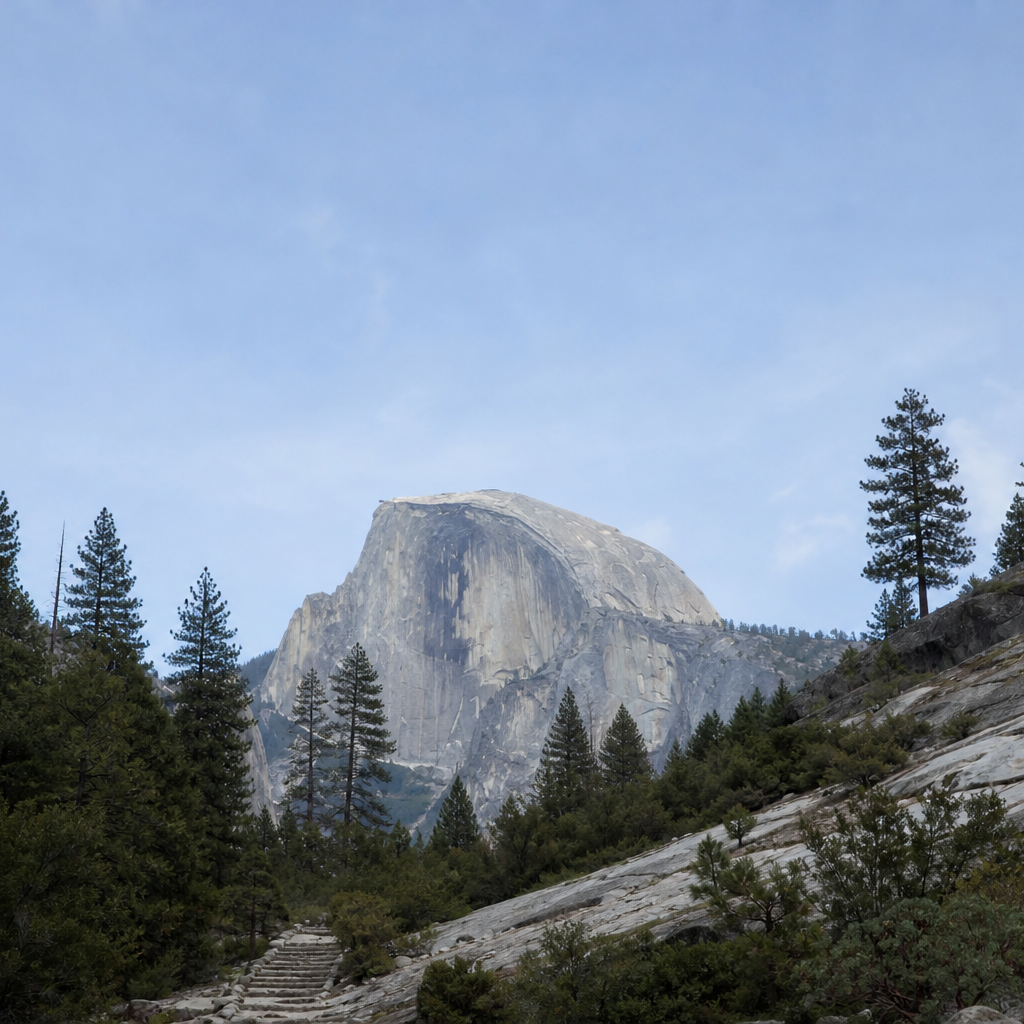
Half
Dome
Half Dome is the significant icon of Yosemite National Park and arguably the most famous and coveted day hike in North America.
Duration
1 day
Route distance
26.0km
Vertical Gain
+1,460m
Max Altitude
2,690m
Mission Brief
Half Dome is the significant icon of Yosemite National Park and arguably the most famous and coveted day hike in North America.
Looming almost 5,000 feet (1,500m) above Yosemite Valley, the massive granite dome challenges hikers with a grueling, massive elevation gain. The classic route ascends via the dramatic Mist Trail, passing two massive waterfalls, ascending through dense pine forests to Little Yosemite Valley, and finally climbing the stark, exposed rock of Sub Dome. The grand finale is the legendary 'Cables' section—two metal cables suspended by steel poles drilled into the sheer, 45-degree granite face.
Hikers should use their upper body strength to pull themselves up the final 400 feet of slick granite to a flat summary that offers scenic views of the entire Yosemite Valley and the High Sierra.
The Cables. The 'X-Factor' is the raw physical and psychological exertion of the final cable ascent. The granite is polished smooth by millions of boots. Hanging onto the steel cables, looking back over your shoulder do…
Mission Snapshot
Intensity Breakdown
Understanding what drives the overall route demand
Physical
53
Technical
75
Commitment
18
Primary driver: Technical seriousness
- Technical Terrain Exposure
Advanced multi-day effort: heavy fatigue, logistics, or movement friction—not necessarily alpine exposure.
Full Route Breakdown
Complete stage overview with transparent route metrics. Values are shown as recorded in the route dataset and source links.
Distance
26.0 km
Ascent
1,460 m
Highest point
2,690 m
Start
The Valley Floor to Nevada Fall
Finish
The Cables and Descent
Use the KM / MI toggle in the main menu to switch units.
Route Profile
Out-and-back day-hike structure
Route Considerations
This route is generally safe, but these are the main factors to be aware of.
Lightning strikes
Half Dome is a giant lightning rod. Several people have been killed by lightning while on the summit or the cables.
Impact
Route-specific
Likelihood
Context-dependent
Tip
NEVER attempt the ascent if thunderstorm clouds are visible.
Serious falls on cables
The granite is slick. If you fall outside the cables, there is nothing to stop you.
Impact
Route-specific
Likelihood
Context-dependent
Tip
Wear grippy gloves. Do not ascend if it is raining. Many climbers legally (but cautiously) use a climbing harness and via ferrata lanyard to clip into the cables.
Terrain & conditions
Conditions change quickly on the ground. Slow down on wet rock and pay more attention where paths narrow or exposure increases.
Impact
Moderate
Likelihood
Variable
Tip
Refer to stage notes and expert briefings; maintain focus on slick or exposed sections.
Why hike this route?
LANDSCAPE
The scenic view looking straight down 4,000 feet into Yosemite Valley from the precipice.
VARIETY
Waterfalls, massive pine forests, and stark, highly exposed alpine granite.
CULTURE & PLACE
The sheer prestige; returning to the valley floor and pointing up at the impossibly high rock and knowing you stood on top.
STANDOUT
The Cables. The 'X-Factor' is the raw physical and psychological exertion of the final cable ascent. The granite is polished smooth by millions of boots. Hanging onto the steel cables, looking back over your shoulder down a demandingly steep slide straight into the valley, is a…
Expert Verdict
“Half Dome is the significant test piece for the American day-hiker. It is painful, crowded, and heavily regulated, but the reward is undeniable. Breaking through the tree line onto Sub Dome and seeing the smooth curve of the monolith rising against the sky is awe-inspiring. Hauling yourself up the cables—muscles burning, feet slipping, staring out at the vast glaciated high country of the Sierra Nevada—is one of the most intense, rewarding experiences you can have in a National Park without needing technical climbing equipment. It is a true endurance marathon. For Half Dome, the decisive load is 26-28km, via Mist Trail/John Muir Trail) across 10-14 hours on foot, with roughly 1460 m of climbing.”
Who This Is For
- ADVANCED — Tremendous cardiovascular fitness. The cables require upper body strength and an absolute lack of vertigo.
- PHYSICAL — Extreme. A 16-mile day with 4,800 feet of gain leaves average hikers physically destroyed for days afterward.
- WATCH FOR — Bringing cheap gardening gloves. The cables will shred them. Use leather work gloves or rubber-dipped grip gloves.
- WATCH FOR — Descending face-down. The easiest, safest way to go down the cables is backwards (like rappelling), facing the rock, allowing you to use your body weight.
Plan This Hike
Key things to arrange before starting this route—practical tips first, then buttons that open curated picks (gear, maps, stays) where we list them.
Permit Lottery
Practical next step for this hike:
Recreation.gov permit is mandatory for the cables section.
- Preseason lottery in March (~20% success rate)
- Daily lottery two days ahead during cable season
- Rangers check permits at Sub Dome — no exceptions
Essential Gear
Recommended preparation for this route:
Cables day needs grip, water, and storm awareness.
- Rubberized or leather work gloves for the steel cables
- 4–5 L water capacity — no sources past Little Yosemite Valley
- Headlamp for 4:30 a.m. Happy Isles starts
Cable Season
Practical next step for this hike:
Cables are hoisted late May–October only.
- Memorial Day to Columbus Day typical window — snowpack varies
- Wet granite on cables is extremely dangerous
- Descend cables backwards facing the rock
Getting There
Travel and trail access for this route:
Happy Isles trailhead via valley shuttle or walk.
- Trailhead at Happy Isles (Shuttle Stop #16)
- Park at Yosemite Valley Trailhead Parking near Curry Village
- Book valley lodging months ahead for dawn starts
Compare This Route
See how this route compares to similar hikes in overall demand and terrain profile.Compare routes by the shape of the effort, not only the headline score.
The Highline Trail
Closest overall match in demand profile
The Highline Trail is the signature, marquee hike of Glacier National Park....
Intensity
Lower intensityLost City Trek
Lower overall intensity, similar terrain type
Route Typology: Guided Jungle Expedition. The Lost City Trek leads to 'Teyu...
Intensity
Lower intensityTrolltunga
Higher physical or technical demand
The Troll's Tongue. Trolltunga is one of Norway's most spectacular scenic c...
Intensity
Higher intensityExplore Alternatives
Broaden the picture with easier, harder, and nearby options.
Looking for something easier?
Lower intensity — helpful if this route feels like a stretch right now.
Want more challenge?
Higher intensity — for when you are ready for a bigger physical or technical step.
More hikes in this region
Nearby and regionally relevant routes for the next step in your search.
Sky Rim Trail
Wyoming / Montana (Yellowstone National Park) · usa
Distance
33.0 km
Ascent
1,200 m
Cirque of the Towers
Wyoming (Wind River Range) · usa
Distance
29.0 km
Ascent
700 m
The Wonderland Trail
Washington (Mount Rainier National Park) · usa
Distance
150.0 km
Ascent
6,700 m
Uncompahgre Peak
Colorado (San Juan Mountains) · usa
Distance
12.0 km
Ascent
890 m
Grand Canyon Rim-to-Rim
arizona · usa
Distance
38.0 km
Ascent
1,400 m
Appalachian Trail
new-hampshire · usa
Distance
160.0 km
Ascent
20,000 m
Compare with any route
Pick any hike worldwide and open a full side-by-side comparison.
What You Need to Know
Essential answers about the demands, risks, and logistics of this route.
Q.How hard is this hike really?
Q.Do I need technical gear?
Q.Is water available on the route?
Q.What is the main risk?
Ready to hike Half Dome?
A final decision point after reviewing the route, risks, logistics, and alternatives.
This route is a strong match if you're comfortable with the effort level implied by an Intensity Score around 74/100 (Very Hard), sustained hiking where this route requires it, and the terrain and exposure described in this guide.
Build your itinerary, stages, and logistics.
Looking for something easier, more challenging, or a different terrain profile?
Compare routes by intensity, terrain, and region.
Data: official trail documentation and topographic sources · About