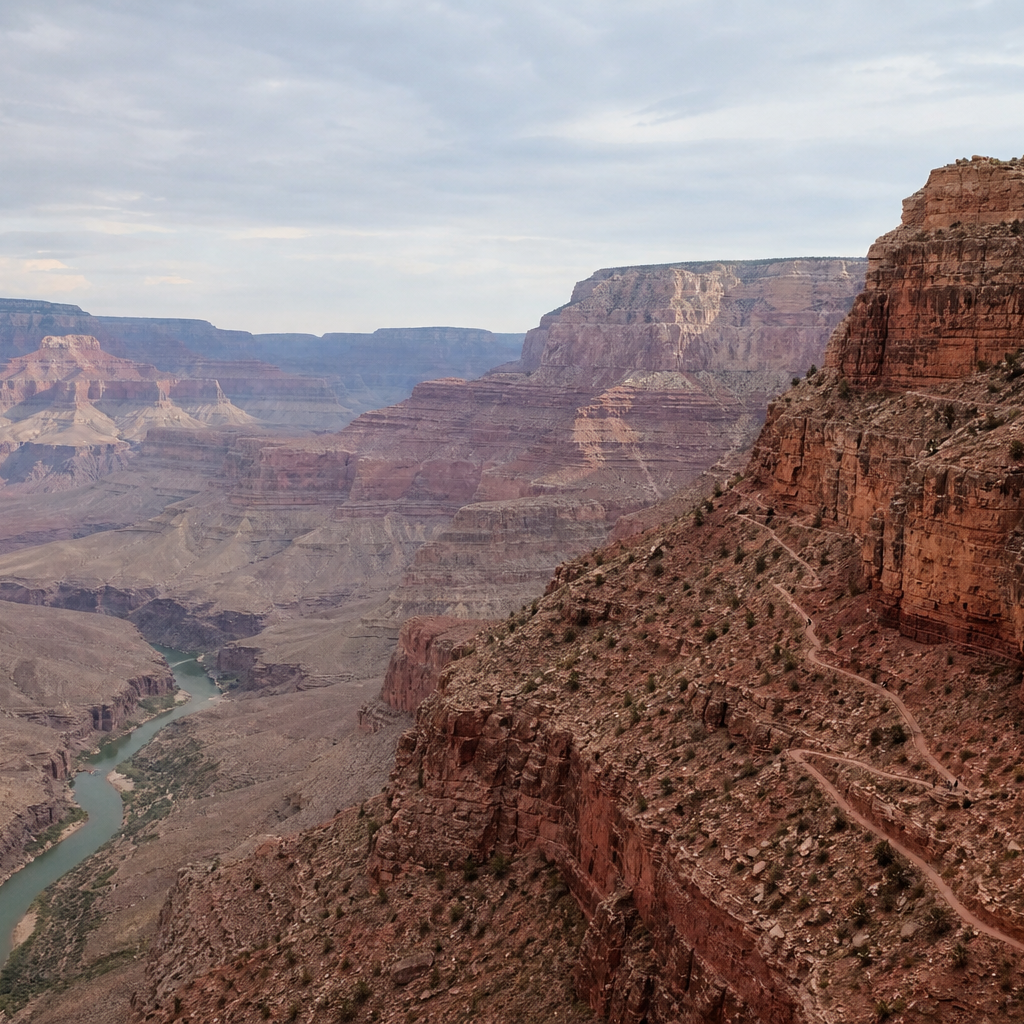
Grand Canyon
Rim-to-Rim
Overview: The Grand Canyon Rim-to-Rim (R2R) is a primary endurance route crossing the Grand Canyon from the North Rim to the South Rim, Arizona.
Duration
1 day
Route distance
38.0km
Vertical Gain
+1,400m
Max Altitude
2,438m
Mission Brief
Overview: The Grand Canyon Rim-to-Rim (R2R) is a primary endurance route crossing the Grand Canyon from the North Rim to the South Rim, Arizona.
Geological Context: The path descends through two billion years of history, from the Kaibab Limestone down to the Vishnu Schist at the Colorado River. Booking & Logistics Reality: Overnight stays require mandated backcountry permits or lottery-won lodging at Phantom Ranch. The trail is characterized by an 'inverted' profile and extreme thermal gradients.
Stage Breakdown: The route typically utilizes the North Kaibab Trail for the descent and either the Bright Angel or South Kaibab Trail for the final ascent.
The Canyon Thermal Inversion. A defining feature of this route is the reversal of standard mountain climate patterns. Hikers transition from high-altitude ponderosa forest on the rims into the extreme heat of the inner…
Mission Snapshot
Intensity Breakdown
Understanding what drives the overall route demand
Physical
60
Technical
40
Commitment
50
Primary driver: Physical load
- Standard Recreational Effort
Serious physical effort or sustained terrain friction. Demanding but not expedition-scale.
Full Route Breakdown
Complete stage overview with transparent route metrics. Values are shown as recorded in the route dataset and source links.
Distance
38.0 km
Ascent
1,400 m
Highest point
2,438 m
Start
North Rim to Cottonwood
Finish
The South Ascent
Use the KM / MI toggle in the main menu to switch units.
Route Profile
Single-day stage structure
Route Considerations
This route is generally safe, but these are the main factors to be aware of.
Heat exhaustion
Temperature in the inner canyon (The Box) can reach 45°C. Heat stroke is the primary cause of rescue.
Impact
Route-specific
Likelihood
Context-dependent
Tip
Avoid hiking between 10 AM and 4 PM; wet your clothes at every water station; carry electrolytes; know your limits.
Physical collapse
The descent is hard on the knees, but the climb out often causes total muscle failure for the unprepared.
Impact
Route-specific
Likelihood
Context-dependent
Tip
Do NOT attempt Rim-to-Rim in a single day unless you are an elite endurance athlete; stay overnight at Phantom Ranch or Bright Angel Campground.
Terrain & conditions
Conditions change quickly on the ground. Slow down on wet rock and pay more attention where paths narrow or exposure increases.
Impact
Moderate
Likelihood
Variable
Tip
Refer to stage notes and expert briefings; maintain focus on slick or exposed sections.
Why hike this route?
LANDSCAPE
scenic exposure to billions of years of geological history.
VARIETY
The total shift in ecosystem from sub-alpine forests at the rim to cacti at the bottom.
CULTURE & PLACE
The shared suffering and success with fellow 'R2R' hikers creates an instant bond.
STANDOUT
The Canyon Thermal Inversion. A defining feature of this route is the reversal of standard mountain climate patterns. Hikers transition from high-altitude ponderosa forest on the rims into the extreme heat of the inner canyon gorge. Expedition accounts frequently cite the 'Box'…
Expert Verdict
“Technical Profile: Documented Class 1 movement on maintained National Park trails. Stage Breakdown: Continuous descent from the North Rim to the Colorado River followed by a sustained ascent to the South Rim. Hazard Assessment: The primary risks are heat exhaustion and the inverted elevation profile. Start the South Rim climb before dawn; most rescues involve hikers still in The Box after 10 a.m. Manage electrolytes — hyponatremia from water-only hydration is common on R2R day hikes.”
Who This Is For
- ADVANCED — For extremely fit hikers who want an significant single-day or multi-day challenge. Mental toughness for heat and verticality is more important than technical skill.
- PHYSICAL — Extreme. Descending 1,500m is punishing on the knees, but climbing 1,500m in the high desert heat back out is the real test.
- WATCH FOR — Attempting to hike back out during the heat of the day (10am - 4pm).
- WATCH FOR — Over-hydrating without replacing electrolytes (leads to hyponatremia).
Plan This Hike
Key things to arrange before starting this route—practical tips first, then buttons that open curated picks (gear, maps, stays) where we list them.
Shuttle Logistics
Explore accommodation options for this trail:
Point-to-point — Trans-Canyon Shuttle between rims.
- North Rim to South Rim is ~4.5 hours by road
- Book Trans-Canyon Shuttle before your hike dates
- May and October are the standard R2R windows
Heat Management
Practical next step for this hike:
Inner canyon can exceed 40°C in The Box.
- Avoid hiking 10 a.m.–4 p.m. in the gorge
- Wet clothing at every water station
- Electrolytes + salty snacks — not water alone
Phantom Ranch
Practical next step for this hike:
Overnight at river level splits the climb.
- Phantom Ranch lottery ~15 months ahead
- Bright Angel Campground needs backcountry permit
- One-day R2R is strongly discouraged by NPS
Trail Choice
Practical next step for this hike:
North Kaibab down; Bright Angel or South Kaibab up.
- North Kaibab: steeper descent, The Box heat trap
- Bright Angel: water stations + Indian Garden shade
- Check seasonal water station status before start
Compare This Route
See how this route compares to similar hikes in overall demand and terrain profile.Compare routes by the shape of the effort, not only the headline score.
Grinnell Glacier Trail
Closest overall match in demand profile
Overview: The Grinnell Glacier Trail is a primary destination route in the ...
Intensity
Lower intensitySeefelder Spitze — The Karwendel Crown
Lower overall intensity, similar terrain type
Rising sharply from the Seefeld plateau, the Seefelder Spitze (2,221m) is a...
Intensity
Lower intensityCerro Chirripó
Higher physical or technical demand
Route Typology: High-Altitude Páramo Ascent. Cerro Chirripó is Costa Rica's...
Intensity
Higher intensityExplore Alternatives
Broaden the picture with easier, harder, and nearby options.
Looking for something easier?
Lower intensity — helpful if this route feels like a stretch right now.
Want more challenge?
Higher intensity — for when you are ready for a bigger physical or technical step.
More hikes in this region
Nearby and regionally relevant routes for the next step in your search.
The Highline Trail
Montana (Glacier National Park) · usa
Distance
18.6 km
Ascent
580 m
Alum Cave Trail to Mount LeConte
Tennessee (Great Smoky Mountains) · usa
Distance
16.1 km
Ascent
850 m
South Kaibab Trail
Arizona (Grand Canyon National Park) · usa
Distance
22.6 km
Ascent
1,450 m
Cirque of the Towers
Wyoming (Wind River Range) · usa
Distance
29.0 km
Ascent
700 m
Bright Angel Trail
Arizona (Grand Canyon National Park) · usa
Distance
30.6 km
Ascent
1,340 m
Coyote Gulch
Utah (Grand Staircase-Escalante) · usa
Distance
24.0 km
Ascent
300 m
Compare with any route
Pick any hike worldwide and open a full side-by-side comparison.
What You Need to Know
Essential answers about the demands, risks, and logistics of this route.
Q.How hard is this hike really?
Q.Do I need technical gear?
Q.Is water available on the route?
Q.What is the main risk?
Ready to hike Grand Canyon Rim-to-Rim?
A final decision point after reviewing the route, risks, logistics, and alternatives.
This route is a strong match if you're comfortable with the effort level implied by an Intensity Score around 61/100 (Hard), sustained hiking where this route requires it, and the terrain and exposure described in this guide.
Build your itinerary, stages, and logistics.
Looking for something easier, more challenging, or a different terrain profile?
Compare routes by intensity, terrain, and region.
Data: official trail documentation and topographic sources · About