Cirque of
the Towers
29 km round-trip from Big Sandy via Jackass Pass — typically a three-day backpack, not a day hike.
Duration
3 days
Route distance
29.0km
Vertical Gain
+700m
Max Altitude
3,290m
Mission Brief
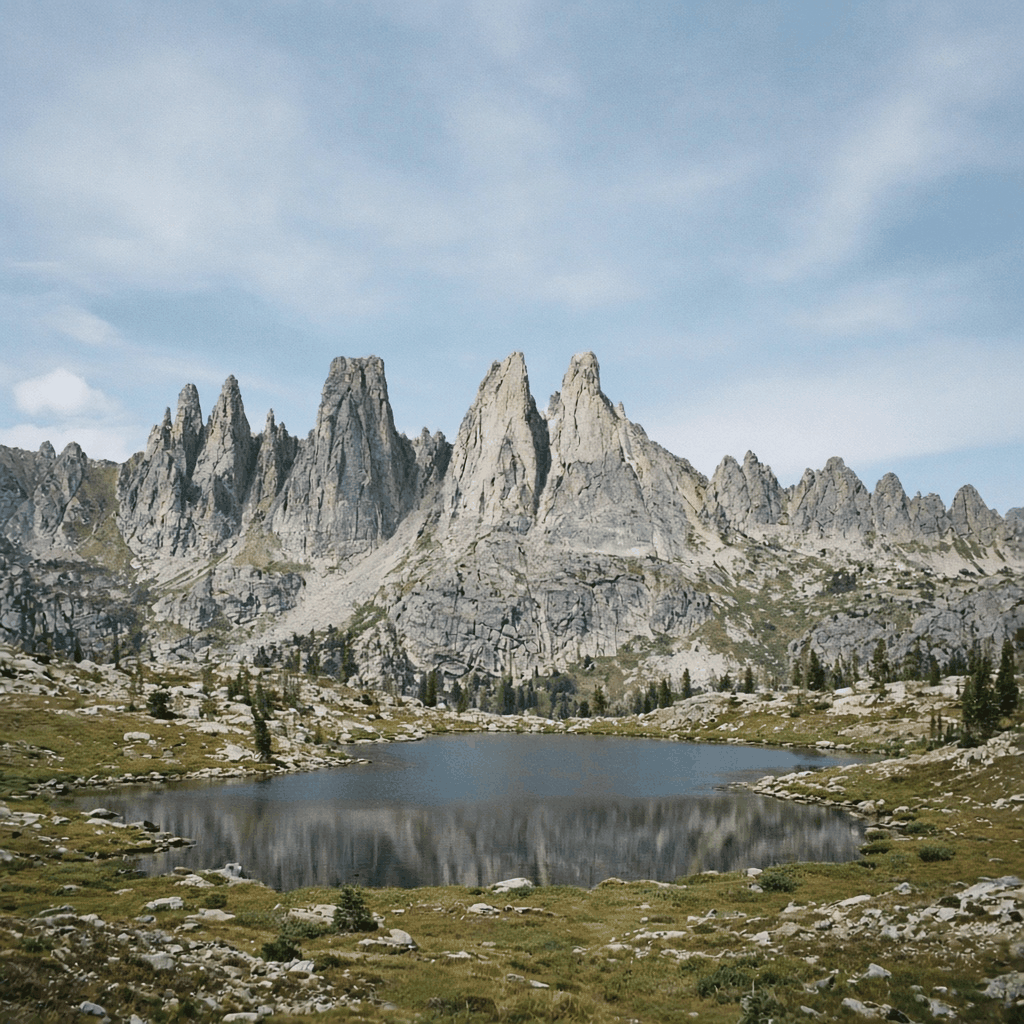
The Cirque of the Towers, located deep within the remote Wind River Range of Wyoming, is arguably the most spectacular alpine amphitheater in the entire Rocky Mountains.
Reaching the Cirque requires a grueling backpacking approach, but the payoff is legendary: a massive, semi-circular basin of jagged, sheer granite spires (including Pingora, Wolf's Head, and the Shark's Nose) rising vertically out of high-alpine meadows dotted with pristine, trout-filled glacial lakes like Lonesome Lake. It is a legendary destination for spectacular technical rock climbers and serious backpackers seeking the raw, roadless, untamed wilderness that the 'Winds' are famous for.
The Wind Rivers' granite amphitheater: Pingora, Wolf's Head, and Lonesome Lake, a dirt-road approach away from Teton highways.
Mission Snapshot
Intensity Breakdown
Understanding what drives the overall route demand
Physical
58
Technical
35
Commitment
72
Primary driver: Remote Wind River backpack over Jackass Pass, not a thru-hike expedition
- Remote 3-day alpine approach (R3) with no cell coverage
- Jackass Pass boulder fields at 3,290 m with a full backpack
- Daily thunderstorms and a short snow-free window
- About 29 miles of unpaved road after WY-353 becomes Big Sandy-Elkhorn Road
Serious physical effort or sustained terrain friction. Demanding but not expedition-scale.
Full Route Breakdown
Complete stage overview with transparent route metrics. Values are shown as recorded in the route dataset and source links.
Distance
29.0 km
Ascent
700 m
Highest point
3,290 m
Start
Big Sandy Trailhead, Bridger-Teton National Forest
Finish
Big Sandy Trailhead (out-and-back via Jackass Pass)
Use the KM / MI toggle in the main menu to switch units.
Route Profile
Operational Reality
Round-trip from Big Sandy Trailhead via Jackass Pass. Headline 29 km follows 18.0 miles RT. Stage distances: 8 km to Big Sandy Lake, 6.5 km over the pass to the Cirque, 14.5 km return. Elevations 2,770–3,290 m and 700 m pass-focused gain. Texas Pass (~40 km) is a variant. Sources: USFS Bridger-Teton and CleverHiker.
Route Considerations
This route is generally safe, but these are the main factors to be aware of.
Extreme mosquitoes
The Wind River Range is notorious for producing some of the thickest, most aggressive mosquito swarms in North America from late June through early August.
Impact
Route-specific
Likelihood
Context-dependent
Tip
Bring massive amounts of DEET, a head-net, and treat clothing with Permethrin. Avoid camping directly near marshy meadows.
Sustained alpine weather
The Cirque creates its own microclimate. sustained afternoon thunderstorms bringing lightning and hail are a daily occurrence in July.
Impact
Route-specific
Likelihood
Context-dependent
Tip
Be off high passes (like Jackass Pass or Texas Pass) before noon. Set up a bombproof tent shelter.
Terrain & conditions
Conditions change quickly on the ground. Slow down on wet rock and pay more attention where paths narrow or exposure increases.
Impact
Moderate
Likelihood
Variable
Tip
Refer to stage notes and expert briefings; maintain focus on slick or exposed sections.
Why hike this route?
LANDSCAPE
The aggressive, shark-tooth profile of the granite peaks completely surrounding the valley.
VARIETY
The journey from soft, meandering pine forests to stark, strenuous, high-alpine rock and ice.
CULTURE & PLACE
The deep satisfaction of self-reliant wilderness travel far away from any pavement or crowds.
WHY GO
The Wind Rivers' granite amphitheater: Pingora, Wolf's Head, and Lonesome Lake, a dirt-road approach away from Teton highways.
Expert Verdict
“The Cirque of the Towers is the crown jewel of Wyoming backcountry. The Wind River Range demands that you earn your views through miles of dirt road driving and heavy-pack hauling. The sheer density and verticality of the granite spires enclosing Lonesome Lake creates one of the most awe-inspiring, primeval alpine environments in the world. It is the significant rite of passage for serious American backpackers, requiring true wilderness self-reliance. Use the route sheet for Cirque of the Towers: 29 km round-trip via Jackass Pass (18.0 miles) over a 12-16-hour walking window, plus 700 m of pass-focused gain. The Texas Pass loop (~40 km) is a variant, not the headline.”
Who This Is For
- ADVANCED — Extensive multi-day backcountry skills. Route finding is sometimes necessary over snow fields and boulder hopping. Bear safety protocols are critical.
- PHYSICAL — High. Navigating Jackass Pass with a 35-pound multi-day backpack at 10,800 feet of altitude is incredibly exhausting.
- WATCH FOR — Attempting it as a day hike. While fit trail-runners do the 18-mile round trip, hiking it in a single day deprives you of the magical sunset light hitting the granite spires.
- WATCH FOR — Ignoring the 1/4 mile camping restriction around Lonesome Lake. Rangers patrol the Cirque and will issue massive fines to protect the fragile meadow.
Plan This Hike
Key things to arrange before starting this route—practical tips first, then buttons that open curated picks (gear, maps, stays) where we list them.
Essential Gear
Recommended preparation for this route:
Approved bear-resistant food storage, a head-net, and a tent that can take Wind River wind.
- Bear-resistant storage — IGBC container, IGBC bag, or a proper hang; canisters are not the only legal method
- DEET and a head-net through early August
- Water filter; lakes and streams are everywhere
Stay Connected
Explore accommodation options for this trail:
No cell for about 50 miles. Carry a satellite messenger.
- InReach or Zoleo is the realistic emergency link
- Helicopter rescue can take 24 hours or more
- Register at the trailhead even though the permit is free
Getting There
Travel and trail access for this route:
Big Sandy is about two hours from Pinedale on corrugated dirt.
- High-clearance recommended; sedans pop tires
- Snow typically blocks Jackass Pass until mid-July
- Be off the pass before noon thunderstorms
Where to Stay
Explore accommodation options for this trail:
Wilderness camping only — no huts, no campground.
- Stay at least 1/4 mile from Lonesome Lake
- Use durable rock or sand benches, not meadow turf
- Pinedale motels are the last pavement before the dirt road
Compare This Route
See how this route compares to similar hikes in overall demand and terrain profile.Compare routes by the shape of the effort, not only the headline score.
Overland Track
Closest overall match in demand profile
The Overland Track is a 65km point-to-point alpine traverse through the hea...
Intensity
Slightly higher intensityFouta Djallon Highlands
Lower overall intensity, similar terrain type
Geological heart of West Africa. The Fouta Djallon is a vast sandstone plat...
Intensity
Lower intensityLost City Trek
Higher physical or technical demand
Route Typology: Guided Jungle Expedition. The Lost City Trek leads to 'Teyu...
Intensity
Higher intensityExplore Alternatives
Broaden the picture with easier, harder, and nearby options.
Looking for something easier?
Lower intensity — helpful if this route feels like a stretch right now.
Want more challenge?
Higher intensity — for when you are ready for a bigger physical or technical step.
More hikes in this region
Nearby and regionally relevant routes for the next step in your search.
South Kaibab Trail
Arizona (Grand Canyon National Park) · usa
Distance
22.6 km
Ascent
1,450 m
The Highline Trail
Montana (Glacier National Park) · usa
Distance
18.6 km
Ascent
580 m
Grand Canyon Rim-to-Rim
arizona · usa
Distance
38.0 km
Ascent
1,400 m
Grinnell Glacier Trail
Montana (Glacier National Park) · usa
Distance
17.1 km
Ascent
560 m
Half Dome
California (Yosemite National Park) · usa
Distance
26.0 km
Ascent
1,460 m
Sky Rim Trail
Wyoming / Montana (Yellowstone National Park) · usa
Distance
33.0 km
Ascent
1,200 m
Compare with any route
Pick any hike worldwide and open a full side-by-side comparison.
What You Need to Know
Essential answers about the demands, risks, and logistics of this route.
Q.How hard is this hike really?
Q.Do I need technical gear?
Q.Is water available on the route?
Q.What is the main risk?
Ready to hike Cirque of the Towers?
A final decision point after reviewing the route, risks, logistics, and alternatives.
This route is a strong match if you're comfortable with the effort level implied by an Intensity Score around 64/100 (Hard), sustained hiking where this route requires it, and the terrain and exposure described in this guide.
Build your itinerary, stages, and logistics.
Looking for something easier, more challenging, or a different terrain profile?
Compare routes by intensity, terrain, and region.
Data: official trail documentation and topographic sources · About