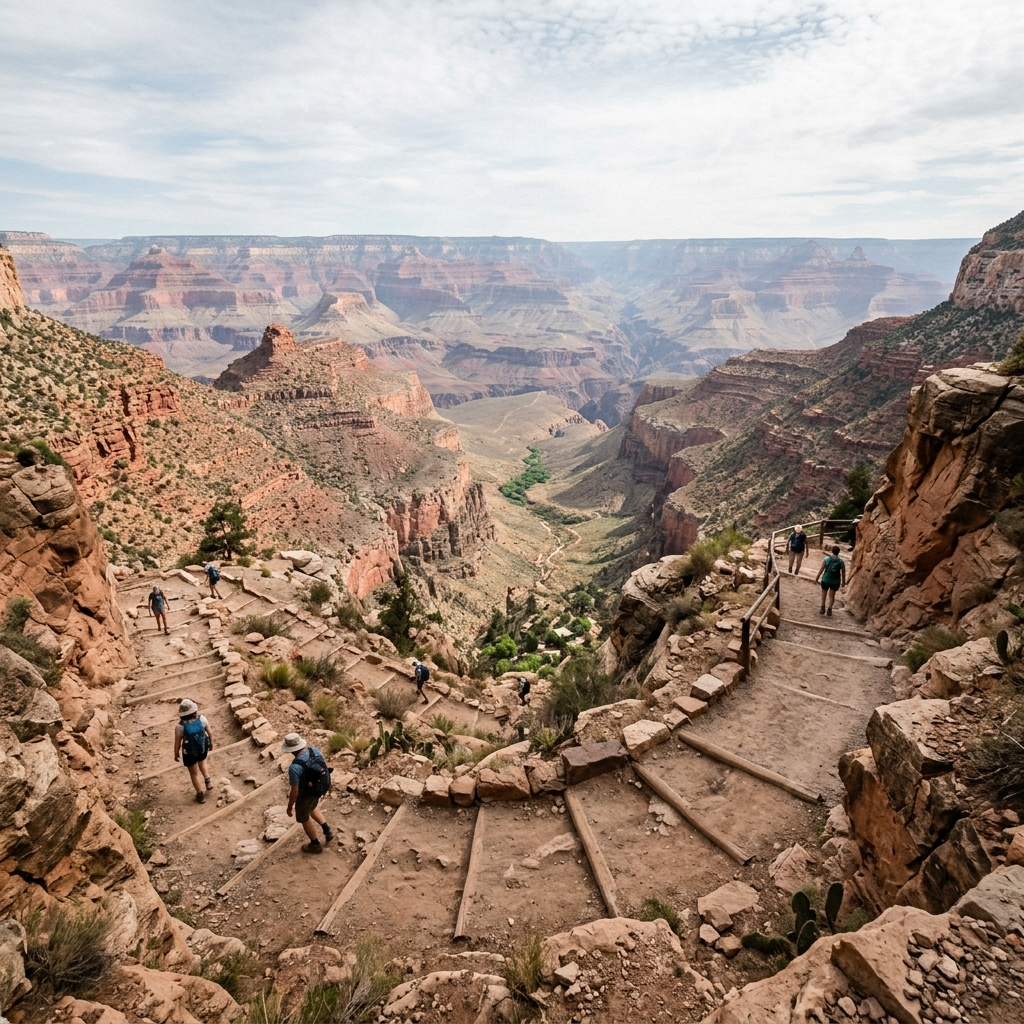
Bright Angel
Trail
~30.6 km round-trip from South Rim to Phantom Ranch; usually completed in 2 days.
Duration
2 days
Route distance
30.6km
Vertical Gain
+1,340m
Max Altitude
2,090m
Mission Brief
Overview: The Bright Angel Trail is a primary historical corridor into the Grand Canyon, Arizona.
Geological Context: The path descends approximately 1,340 meters (4,400 feet) through multiple geological strata, navigating from the Kaibab Limestone at the rim down to the Proterozoic Vishnu Schist at the Colorado River. Booking & Logistics Reality: Overnight stays below the rim require mandated backcountry permits. The trail is characterized by an 'inverted' profile, meaning the most strenuous physical load occurs during the final ascent, often under extreme thermal conditions.
Key features include the 1.5-mile and 3-mile resthouses and the Havasupai Gardens oasis.
The classic, historically significant corridor into the Grand Canyon—a well-maintained dirt path descending 1.3 km into Earth's history.
Mission Snapshot
Intensity Breakdown
Understanding what drives the overall route demand
Physical
56
Technical
30
Commitment
18
Primary driver: Physical load
- Standard Recreational Effort
Serious physical effort or sustained terrain friction. Demanding but not expedition-scale.
Full Route Breakdown
Complete stage overview with transparent route metrics. Values are shown as recorded in the route dataset and source links.
Distance
30.6 km
Ascent
1,340 m
Highest point
2,090 m
Start
The Descent to Havasupai Gardens
Finish
The Strenuous Climb Out
Use the KM / MI toggle in the main menu to switch units.
Route Profile
Multi-day stage structure
Operational Reality
Itinerary covers the full round-trip route to the Colorado River and back; many hikers turn around at Havasupai Gardens for a shorter day hike. Not survey-grade GPS.
Route Considerations
Extreme summer heat (over 46°C/115°F at the bottom), severe dehydration/hyponatremia, and steep ascent fatigue.
Severe heat and exhaustion
Temperatures at the bottom routinely exceed 115°F (46°C) in summer. The hike out is incredibly steep. Every year, hundreds of rescues are performed for severe heat exhaustion and hyponatremia.
Impact
Route-specific
Likelihood
Context-dependent
Tip
NEVER attempt to hike Rim-to-River-to-Rim in a single day, especially in summer. Start climbing out before dawn, or wait until dusk.
Mule train hazards
The trail is heavily used by commercial mule trains carrying supplies and tourists.
Impact
Route-specific
Likelihood
Context-dependent
Tip
Always stand on the uphill, wall-side of the trail when a mule train passes. Follow the wrangler's verbal instructions implicitly.
Terrain & conditions
Conditions change quickly on the ground. Slow down on wet rock and pay more attention where paths narrow or exposure increases.
Impact
Moderate
Likelihood
Variable
Tip
Refer to stage notes and expert briefings; maintain focus on slick or exposed sections.
Why hike this route?
LANDSCAPE
Watching the layers of geology change as you walk backward in time, from Kaibab Limestone down to the 1.8-billion-year-old Vishnu Schist.
VARIETY
The surprising transition from arid desert to the shady, creek-side paradise at Havasupai Gardens.
CULTURE & PLACE
Reaching Phantom Ranch at the bottom and drinking cold lemonade in a historic 1920s cabin.
WHY GO
The classic, historically significant corridor into the Grand Canyon—a well-maintained dirt path descending 1.3 km into Earth's history.
Expert Verdict
“Technical Profile: Documented Class 1 movement on a wide, maintained graded path. Stage Breakdown: The route follows switchbacks from the South Rim to Havasupai Gardens (formerly Indian Garden) before dropping through the Devil's Corkscrew to the Colorado River. Hazard Assessment: The primary risk is the inverted elevation profile and extreme thermal stress. Visitors often report significant fatigue during the 1,340m ascent from the river. It is essential to manage electrolyte balance and heat exposure. High physical load is a characteristic of this canyon environment. Most non-elite hikers should split a full rim-to-river route across two days.”
Who This Is For
- ADVANCED — No technical skills needed—it is essentially a wide dirt highway. However, you need acute 'heat management' skills and tremendous cardiovascular endurance.
- PHYSICAL — Extreme. Doing the hardest work (climbing 4,300 feet) on the second half of the hike when your legs are already tired is psychologically punishing.
- WATCH FOR — The 'Down is Optional, Up is required' trap. Hikers easily jog down 4 miles, feeling great, turn around, and suddenly realize they face a 3,000-foot wall of vertical exertion in t…
- WATCH FOR — Drinking gallons of water without eating salty snacks. You flush the sodium out of your system, leading to hyponatremia, which is serious.
Plan This Hike
Key things to arrange before starting this route—practical tips first, then buttons that open curated picks (gear, maps, stays) where we list them.
Essential Gear
Recommended preparation for this route:
Hydration, sun protection, and electrolyte replacement.
- Electrolytes and salty snacks to prevent hyponatremia
- Sun protection: wide-brimmed hat, UPF clothing, sunscreen
- Headlamp for pre-dawn starts to avoid midday sun
Stay Connected
Explore accommodation options for this trail:
Cell signal ends shortly below the rim.
- No cell service below the first mile of descent
- Utilize solar chargers or high-capacity power banks
- Emergency phones are available at resthouses to contact park dispatch
Getting There
Travel and trail access for this route:
Grand Canyon South Rim village access.
- Drive to Grand Canyon South Rim; park at Backcountry Information Center
- Use free park shuttle buses to reach the trailhead directly
- Check seasonal road closures before departure
Where to Stay
Explore accommodation options for this trail:
Bright Angel Campground or historic Phantom Ranch.
- Mandated backcountry permit is required for camping at the bottom
- Phantom Ranch cabins require entering a lottery 15 months in advance
- South Rim hotels should be reserved months ahead
Compare This Route
See how this route compares to similar hikes in overall demand and terrain profile.Compare routes by the shape of the effort, not only the headline score.
South Kaibab Trail
Closest overall match in demand profile
If the Bright Angel Trail minimizes suffering with shade and water, the Sou...
Intensity
Higher intensityMount Hallasan
Lower overall intensity, similar terrain type
The guardian of the island. Mount Hallasan is a majestic shield volcano tha...
Intensity
Lower intensityMeiringen to Grindelwald via Grosse Scheidegg
Higher physical or technical demand
Technically Stage 10 of the Swiss Via Alpina (Route 1), this long-distance ...
Intensity
Higher intensityExplore Alternatives
Broaden the picture with easier, harder, and nearby options.
Looking for something easier?
Lower intensity — helpful if this route feels like a stretch right now.
Want more challenge?
Higher intensity — for when you are ready for a bigger physical or technical step.
More hikes in this region
Nearby and regionally relevant routes for the next step in your search.
Coyote Gulch
Utah (Grand Staircase-Escalante) · usa
Distance
24.0 km
Ascent
300 m
Skyline Trail
Washington (Mount Rainier National Park) · usa
Distance
8.8 km
Ascent
520 m
The Wave
Arizona / Utah · usa
Distance
10.0 km
Ascent
200 m
Alum Cave Trail to Mount LeConte
Tennessee (Great Smoky Mountains) · usa
Distance
16.1 km
Ascent
850 m
Angels Landing
Utah (Zion National Park) · usa
Distance
8.7 km
Ascent
453 m
Grinnell Glacier Trail
Montana (Glacier National Park) · usa
Distance
17.1 km
Ascent
560 m
Compare with any route
Pick any hike worldwide and open a full side-by-side comparison.
What You Need to Know
Essential answers about the demands, risks, and logistics of this route.
Q.How hard is this hike really?
Q.Do I need technical gear?
Q.Is water available on the route?
Q.What is the main risk?
Ready to hike Bright Angel Trail?
A final decision point after reviewing the route, risks, logistics, and alternatives.
This route is a strong match if you're comfortable with the effort level implied by an Intensity Score around 50/100 (Hard), sustained hiking where this route requires it, and the terrain and exposure described in this guide.
Build your itinerary, stages, and logistics.
Looking for something easier, more challenging, or a different terrain profile?
Compare routes by intensity, terrain, and region.
Data: official trail documentation and topographic sources · About