The Yorkshire
Three Peaks Challenge
38.6 km loop from Horton-in-Ribblesdale: Pen-y-ghent 694 m, Whernside 736 m, Ingleborough 723 m.
Duration
1 day
Route distance
38.6km
Vertical Gain
+1,585m
Max Altitude
736m
Mission Brief
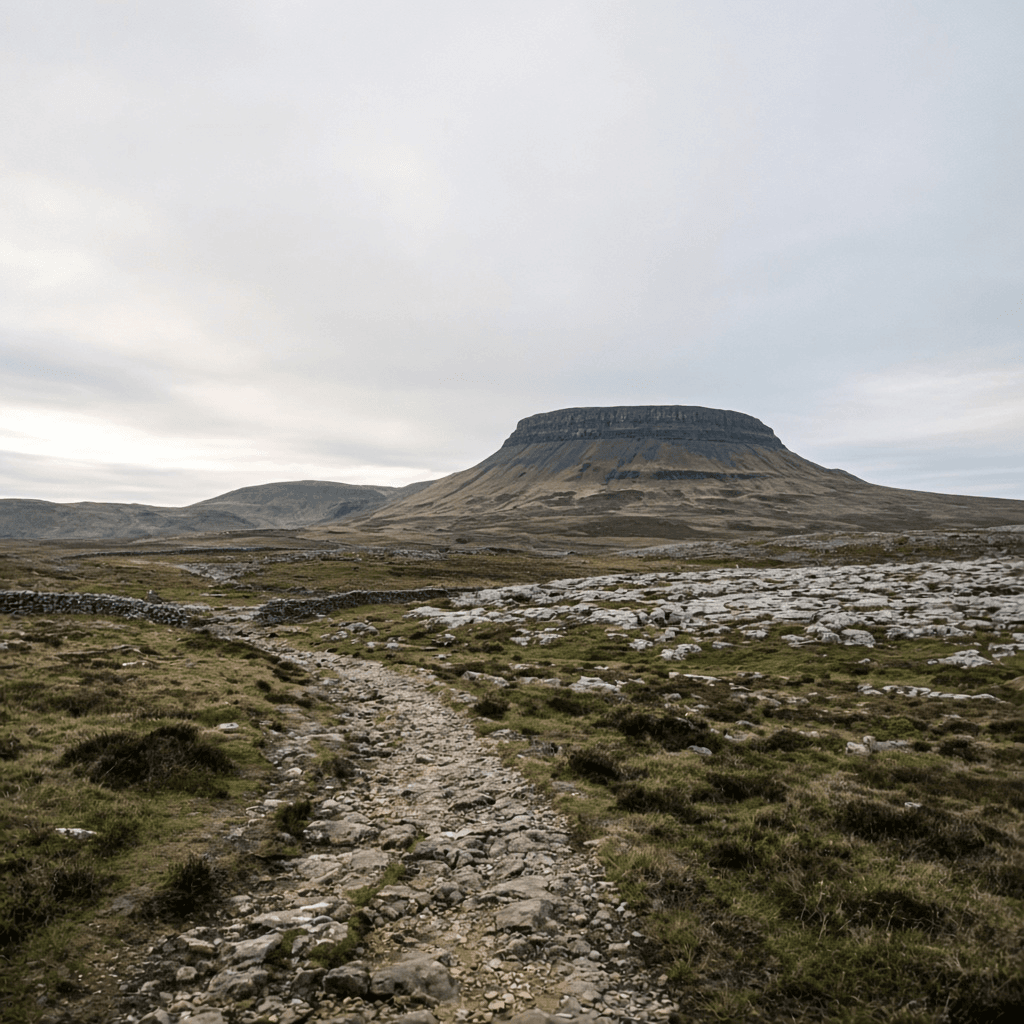
The Yorkshire Three Peaks is one of Britain's quintessential endurance challenges. Walkers attempt Pen-y-ghent (694 m), Whernside (736 m), and Ingleborough (723 m) in a continuous 38.6 km (24-mile) loop in the Yorkshire Dales National Park, traditionally within 12 hours. Typical figures for the Horton loop are 38.6 km, 1,585 m of ascent, high point 736 m (Whernside), and 10–12 hours of walking in a single day.
Yorkshire Dales National Park Authority and threepeakschallenge.uk both publish 24 miles / 38.6 km for the Horton-in-Ribblesdale loop. YDNPA rounds ascent to 5,000 ft (1,600 m); the challenge site publishes 1,585 m. Peak heights are the Database of British and Irish Hills values rounded to the metre: Pen-y-ghent 694 m, Whernside 736 m, Ingleborough 723 m.
The usual circuit starts in Horton-in-Ribblesdale, climbs Pen-y-ghent, crosses toward Ribblehead Viaduct, climbs Whernside (the highest of the three), then Ingleborough's plateau, and returns to Horton. Footing is gritstone and limestone path, moorland, and limestone pavement. Pen-y-ghent includes minor scrambling. No via ferrata or glacier travel. No permit is required; large organised charity groups should register with the National Park so Horton is not overwhelmed.
The 12-hour challenge is a tradition, not a National Park time limit. The same 38.6 km loop can be walked over two or three days with nights in the dale villages. Winter daylight makes a 12-hour finish unlikely for most walkers. Start at first light if the 10–12 hour band is the goal.
38.6 km and 1,585 m of ascent over Pen-y-ghent, Whernside and Ingleborough, traditionally in 10–12 hours from Horton-in-Ribblesdale.
Mission Snapshot
Intensity Breakdown
Understanding what drives the overall route demand
Physical
82
Technical
28
Commitment
58
Primary driver: Single-day hill endurance on the 38.6 km Dales loop
- 38.6 km and 1,585 m in one day
- Minor scramble on Pen-y-ghent
- 10–12 hour clock and early Horton start
- Bailouts exist; this is not a wilderness traverse
Advanced multi-day effort: heavy fatigue, logistics, or movement friction—not necessarily alpine exposure.
Full Route Breakdown
Complete stage overview with transparent route metrics. Values are shown as recorded in the route dataset and source links.
Distance
38.6 km
Ascent
1,585 m
Highest point
736 m
Start
Horton-in-Ribblesdale, Yorkshire Dales National Park
Finish
Horton-in-Ribblesdale (loop)
Use the KM / MI toggle in the main menu to switch units.
Route Profile
Single-night summit push structure
Operational Reality
Headline 38.6 km is the YDNPA / challenge-site Horton loop. Itinerary blocks are named peaks and time-order, not kilometre stages, so they are not summed against 38.6 km. Elevations: low 235 m, high 736 m, gain 1,585 m. Peak heights from DoBIH. Sources: YDNPA walking page and threepeakschallenge.uk.
Route Considerations
This route is generally safe, but these are the main factors to be aware of.
Extreme exhaustion blisters
38.6 km in 10–12 hours on gritstone, bog, and limestone pavement will test feet, calves, and knees.
Impact
Route-specific
Likelihood
Context-dependent
Tip
Broken-in boots, blister plasters, a mid-walk sock change, and food for a 10–12 hour day. This is not a 24-mile road walk.
Darkness and navigation
Walkers who miss the 10–12 hour band often descend Ingleborough in the dark. Moorland in mist is easy to lose.
Impact
Route-specific
Likelihood
Context-dependent
Tip
Start at first light. Carry a charged headtorch and spare batteries, OS Explorer OL2, and a compass. Know the road and pub bailouts between peaks.
Terrain & conditions
Conditions change quickly on the ground. Slow down on wet rock and pay more attention where paths narrow or exposure increases.
Impact
Moderate
Likelihood
Variable
Tip
Refer to stage notes and expert briefings; maintain focus on slick or exposed sections.
Why hike this route?
LANDSCAPE
Limestone pavement, dry valleys, and Ribblehead Viaduct between Pen-y-ghent and Whernside.
VARIETY
Three named mountains and two valleys on one 38.6 km loop from Horton-in-Ribblesdale.
CULTURE & PLACE
The cafe clock at the start and the pub at the finish in Horton.
WHY GO
38.6 km and 1,585 m of ascent over Pen-y-ghent, Whernside and Ingleborough, traditionally in 10–12 hours from Horton-in-Ribblesdale.
Expert Verdict
“A British classic in the Yorkshire Dales National Park: 38.6 km, 1,585 m of ascent, 10–12 hours, Pen-y-ghent 694 m, Whernside 736 m, Ingleborough 723 m. The 12-hour mark is the challenge tradition; YDNPA publishes the 24-mile loop without making that clock a rule. No permit, no ferrata, no glacier. The scramble is short and on Pen-y-ghent. Train the distance; do not sprint the first peak; treat the first hot spot on a heel as a stop, not a later problem. Walking back into Horton is the finish, not a fourth hill.”
Who This Is For
- ADVANCED — Stamina for 38.6 km and 1,585 m of ascent in 10–12 hours, plus comfort with a short scramble on Pen-y-ghent. Navigation on OL2 in mist.
- PHYSICAL — A single-day endurance load: marathon-length hill walking, three named summits, 1,585 m of gain.
- WATCH FOR — Treating 38.6 km of Dales path as 24 road miles.
- WATCH FOR — Going too fast on Pen-y-ghent and arriving empty at Whernside.
Plan This Hike
Key things to arrange before starting this route—practical tips first, then buttons that open curated picks (gear, maps, stays) where we list them.
Essential Gear
Recommended preparation for this route:
Broken-in boots and OL2 — 38.6 km of Dales path, not a road marathon.
- Category B boots already worn in
- OS Explorer OL2, compass, headtorch
- Waterproof jacket and overtrousers
Stay Connected
Explore accommodation options for this trail:
Signal is partial. Navigation is the map, not the phone.
- OL2 stays in the pack even if the GPX is loaded
- Water: Horton, then Ribblehead and Chapel-le-Dale
- Bailout roads and pubs sit between the peaks
Getting There
Travel and trail access for this route:
Start and finish in Horton-in-Ribblesdale on the Settle–Carlisle line.
- Train on the Settle–Carlisle, or drive before 06:00
- Paid National Park car park or designated field
- 38.6 km loop — do not park on village streets
Where to Stay
Explore accommodation options for this trail:
Horton B&Bs, pubs, and campsites; book summer weekends early.
- Overnight in Horton for a dawn start
- The same loop splits over two or three village nights
- Charity groups should register with the National Park
Compare This Route
See how this route compares to similar hikes in overall demand and terrain profile.Compare routes by the shape of the effort, not only the headline score.
The Pen y Fan Horseshoe
Closest overall match in demand profile
Pen y Fan is the highest peak in South Wales (886m) and the crown jewel of ...
Intensity
Lower intensityLost City Trek
Lower overall intensity, similar terrain type
Route Typology: Guided Jungle Expedition. The Lost City Trek leads to 'Teyu...
Intensity
Lower intensityTrolltunga
Higher physical or technical demand
The Troll's Tongue. Trolltunga is one of Norway's most spectacular scenic c...
Intensity
Higher intensityExplore Alternatives
Broaden the picture with easier, harder, and nearby options.
Looking for something easier?
Lower intensity — helpful if this route feels like a stretch right now.
Want more challenge?
Higher intensity — for when you are ready for a bigger physical or technical step.
More hikes in this region
Nearby and regionally relevant routes for the next step in your search.
Central Mourne Mountains Circular
County Down, Northern Ireland · united-kingdom
Distance
16.0 km
Ascent
750 m
Ben Nevis via the Mountain Track
Scottish Highlands · united-kingdom
Distance
17.0 km
Ascent
1,352 m
The Pembrokeshire Coast Path
Pembrokeshire Coast National Park, Wales · united-kingdom
Distance
299.0 km
Ascent
11,000 m
The Jurassic Coast Path
Dorset & East Devon · united-kingdom
Distance
153.0 km
Ascent
4,200 m
Hadrian's Wall Path
Northern England · united-kingdom
Distance
135.0 km
Ascent
1,800 m
The South Downs Way
South East England · united-kingdom
Distance
160.0 km
Ascent
4,150 m
Compare with any route
Pick any hike worldwide and open a full side-by-side comparison.
What You Need to Know
Essential answers about the demands, risks, and logistics of this route.
Q.How hard is this hike really?
Q.Do I need technical gear?
Q.Is water available on the route?
Q.What is the main risk?
Ready to hike The Yorkshire Three Peaks Challenge?
A final decision point after reviewing the route, risks, logistics, and alternatives.
This route is a strong match if you're comfortable with the effort level implied by an Intensity Score around 74/100 (Very Hard), sustained hiking where this route requires it, and the terrain and exposure described in this guide.
Build your itinerary, stages, and logistics.
Looking for something easier, more challenging, or a different terrain profile?
Compare routes by intensity, terrain, and region.
Data: official trail documentation and topographic sources · About