Mount
Kilimanjaro
The rooftop of Africa.
Duration
8 days
Route distance
70.0km
Vertical Gain
+4,800m
Max Altitude
5,895m
Mission Brief
The rooftop of Africa.
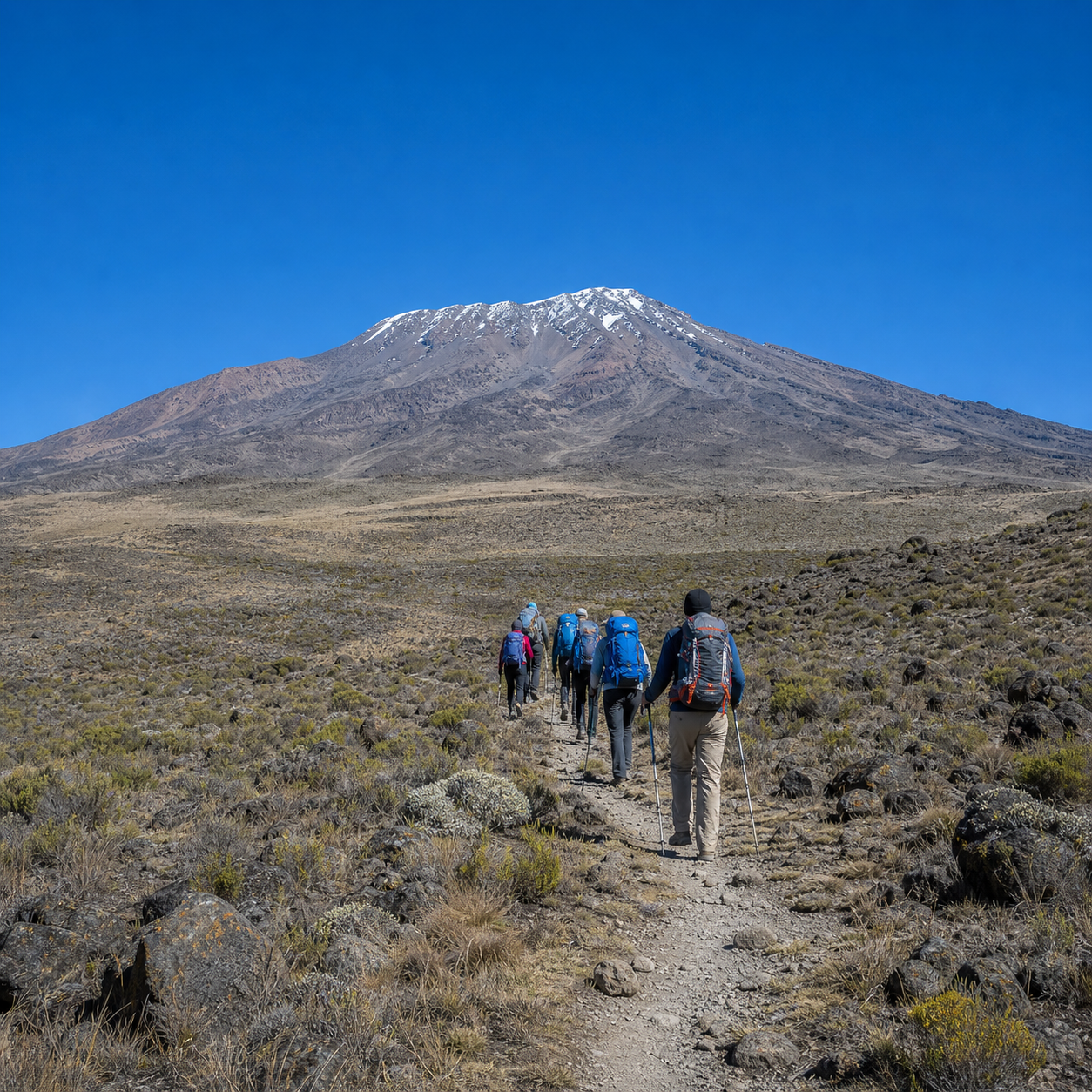
The Lemosho Route is widely considered the most scenic and successful path to the summit of Mount Kilimanjaro (5,895m). Starting from the west at the Lemosho Glades, the trail traverses the vast Shira Plateau before joining the southern circuit. Over 7 or 8 days, hikers pass through five distinct ecological zones: tropical rainforest, heath, moorland, alpine desert, and the arctic summit zone.
Its longer itinerary provides superior acclimatization, leading to some of the highest summit success rates on the mountain.
The Shira Plateau and the Barranco Wall. The 'X-Factor' of Lemosho is the diversity of the scenery. Crossing the Shira Plateau—one of the highest plateaus on earth—offers a sense of immense scale. But the true adrenalin…
Mission Snapshot
Intensity Breakdown
Understanding what drives the overall route demand
Physical
5
Technical
2
Commitment
5
Primary driver: Altitude
- Extreme altitude (5,895m)
- Multi-day sustained elevation
- Barranco Wall scramble
High commitment routes with serious consequence, remote terrain, or sustained objective hazard.
Full Route Breakdown
Complete stage overview with transparent route metrics. Values are shown as recorded in the route dataset and source links.
Distance
70.0 km
Ascent
4,800 m
Highest point
5,895 m
Start
Lemosho Gate to Mti Mkubwa
Finish
Mweka Camp to Mweka Gate
Use the KM / MI toggle in the main menu to switch units.
Route Profile
Fixed backcountry campground structure for this route
Route Considerations
This route is generally safe, but these are the main factors to be aware of.
Acute mountain sickness ams
Kilimanjaro is high enough that AMS (Altitude Sickness) is a major risk for all climbers.
Impact
Route-specific
Likelihood
Context-dependent
Tip
Choose an 8-day itinerary for better acclimatization; walk 'Pole Pole' (slowly); drink 4L of water daily; climb high and sleep low; take Diamox if recommended by your doctor.
Extreme cold
Summit temperatures can drop to -20°C with high wind chill.
Impact
Route-specific
Likelihood
Context-dependent
Tip
Use a 4-layer system; high-quality down jacket and heavy-duty summit mitts; insulated water bottles (to prevent freezing).
Altitude Warning
Potential altitude-related conditions include AMS, HAPE, and HACE. Adequate acclimatization is essential.
Impact
Route-specific
Likelihood
Context-dependent
Tip
Strict adherence to hydration and gradual ascent protocols (climb high, sleep low).
Why hike this route?
LANDSCAPE
Crossing five ecological zones in a week. From monkeys in the jungle to glaciers in the desert.
VARIETY
The Shira Plateau is one of the most unique geological features in Africa. It feels like walking across the moon.
CULTURE & PLACE
The incredible spirit and songs of the Chagga porters and guides.
STANDOUT
The Shira Plateau and the Barranco Wall. The 'X-Factor' of Lemosho is the diversity of the scenery. Crossing the Shira Plateau—one of the highest plateaus on earth—offers a sense of immense scale. But the true adrenaline moment is the climb up the Barranco Wall. While it looks v…
Expert Verdict
“If you're going to climb Kili once, Lemosho is the thinking hiker's choice. It's longer, which people think is 'harder', but it's actually the secret to success. That extra day for your blood to produce more red cells is the difference between reaching Uhuru Peak and ending up on a stretcher at Barafu Camp. 'Pole Pole' isn't just a catchy phrase—it's the only way to the top. For this itinerary, Mount Kilimanjaro's own metrics set the effort band: 70km, 4800 m gain and 5-7 (Summit day: 12-15) hours on foot.”
Who This Is For
- INTERMEDIATE — No technical climbing experience is needed, but you should have a high degree of mental resilience. Previous experience with multi-day high-altitude trekking (above 3,000m) is a major asset.
- PHYSICAL — High. While porters carry your heavy gear, your heart and lungs will be working at maximum capacity. Summit night involves a 1,200m vertical push in sub-zero temperatures.
- WATCH FOR — Walking too fast in the first three days because you 'feel fine'.
- WATCH FOR — Not eating enough—altitude suppresses appetite, but you need the fuel for summit night.
Plan This Hike
Key things to arrange before starting this route—practical tips first, then buttons that open curated picks (gear, maps, stays) where we list them.
Essential Gear
Recommended preparation for this route:
Summit-night kit and descent comfort matter more than speed.
- Pack true summit-night insulation: down jacket, warm mitts, headlamp and spare batteries.
- Use broken-in boots and poles for the long descent from Uhuru Peak.
- Carry enough bottles or bladder capacity for operator-treated water between camps.
Stay Connected
Explore accommodation options for this trail:
The guide team is the safety system once coverage fades.
- Do not rely on phone coverage above the gate; treat the guide team as the safety system.
- Choose an operator carrying oxygen, pulse oximeters and a clear evacuation plan.
- Keep passport, permit copies and insurance details accessible in a dry bag.
Getting There
Travel and trail access for this route:
Western access means more transfer planning than the shorter routes.
- Fly into Kilimanjaro International Airport, then stage from Moshi or Arusha.
- Expect a longer transfer to the western Lemosho gate than for Marangu or Machame.
- Build in buffer time before the climb for gear checks and altitude pacing.
Where to Stay
Explore accommodation options for this trail:
Lemosho is a tented-camp itinerary with operator logistics.
- The route uses tented camps rather than huts, with porters moving camp each day.
- An 8-day itinerary gives more acclimatization margin than shorter summit schedules.
- Sleep in Moshi or Arusha before and after the climb to absorb transfer delays.
Compare This Route
See how this route compares to similar hikes in overall demand and terrain profile.Compare routes by the shape of the effort, not only the headline score.
The Chomolhari Trek
Closest overall match in demand profile
The Chomolhari Trek is a 7–9 day high-altitude route through the Jigme Dorj...
Intensity
Slightly lower intensityVolcán Barú
Lower overall intensity, similar terrain type
Volcán Barú is Panama's highest summit (3,474 m): a brutal night hike from ...
Intensity
Lower intensityCordillera Real Traverse
Higher physical or technical demand
The Cordillera Real Traverse is considered by many high-altitude trekkers t...
Intensity
Higher intensityExplore Alternatives
Broaden the picture with easier, harder, and nearby options.
Looking for something easier?
Lower intensity — helpful if this route feels like a stretch right now.
Want more challenge?
Higher intensity — for when you are ready for a bigger physical or technical step.
More hikes in this region
Nearby and regionally relevant routes for the next step in your search.
Compare with any route
Pick any hike worldwide and open a full side-by-side comparison.
What You Need to Know
Essential answers about the demands, risks, and logistics of this route.
Q.How hard is this hike really?
Q.Do I need technical gear?
Q.Is water available on the route?
Q.What is the main risk?
Ready to hike Mount Kilimanjaro?
A final decision point after reviewing the route, risks, logistics, and alternatives.
This route is a strong match if you're comfortable with the effort level implied by an Intensity Score around 88/100 (Severe), sustained hiking where this route requires it, and the terrain and exposure described in this guide.
Build your itinerary, stages, and logistics.
Looking for something easier, more challenging, or a different terrain profile?
Compare routes by intensity, terrain, and region.
Data: official trail documentation and topographic sources · About