Huayhuash
Circuit
The elite Andes experience.
Duration
10 days
Route distance
130.0km
Vertical Gain
+8,500m
Max Altitude
5,050m
Mission Brief
The elite Andes experience.
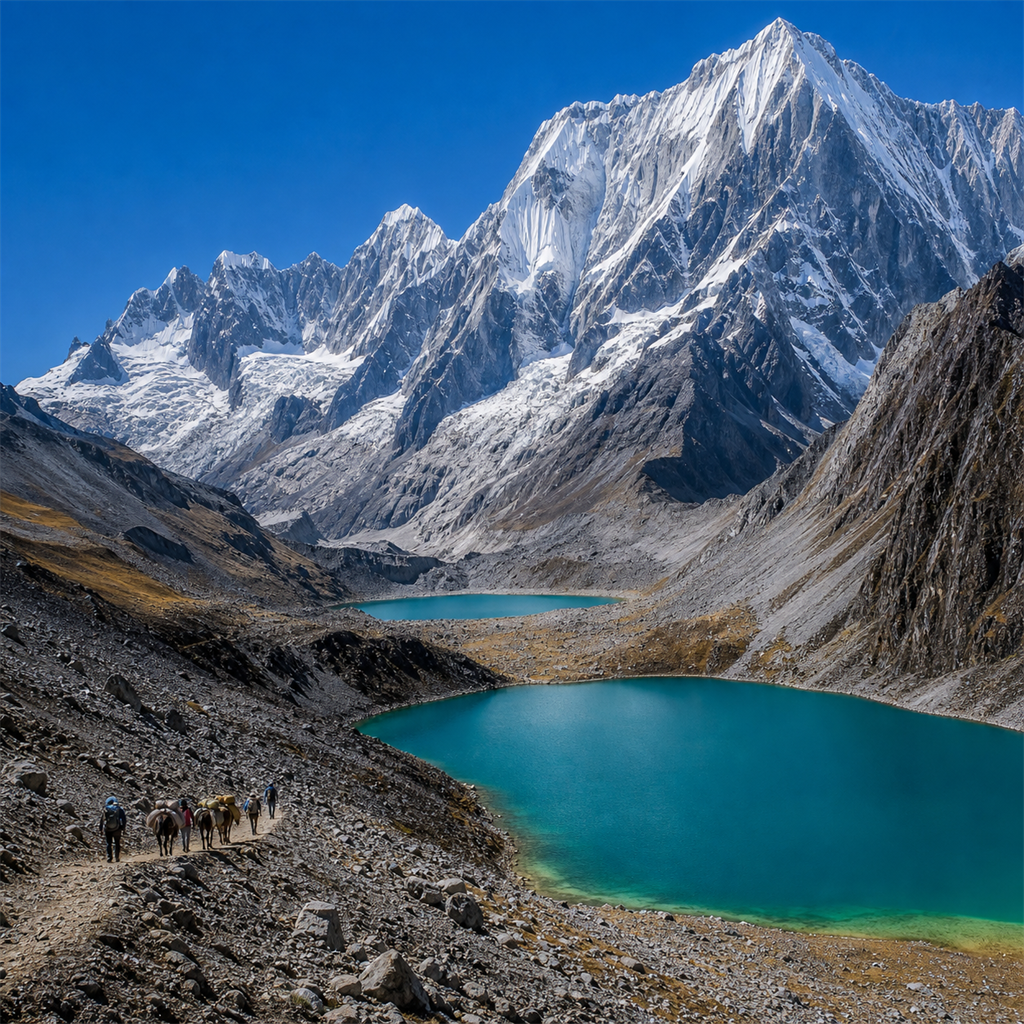
The Huayhuash Circuit is a legendary 130km (80 mile) high-altitude trek and is consistently ranked as one of the best treks in the world. It circumnavigates the Cordillera Huayhuash, a compact but vertically extreme mountain range containing some of the planet's most demandingly beautiful peaks, including Siula Grande (of 'Touching the Void' fame) and Yerupajá. This is a journey of extreme scale, crossing multiple 5,000m passes and camping beside crystalline glacial lakes, far removed from any roads or towns.
The Siula Pass View and the Verticality. The 'X-Factor' of Huayhuash is the sheer verticality of the peaks rising directly from the turquoise lakes below. Standing on the Siula Pass or the San Antonio Viewpoint, looking…
Mission Snapshot
Intensity Breakdown
Understanding what drives the overall route demand
Physical
85
Technical
64
Commitment
100
Primary driver: Commitment
- Sustained Physical Output
- Significant Vertical Gain
- Technical Terrain Exposure
- High Remote Commitment
Major expeditions for elite teams. Sustained isolation and technical mastery required.
Full Route Breakdown
Complete stage overview with transparent route metrics. Values are shown as recorded in the route dataset and source links.
Distance
130.0 km
Ascent
8,500 m
Highest point
5,050 m
Start
The North Side
Finish
The South Exit
Use the KM / MI toggle in the main menu to switch units.
Route Profile
Fixed backcountry campground structure for this route
Route Considerations
This route is generally safe, but these are the main factors to be aware of.
Sustained high altitude
The trek stays almost entirely above 4,000m, with daily passes around 5,000m.
Impact
Route-specific
Likelihood
Context-dependent
Tip
Proper acclimatization (at least 3-4 days in Huaraz with day hikes like Laguna 69) is strongly advised; carry Diamox and Pulse Oximeter; be prepared for an emergency horse evacuation.
Extreme isolation
If you are injured, help is days away and helicopter rescues are difficult at these altitudes.
Impact
Route-specific
Likelihood
Context-dependent
Tip
Trek with a professional team (guide, cook, and muleteers); carry a satellite messenger (InReach); follow local community rules and pay the camping fees (approx $70 total).
Altitude Warning
Potential altitude-related conditions include AMS, HAPE, and HACE. Adequate acclimatization is essential.
Impact
Route-specific
Likelihood
Context-dependent
Tip
Strict adherence to hydration and gradual ascent protocols (climb high, sleep low).
Why hike this route?
LANDSCAPE
Jagged ice-peaks, fluted glaciers, and turquoise lakes—it's the Andes in high definition.
VARIETY
Passing through remote farming valleys, high rocky passes, and hidden glacial basins.
CULTURE & PLACE
Interacting with the local Quechua-speaking communities who have managed these lands for centuries.
STANDOUT
The Siula Pass View and the Verticality. The 'X-Factor' of Huayhuash is the sheer verticality of the peaks rising directly from the turquoise lakes below. Standing on the Siula Pass or the San Antonio Viewpoint, looking across at the massive, fluted ice-walls of Yerupajá and Siu…
Expert Verdict
“The Huayhuash is the most visually stunning circuit on Earth. It is 'Touching the Void' in real life. Experienced hikers often suggest that you spend at least 4 days in Huaraz doing acclimatization hikes before starting. Don't miss the San Antonio viewpoint; it's a strenuous side-climb, but the view of the fluted ice-walls is the best in the Andes. Treat Huayhuash Circuit as a 6-8 walking-hour commitment shaped by 130km, 8500 m of ascent and a high point near 5050 m.”
Who This Is For
- EXPERT — For serious mountain lovers who find the Inca Trail too crowded and easy. You should have prior experience with multi-day high-altitude camping and the stamina for back-to-back 5,000m passes.
- PHYSICAL — Extreme. You will cross a pass near or above 5,000m almost every single day for 10-12 days. The cumulative effect of thin air and verticality is immense.
- WATCH FOR — Attempting to start the trek with only 1-2 days of acclimatization in Huaraz.
- WATCH FOR — Ignoring the 'horse fee'; if you can't make it up a pass, a rescue horse is your only way out and costs extra.
Plan This Hike
Key things to arrange before starting this route—practical tips first, then buttons that open curated picks (gear, maps, stays) where we list them.
Essential Gear
Recommended preparation for this route:
Cold camps and 5,000m passes make margin more important than speed.
- Bring a true cold-weather sleep system for freezing nights above 4,000m.
- Use poles and grippy boots for loose descents from Siula, Yaucha and Tapush passes.
- Carry cash in Peruvian soles for community checkpoints and campsite fees.
Stay Connected
Explore accommodation options for this trail:
Remote Andean terrain leaves little room for improvised rescue.
- Do not rely on phone coverage; carry offline maps and a satellite messenger.
- Choose a support team with mule evacuation options and altitude protocols.
- Build acclimatization days in Huaraz before committing to the circuit.
Getting There
Travel and trail access for this route:
Huaraz is the staging base for trailhead access.
- Stage in Huaraz, then transfer by road to Pocpa or Llamac depending on route choice.
- Plan 3-4 days of acclimatization hikes before the first high camp.
- Confirm road access and community fee points before leaving town.
Where to Stay
Explore accommodation options for this trail:
This is a camping circuit managed through local communities.
- Expect designated community campsites rather than huts or villages each night.
- Carry enough fuel and food for remote stages between Llamac and Huayllapa.
- Keep one buffer day for weather, altitude symptoms or slower pass crossings.
Compare This Route
See how this route compares to similar hikes in overall demand and terrain profile.Compare routes by the shape of the effort, not only the headline score.
Berliner Höhenweg — The Zillertal High-Route
Closest overall match in demand profile
The Berliner Höhenweg (also known as the Zillertaler Runde) is one of the m...
Intensity
Slightly higher intensityCordillera Real Traverse
Lower overall intensity, similar terrain type
The Cordillera Real Traverse is considered by many high-altitude trekkers t...
Intensity
Lower intensityExplore Alternatives
Broaden the picture with easier, harder, and nearby options.
Looking for something easier?
Lower intensity — helpful if this route feels like a stretch right now.
Dientes de Navarino Circuit
magallanes-and-antarctica-chilena-region · chile
Distance
40.0 km
Ascent
2,100 m
Ancient Tea Horse Road
Yunnan / Shangri-La / Tiger Leaping Gorge · china
Distance
150.0 km
Ascent
6,000 m
Mount Kenya Traverse
mount-kenya-national-park · kenya
Distance
55.0 km
Ascent
2,000 m
More hikes in this region
Nearby and regionally relevant routes for the next step in your search.
Alpamayo Circuit
ancash-huaraz · peru
Distance
130.0 km
Ascent
7,200 m
Cordillera Blanca Traverse
ancash-department-central-andes · peru
Distance
250.0 km
Ascent
20,000 m
Ausangate Circuit
cusco-department-southern-andes · peru
Distance
70.0 km
Ascent
4,200 m
Salkantay Trek
cusco · peru
Distance
74.0 km
Ascent
3,200 m
Santa Cruz Trek
cordillera-blanca · peru
Distance
50.0 km
Ascent
2,000 m
The Classic Inca Trail
cusco · peru
Distance
42.0 km
Ascent
2,200 m
Compare with any route
Pick any hike worldwide and open a full side-by-side comparison.
What You Need to Know
Essential answers about the demands, risks, and logistics of this route.
Q.How hard is this hike really?
Q.Do I need technical gear?
Q.Is water available on the route?
Q.What is the main risk?
Ready to hike Huayhuash Circuit?
A final decision point after reviewing the route, risks, logistics, and alternatives.
This route is a strong match if you're comfortable with the effort level implied by an Intensity Score around 98/100 (Expedition), sustained hiking where this route requires it, and the terrain and exposure described in this guide.
Build your itinerary, stages, and logistics.
Looking for something easier, more challenging, or a different terrain profile?
Compare routes by intensity, terrain, and region.
Data: official trail documentation and topographic sources · About