Laugavegur
Trail
Iceland's Flagship Wilderness Trek.
Duration
4 days
Route distance
55.0km
Vertical Gain
+1,200m
Max Altitude
1,100m
Mission Brief
Iceland's Flagship Wilderness Trek.
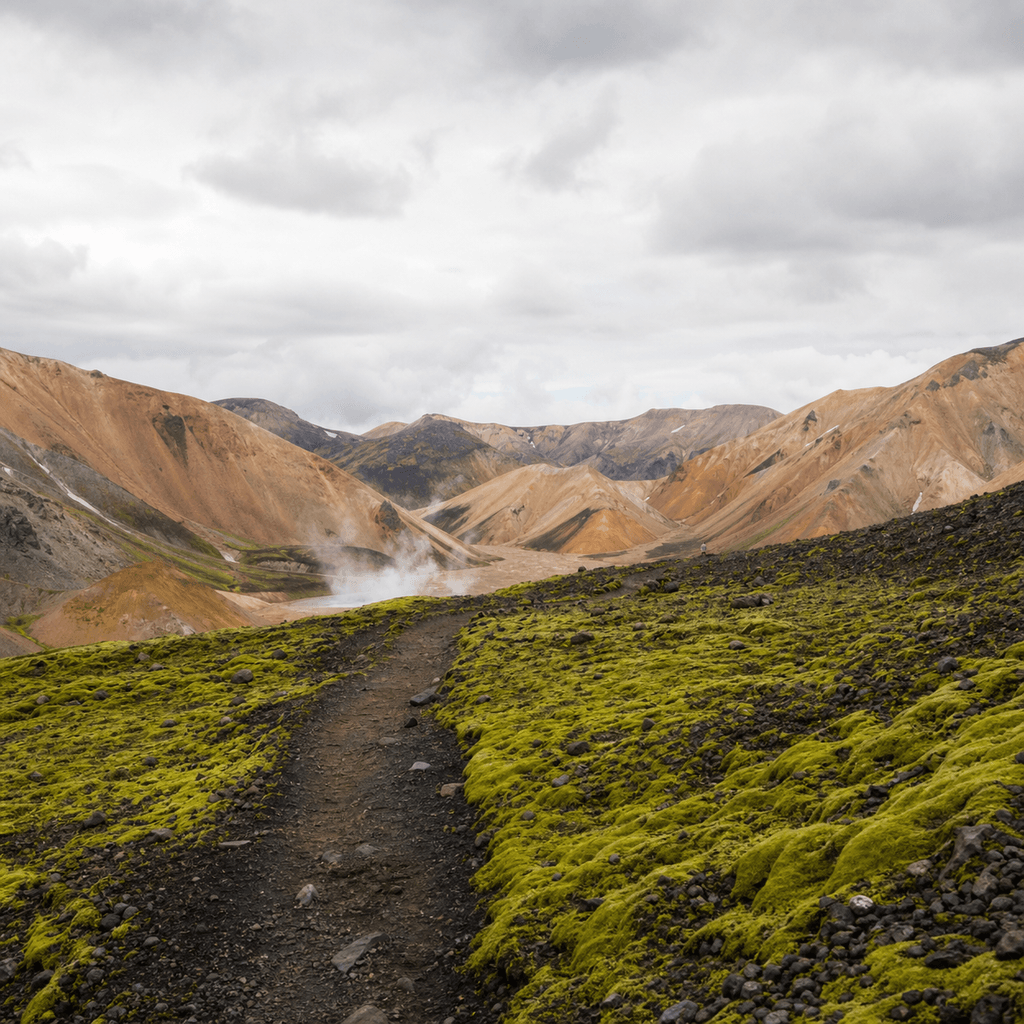
The Laugavegur Trail is the island's premier long-distance route, a 55km journey from the geothermal highland basin of Landmannalaugar to the wooded glacial valley of Þórsmörk. It is renowned for its surreal geological transitions, crossing neon-green moss fields, obsidian lava flows, rhyolite mountains in shades of yellow and pink, and stark black sand deserts. It is widely considered one of Europe's most visually diverse multi-day hikes.
Geological Hallucinations. The 'X-Factor' is the feeling of walking on another planet. Every 5 kilometers, the landscape changes completely—from the orange and cream-colored rhyolite hills of Landmannalaugar to the star…
Mission Snapshot
Intensity Breakdown
Understanding what drives the overall route demand
Physical
65
Technical
64
Commitment
83
Primary driver: Commitment
- Sustained Physical Output
- Technical Terrain Exposure
- High Remote Commitment
Advanced multi-day effort: heavy fatigue, logistics, or movement friction—not necessarily alpine exposure.
Full Route Breakdown
Complete stage overview with transparent route metrics. Values are shown as recorded in the route dataset and source links.
Distance
55.0 km
Ascent
1,200 m
Highest point
1,100 m
Start
Landmannalaugar to Hrafntinnusker
Finish
Emstrur to Þórsmörk
Use the KM / MI toggle in the main menu to switch units.
Route Profile
Multi-day stage structure
Route Considerations
This route is generally safe, but these are the main factors to be aware of.
Weather
The highlands are characterized by horizontal rain, gale-force winds, and snow even in mid-summer.
Impact
Route-specific
Likelihood
Context-dependent
Tip
High-quality, professional-grade waterproof gear is essential; monitor road.is and vedur.is forecasts daily. Do not attempt high-altitude sections, such as Hrafntinnusker, during periods of low visibility or storm forecasts.
River crossings
The trail involves several unbridged glacial river crossings that can be deep and fast.
Impact
Route-specific
Likelihood
Context-dependent
Tip
Always unbuckle your backpack waist strap before crossing; cross in pairs; use trekking poles; cross at the widest (shallowest) points; wear neoprene socks or river sandals.
Terrain & conditions
Conditions change quickly on the ground. Slow down on wet rock and pay more attention where paths narrow or exposure increases.
Impact
Moderate
Likelihood
Variable
Tip
Refer to stage notes and expert briefings; maintain focus on slick or exposed sections.
Why hike this route?
LANDSCAPE
Otherworldly rhyolite mountains, blue glaciers, and black sand deserts.
VARIETY
The total shift in ecology every single day of the trek.
CULTURE & PLACE
The unique atmosphere of the Icelandic mountain huts—pragmatic, cozy, and filled with hikers from around the world.
STANDOUT
Geological Hallucinations. The 'X-Factor' is the feeling of walking on another planet. Every 5 kilometers, the landscape changes completely—from the orange and cream-colored rhyolite hills of Landmannalaugar to the stark black arctic deserts of Mælifellssandur and finally the em…
Expert Verdict
“The Laugavegur remains the definitive Icelandic trekking experience, providing an unparalleled overview of the island's volcanic geology. Many hikers report that the North-to-South direction is visually more dramatic and climatically more favorable. Practical feedback emphasizes the importance of unbuckling pack straps during river fords and utilizing light neoprene socks to manage the thermal shock of glacial water.”
Who This Is For
- ADVANCED — For experienced backpackers who are prepared for the isolation and the weather. You must be comfortable with river crossings and navigating in whiteout/fog conditions.
- PHYSICAL — High. While the elevation gain isn't extreme, the wind, rain, and the weight of a 4-day pack make this a strenuous endurance test.
- WATCH FOR — Attempting the first day (Hrafntinnusker) in a storm; this is the most dangerous section where people have lost their lives in fog.
- WATCH FOR — Not having a proper wind-rated tent; the highlands have no trees and no shelter from the gusts.
Plan This Hike
Key things to arrange before starting this route—practical tips first, then buttons that open curated picks (gear, maps, stays) where we list them.
Essential Gear
Recommended preparation for this route:
Iceland highland kit starts with weatherproofing.
- Full waterproof shell system for horizontal rain
- River shoes or neoprene socks for glacial fords
- Wind-rated tent if camping outside the huts
Stay Connected
Explore accommodation options for this trail:
Interior highlands have limited coverage.
- Download offline maps before the highland bus
- Register or share a travel plan before departure
- Monitor Icelandic weather and road conditions daily
Getting There
Travel and trail access for this route:
Access depends on seasonal F-road and highland bus openings.
- Use 4WD highland buses to Landmannalaugar
- Return from Thorsmork by 4WD bus
- Check road openings before fixed-date plans
Where to Stay
Explore accommodation options for this trail:
Huts are the bottleneck; camping is designated.
- Book FI huts far ahead for July and August
- Camp only at designated hut sites
- Carry all food and fuel for the full trek
Compare This Route
See how this route compares to similar hikes in overall demand and terrain profile.Compare routes by the shape of the effort, not only the headline score.
Condoriri Trek
Closest overall match in demand profile
Shadowing the immense peaks of the Cordillera Real north of La Paz, the Con...
Intensity
Higher intensityThorsborne Trail
Lower overall intensity, similar terrain type
The Thorsborne Trail is a 32km point-to-point trekking route along the east...
Intensity
Lower intensityTravessia Petrópolis-Teresópolis
Higher physical or technical demand
The Travessia Petrópolis-Teresópolis is a premier multi-day traverse within...
Intensity
Higher intensityExplore Alternatives
Broaden the picture with easier, harder, and nearby options.
Looking for something easier?
Lower intensity — helpful if this route feels like a stretch right now.
Want more challenge?
Higher intensity — for when you are ready for a bigger physical or technical step.
More hikes in this region
Nearby and regionally relevant routes for the next step in your search.
Fimmvörðuháls Trail
south-iceland · iceland
Distance
25.0 km
Ascent
1,000 m
Hornstrandir
Westfjords · iceland
Distance
55.0 km
Ascent
1,800 m
Glymur Waterfall
Hvalfjörður (West Iceland) · iceland
Distance
7.0 km
Ascent
425 m
Mt. Esja
Capital Region (Reykjavík) · iceland
Distance
6.9 km
Ascent
750 m
Stuðlagil Canyon
East Iceland · iceland
Distance
8.0 km
Ascent
150 m
Reykjadalur
South Iceland · iceland
Distance
7.4 km
Ascent
350 m
Compare with any route
Pick any hike worldwide and open a full side-by-side comparison.
What You Need to Know
Essential answers about the demands, risks, and logistics of this route.
Q.How hard is this hike really?
Q.Do I need technical gear?
Q.Is water available on the route?
Q.What is the main risk?
Ready to hike Laugavegur Trail?
A final decision point after reviewing the route, risks, logistics, and alternatives.
This route is a strong match if you're comfortable with the effort level implied by an Intensity Score around 69/100 (Very Hard), sustained hiking where this route requires it, and the terrain and exposure described in this guide.
Build your itinerary, stages, and logistics.
Looking for something easier, more challenging, or a different terrain profile?
Compare routes by intensity, terrain, and region.
Data: official trail documentation and topographic sources · About