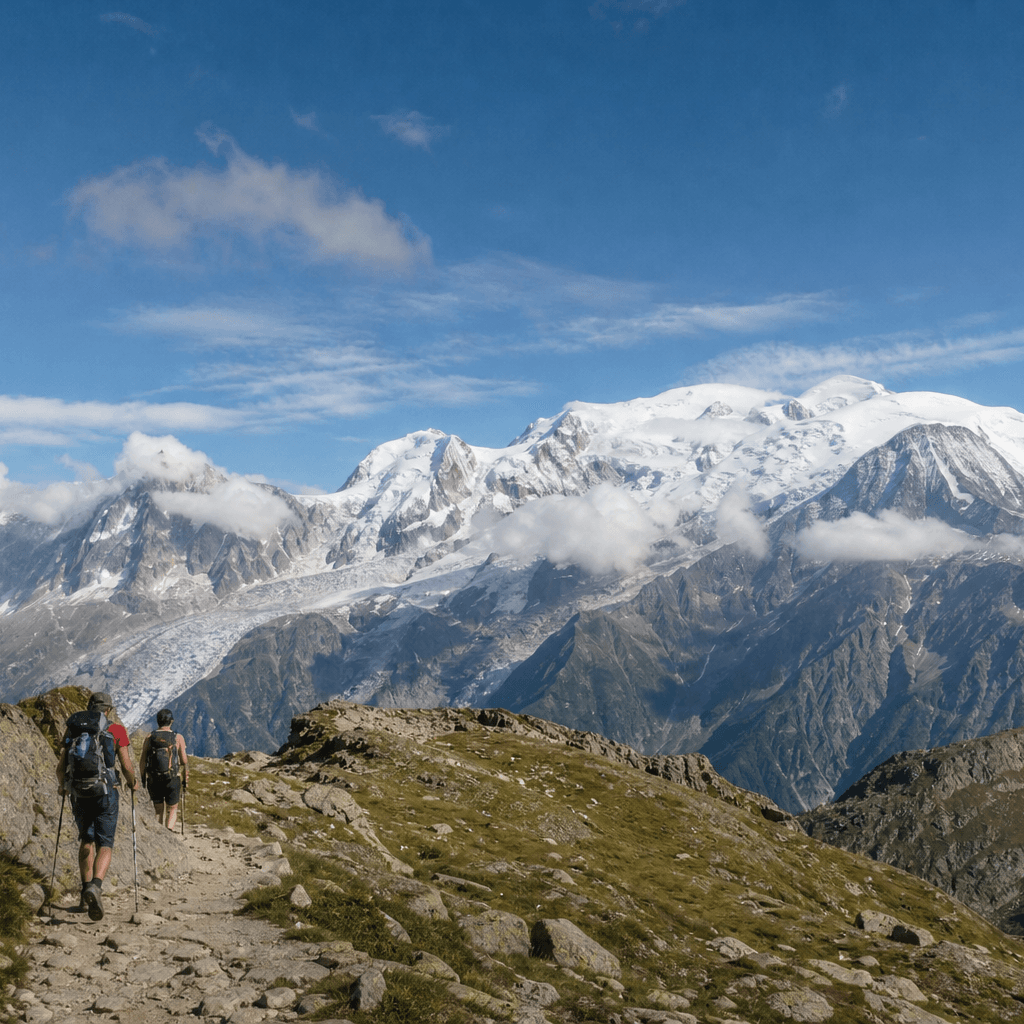
Tour du
Mont Blanc
~170 km loop, ~10,000 m gain, 10–11 hut stages — best window late June to mid-September.
Duration
11 days
Route distance
170.0km
Vertical Gain
+10,000m
Max Altitude
2,665m
Mission Brief
The Tour du Mont Blanc is a ~170 km hut-to-hut loop around Mont Blanc with ~10,000 m cumulative gain, usually walked in 10–11 days from late June to mid-September.
The standard route is non-technical alpine trail; refuge reservations and daily weather calls matter as much as leg strength.
A hut-to-hut Alpine loop through France, Italy, and Switzerland with constant Mont Blanc views—logistics and booking matter as much as fitness.
Mission Snapshot
Intensity Breakdown
Understanding what drives the overall route demand
Physical
74
Technical
42
Commitment
68
Primary driver: Multi-day cumulative alpine vertical
- ~170 km loop with ~10,000 m cumulative gain
- Daily cols often above 2,400 m with afternoon storm risk
- Multi-country hut booking windows and baggage transfer choices
- Optional high variants add boulder navigation (Fenêtre d'Arpette)
Hard reflects cumulative 10,000 m gain across consecutive hut stages, not expedition remoteness. Standard TMB is supported by refuges and villages; difficulty is vertical load, weather on cols, and reservation discipline.
Full Route Breakdown
Complete stage overview with transparent route metrics. Values are shown as recorded in the route dataset and source links.
Distance
170.0 km
Ascent
10,000 m
Highest point
2,665 m
Start
Les Houches (Chamonix valley)
Finish
Les Houches (loop)
Use the KM / MI toggle in the main menu to switch units.
Route Profile
Fixed backcountry campground structure for this route
Operational Reality
Stage distances and vertical gain compiled from autourdumontblanc.com and toursdumontblanc.com standard 10–11 day counter-clockwise itinerary. Individual variants (Fenêtre d'Arpette, Col du Tricot) change daily km. Not survey-grade GPS.
Route Considerations
Afternoon thunderstorms on cols; late-June snow on northern aspects. No technical rope work on standard route, but exposure and weather drive most turn-back decisions.
Meteorological volatility
High-altitude passes (exceeding 2,500m) are subject to sudden convective storms and localized gale-force winds. Late-season snow patches often persist until mid-July on northern aspects.
Impact
Route-specific
Likelihood
Context-dependent
Tip
Consultation of high-resolution alpine forecasts (Météo-France / MeteoSwiss) is required daily. Usage of micro-spikes is recommended for early-season (June) transits of the Col du Bonhomme.
Navigational complexity on high variants
Variant routes such as the Fenêtre d'Arpette involve unstable boulder fields and are susceptible to rapid visibility loss during cloud immersion.
Impact
Route-specific
Likelihood
Context-dependent
Tip
Transition to lower-elevation valley variants (e.g., the Bovine route) is mandatory during periods of low ceiling or predicted precipitation.
Terrain & conditions
Conditions change quickly on the ground. Slow down on wet rock and pay more attention where paths narrow or exposure increases.
Impact
Moderate
Likelihood
Variable
Tip
Refer to stage notes and expert briefings; maintain focus on slick or exposed sections.
Why hike this route?
LANDSCAPE
Continuous 360-degree panorama of the Mont Blanc massif and its expansive glacial discharge systems.
VARIETY
The ability to transit three distinct European linguistic and culinary regions within a single expedition.
CULTURE & PLACE
A globally unique community of trekkers and a highly developed hut system representing the history of alpinism.
WHY GO
A hut-to-hut Alpine loop through France, Italy, and Switzerland with constant Mont Blanc views—logistics and booking matter as much as fitness.
Expert Verdict
“The Tour du Mont Blanc is the ultimate European trekking experience. Success depends as much on logistical planning—booking huts months in advance—as it does on physical fitness. It offers a perfect introduction to the scale of the high Alps, providing world-class scenery without requiring technical mountaineering skills on the standard route.”
Who This Is For
- INTERMEDIATE — Experience with multi-day high-altitude movement and the ability to manage personal equipment over 10 consecutive days.
- PHYSICAL — High. Requires the capacity for 1,000m+ of daily vertical movement while carrying a technical pack (recommended max 10kg).
- WATCH FOR — Excessive pack weight leading to joint fatigue on the long descents into Courmayeur and Chamonix.
- WATCH FOR — Failure to secure refuge bookings during the October-December window for the subsequent summer.
Plan This Hike
Key things to arrange before starting this route—practical tips first, then buttons that open curated picks (gear, maps, stays) where we list them.
Essential Gear
Recommended preparation for this route:
Alpine hut trek—waterproof layers, poles, and refuge sleep liner.
- 3-layer shell, warm mid-layers for dawn cols, compact down for huts
- Trekking poles with snow baskets for early-season cols
- Hut sleep liner (often compulsory) + light technical pack
Stay Connected
Explore accommodation options for this trail:
Partial signal in valleys; treat phone as backup on cols.
- Download offline maps for France/Italy/Switzerland sectors
- Check Météo-France / MeteoSwiss forecasts each afternoon
- EU emergency: 112; share hut reservation PDF with a contact
Getting There
Travel and trail access for this route:
Geneva is the usual hub; shuttles serve Chamonix and Les Houches.
- Book Geneva (GVA) → Chamonix/Les Houches shuttle early in peak season
- Long-term parking at Les Houches Bellevue cable car base
- Validate luggage-transfer rules if using porter services
Where to Stay
Explore accommodation options for this trail:
Mountain refuges and valley guesthouses—reservations are the bottleneck.
- Reserve refuges 6–9 months ahead for July–August
- Carry cash/cards for hut meals and local taxes
- Travel insurance with helicopter evacuation cover is standard advice
Compare This Route
See how this route compares to similar hikes in overall demand and terrain profile.Compare routes by the shape of the effort, not only the headline score.
Alpine Pass Route
Closest overall match in demand profile
The Alpine Pass Route (National Route 1) is a classic trans-Swiss trek that...
Intensity
Higher intensityAlbanian Coastal Trail
Lower overall intensity, similar terrain type
The Albanian Coastal Trail is a rugged multi-day trek traversing the Ionian...
Intensity
Lower intensityThe Jura Crest Trail
Higher physical or technical demand
The Grande Traversée du Jura (GTJ / GR509) is a premier 400km long-distance...
Intensity
Higher intensityExplore Alternatives
Broaden the picture with easier, harder, and nearby options.
Looking for something easier?
Lower intensity — helpful if this route feels like a stretch right now.
Want more challenge?
Higher intensity — for when you are ready for a bigger physical or technical step.
More hikes in this region
Nearby and regionally relevant routes for the next step in your search.
Compare with any route
Pick any hike worldwide and open a full side-by-side comparison.
What You Need to Know
Essential answers about the demands, risks, and logistics of this route.
Q.How hard is this hike really?
Q.Do I need technical gear?
Q.Is water available on the route?
Q.What is the main risk?
Ready to hike Tour du Mont Blanc?
A final decision point after reviewing the route, risks, logistics, and alternatives.
This route is a strong match if you're comfortable with the effort level implied by an Intensity Score around 72/100 (Very Hard), sustained hiking where this route requires it, and the terrain and exposure described in this guide.
Build your itinerary, stages, and logistics.
Looking for something easier, more challenging, or a different terrain profile?
Compare routes by intensity, terrain, and region.
Data: official trail documentation and topographic sources · About