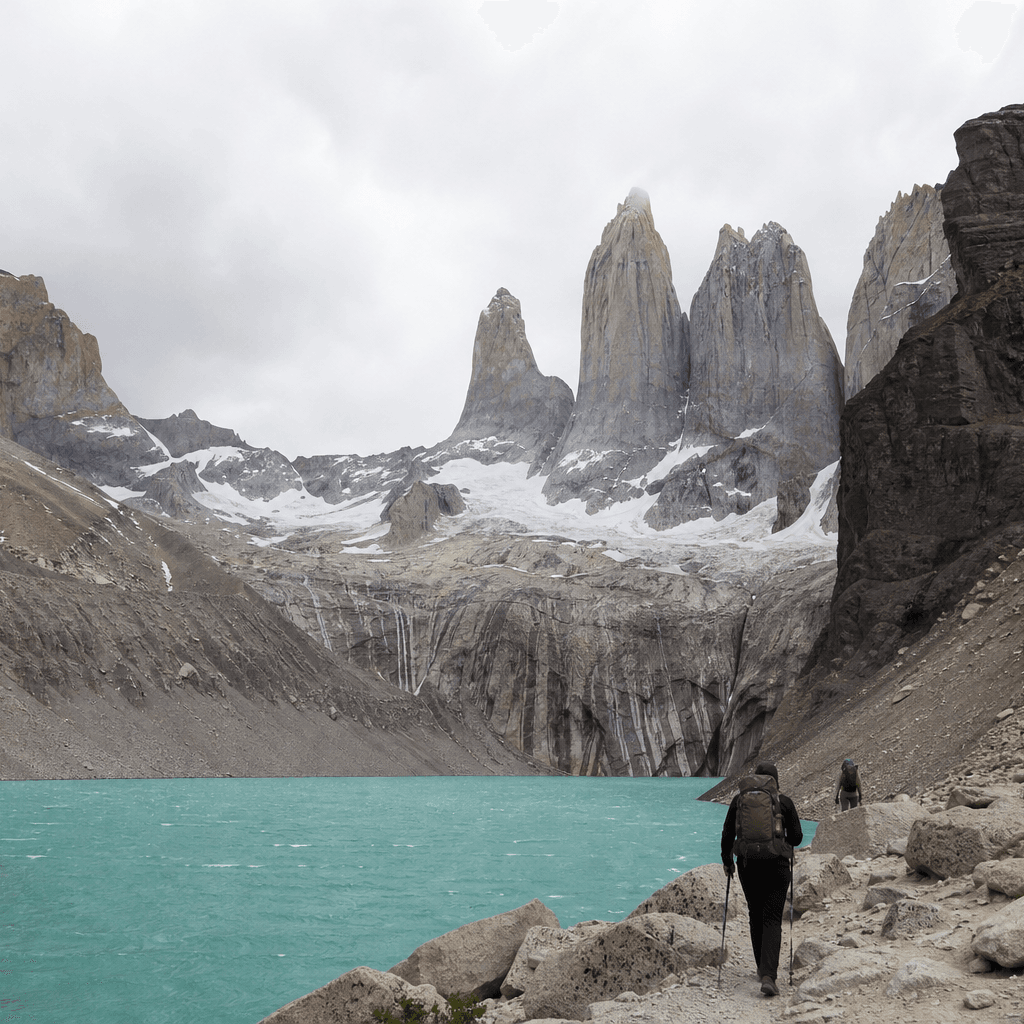
Torres del
Paine
~75 km W circuit (variant-dependent), typically 5 days with pre-booked camps/refugios.
Duration
5 days
Route distance
75.0km
Vertical Gain
+3,000m
Max Altitude
1,190m
Mission Brief
The Torres del Paine W-Trek is a five-day, ~75 km booked corridor through Grey Glacier, Francés Valley, and Base Torres in Chilean Patagonia.
Altitude stays below 1,200 m, but gale-force wind, rapid weather shifts, and multi-operator reservation rules define the trip as much as daily distance.
Patagonia's managed icon trek—Grey Glacier, Francés Valley, and Base Torres in five days on a booked refugio/campsite corridor.
Mission Snapshot
Intensity Breakdown
Understanding what drives the overall route demand
Physical
71
Technical
64
Commitment
83
Primary driver: Commitment
- Sustained Physical Output
- Significant Vertical Gain
- Technical Terrain Exposure
- High Remote Commitment
Advanced multi-day effort: heavy fatigue, logistics, or movement friction—not necessarily alpine exposure.
Full Route Breakdown
Complete stage overview with transparent route metrics. Values are shown as recorded in the route dataset and source links.
Distance
75.0 km
Ascent
3,000 m
Highest point
1,190 m
Start
Paine Grande to Grey Glacier
Finish
Chileno to Las Torres Central
Use the KM / MI toggle in the main menu to switch units.
Route Profile
Fixed backcountry campground structure for this route
Operational Reality
Stage distances sum to ~66 km for this dossier's five-day W sequence; headline 75 km includes connector variants and side-trip allowance. Not survey-grade GPS.
Route Considerations
Wind gusts above 100 km/h on ridges, booking enforcement at gates, and rapid hypothermia risk if layering fails—not altitude sickness.
Planning bottleneck
Accommodation along the route is managed by multiple private concessions (Vertice and Las Torres Patagonia) alongside public CONAF sites. Fragmentation of the booking process often results in gaps that prevent completion of the circuit.
Impact
Route-specific
Likelihood
Context-dependent
Tip
Confirmed reservations for every night of the transit are mandatory before entry. Early booking (4-6 months) via official aggregation platforms is required during the high season (November-March).
Climatological instability
The park experiences sudden and severe weather shifts. Wind speeds on exposed ridges and the French Valley can exceed 100 km/h, leading to temporary trail closures by park authorities.
Impact
Route-specific
Likelihood
Context-dependent
Tip
High-performance wind and waterproof layering systems are essential. Trekking poles are recommended for stability during high-wind gusts. Monitoring of CONAF weather alerts at trailhead stations is mandatory.
Terrain & conditions
Conditions change quickly on the ground. Slow down on wet rock and pay more attention where paths narrow or exposure increases.
Impact
Moderate
Likelihood
Variable
Tip
Refer to stage notes and expert briefings; maintain focus on slick or exposed sections.
Why hike this route?
LANDSCAPE
Direct interface with the Southern Patagonian Ice Field and the specific granite architecture of the Paine Massif.
VARIETY
The sequence of distinct ecosystems from high-altitude scree fields to low-elevation temperate forest.
CULTURE & PLACE
International trekkers sharing refugio dormitories and trail tips along the W circuit inside Torres del Paine National Park.
WHY GO
Patagonia's managed icon trek—Grey Glacier, Francés Valley, and Base Torres in five days on a booked refugio/campsite corridor.
Expert Verdict
“The W-Trek is a premier Patagonian experience, offering a high density of landmark views—from the Grey Glacier to the granite towers. While physically demanding due to long days and relentless wind, the primary hurdle for most hikers is purely logistical: securing reservations across three different booking systems months in advance. A robust packing list with wind gear (windproof shell, poles, layers, sun protection) is mandatory. The notoriously volatile weather dictates that using trekking poles is essential to maintain balance when gale-force winds hit the exposed valleys.”
Who This Is For
- INTERMEDIATE — Multi-day trekking experience and proficiency in managing equipment in volatile weather conditions.
- PHYSICAL — Moderate to High. Requires the ability to sustain 15-20km days on uneven gravel and rock surfaces under heavy external wind loads.
- WATCH FOR — Inadequate wind protection resulting in rapid heat loss on ridgelines.
- WATCH FOR — Failure to secure bookings months in advance, leading to turn-backs at park gates.
Plan This Hike
Key things to arrange before starting this route—practical tips first, then buttons that open curated picks (gear, maps, stays) where we list them.
Essential Gear
Recommended preparation for this route:
Wind-first Patagonia kit—shell over insulation.
- 3-layer hardshell; carbide-tip trekking poles
- Dry bags inside pack; merino base layers
- Printed/digital reservation vouchers for every night
Stay Connected
Explore accommodation options for this trail:
Negligible trail signal—refugio Wi-Fi only.
- Download park offline maps before Puerto Natales
- Monitor CONAF weather boards at trailheads
- Share reservation PDFs with a home contact
Getting There
Travel and trail access for this route:
Puerto Natales → Laguna Amarga bus, park shuttles/catamarans.
- Book CONAF entry tickets on official portal—rules change
- Synchronize Vertice + Las Torres nights across full W sequence
- Catamaran Paine Grande links Grey and central sectors
Where to Stay
Explore accommodation options for this trail:
Refugio or campsite every night—no walk-up guarantee.
- Reserve 4–6 months ahead for November–March
- Full-board vs self-cook changes pack weight materially
- Store extra luggage in Puerto Natales
Compare This Route
See how this route compares to similar hikes in overall demand and terrain profile.Compare routes by the shape of the effort, not only the headline score.
Tour du Cézallier
Closest overall match in demand profile
Known as the 'Tour des Vaches Rouges' (Tour of the Red Cows), the Tour du C...
Intensity
Slightly higher intensityThe East Coast Trail
Lower overall intensity, similar terrain type
Walking the edge of the continent. The East Coast Trail (ECT) is a network ...
Intensity
Lower intensityUpper Mustang
Higher physical or technical demand
The Forbidden Kingdom. Upper Mustang is a remote, arid enclave of Nepal tha...
Intensity
Higher intensityExplore Alternatives
Broaden the picture with easier, harder, and nearby options.
Looking for something easier?
Lower intensity — helpful if this route feels like a stretch right now.
Want more challenge?
Higher intensity — for when you are ready for a bigger physical or technical step.
Dientes de Navarino Circuit
magallanes-and-antarctica-chilena-region · chile
Distance
40.0 km
Ascent
2,100 m
Ancient Tea Horse Road
Yunnan / Shangri-La / Tiger Leaping Gorge · china
Distance
150.0 km
Ascent
6,000 m
Mount Kenya Traverse
mount-kenya-national-park · kenya
Distance
55.0 km
Ascent
2,000 m
More hikes in this region
Nearby and regionally relevant routes for the next step in your search.
Torres del Paine O-Circuit
patagonia · chile
Distance
136.0 km
Ascent
5,400 m
Puyehue Traverse
los-lagos-region-lake-district · chile
Distance
28.0 km
Ascent
1,800 m
Mirador Las Torres
patagonia · chile
Distance
22.0 km
Ascent
1,200 m
Exploradores Glacier
aisen · chile
Distance
6.0 km
Ascent
400 m
Paso Desolación
lakes-district · chile
Distance
12.0 km
Ascent
800 m
Grey Glacier and Lago de Grey
patagonia · chile
Distance
12.0 km
Ascent
300 m
Compare with any route
Pick any hike worldwide and open a full side-by-side comparison.
What You Need to Know
Essential answers about the demands, risks, and logistics of this route.
Q.How hard is this hike really?
Q.Do I need technical gear?
Q.Is water available on the route?
Q.What is the main risk?
Ready to hike Torres del Paine?
A final decision point after reviewing the route, risks, logistics, and alternatives.
This route is a strong match if you're comfortable with the effort level implied by an Intensity Score around 70/100 (Very Hard), sustained hiking where this route requires it, and the terrain and exposure described in this guide.
Build your itinerary, stages, and logistics.
Looking for something easier, more challenging, or a different terrain profile?
Compare routes by intensity, terrain, and region.
Data: official trail documentation and topographic sources · About