Dientes de
Navarino Circuit
Often described as one of the southernmost established multi-day trekking circuits in the world.
Duration
5 days
Route distance
40.0km
Vertical Gain
+2,100m
Max Altitude
850m
Mission Brief
Often described as one of the southernmost established multi-day trekking circuits in the world.
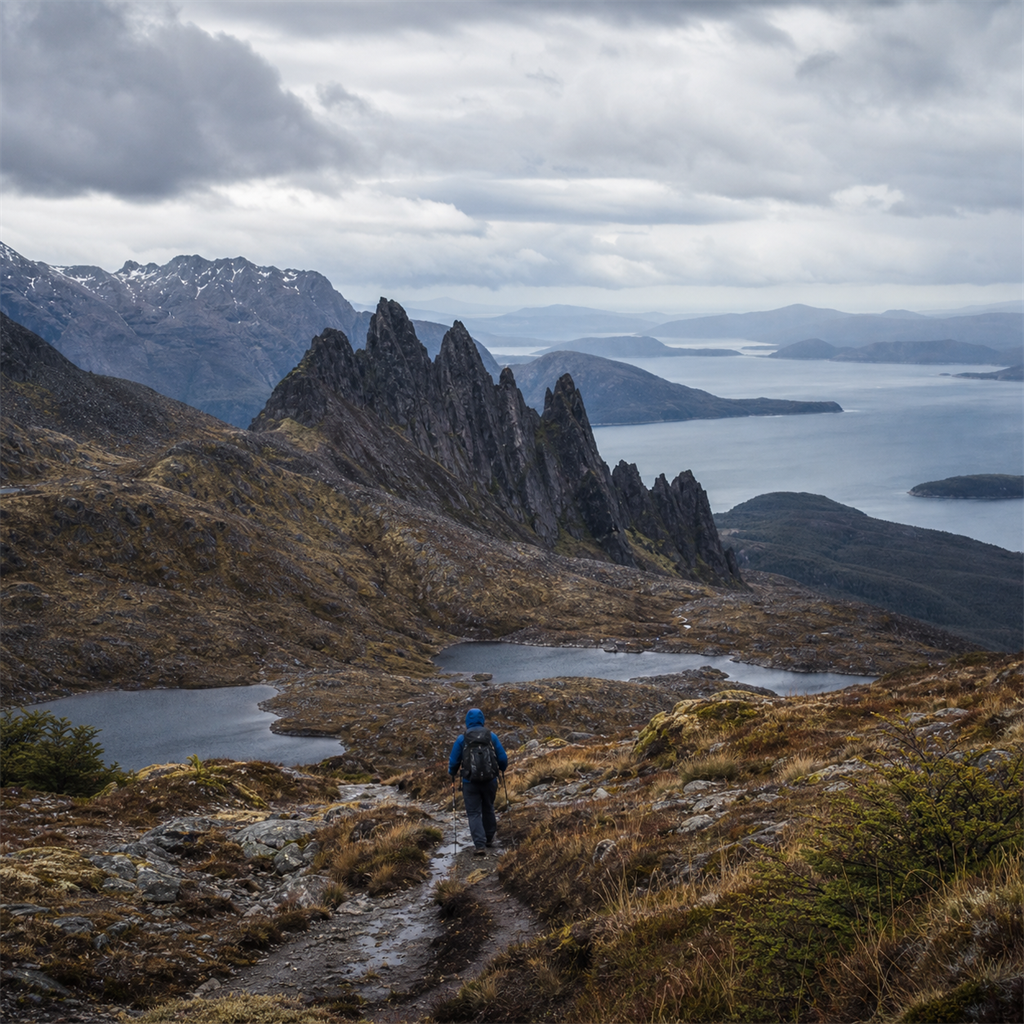
The Dientes de Navarino is a legendary 40-50km loop on Navarino Island, south of the Beagle Channel. This is 'extreme Patagonia'—a place where the wind is a constant companion and trails are often replaced by GPS coordinates and intuition. The circuit winds through the jagged Dientes range, crossing several steep passes like Paso Virginia and Paso Australia.
Trekkers experience a primeval landscape of stunted beech forests, peat bogs, and wind-scoured granite spires. It is a trek for the self-sufficient, offering a raw intensity and isolation that has vanished from more famous Patagonian routes.
The Absolute Edge of South America. Standing on the summit of Paso Virginia (850m) and looking south, there is nothing between you and the frozen continent of Antarctica except the churning waters of the Drake Passage a…
Mission Snapshot
Intensity Breakdown
Understanding what drives the overall route demand
Physical
63
Technical
73
Commitment
100
Primary driver: Commitment
- Sustained Physical Output
- Significant Vertical Gain
- Technical Terrain Exposure
- High Remote Commitment
High commitment routes with serious consequence, remote terrain, or sustained objective hazard.
Full Route Breakdown
Complete stage overview with transparent route metrics. Values are shown as recorded in the route dataset and source links.
Distance
40.0 km
Ascent
2,100 m
Highest point
850 m
Start
Puerto Williams to Laguna del Salto
Finish
Descent to the Beagle Channel
Use the KM / MI toggle in the main menu to switch units.
Route Considerations
This route is generally safe, but these are the main factors to be aware of.
Fast-flipping sub-Antarctic weather
Weather flips fast: wind + sleet can arrive in minutes. Gale-force winds and snow can occur on any day of the year, even at 400m elevation.
Impact
Route-specific
Likelihood
Context-dependent
Tip
Carry high-quality, professional-grade 4-season apparel; strictly monitor pressure changes if using a barometer; avoid high passes during white-outs; register mandatory trekking plans with the Chilean Carabineros in Puerto Williams.
Losing the route in fog and trackless terrain
Sections are faint cairns (hitos), bog paths, and rock fields where the line disappears in mist. There are no official trail markers.
Impact
Route-specific
Likelihood
Context-dependent
Tip
Proficiency with a topographic map and compass is non-negotiable; carry a dedicated hiking GPS with a pre-loaded GPX track; always have backup batteries kept warm against your body.
Physical fatigue from unstable terrain
Long sections involve loose scree (run-outs) and deep peat bogs where you can sink to above your ankles, effectively doubling the energy required for every kilometer.
Impact
Route-specific
Likelihood
Context-dependent
Tip
Use high-quality gaiters to keep mud out of boots; carry lightweight trekking poles for stability on moving rock; plan for short daily distances (8-10km), as terrain is much slower than it looks on a map.
Why hike this route?
LANDSCAPE
Jagged granite 'teeth' rising from deep blue lakes, and the infinite horizon toward Antarctica.
VARIETY
The total transition from the lush, wind-scoured forests to the stark, lunar alpine plateau.
CULTURE & PLACE
The unique, friendly atmosphere of Puerto Williams—the southernmost town in the world.
STANDOUT
The Absolute Edge of South America. Standing on the summit of Paso Virginia (850m) and looking south, there is nothing between you and the frozen continent of Antarctica except the churning waters of the Drake Passage and the lonely islands of Cape Horn. The feeling of being 'at…
Expert Verdict
“Dientes de Navarino is widely regarded as the most demanding trek in southern South America. The combination of trackless terrain, sub-Antarctic weather, and total self-sufficiency creates a challenge that goes well beyond physical fitness. Experienced trekkers recommend planning for 5-6 days (not 4), carrying a satellite messenger, and accepting that weather delays of 1-2 days are common. In very bad weather, parties often wait 1-2 days at a lagoon for a safe window to cross Paso Virginia. Average pace is 6-10 km per day due to bogs and route-finding. The descent from Paso Virginia involves 600m of steep scree that requires careful footing. Use the route sheet for Dientes de Navarino Circuit: ~40-45km (variant-dependent) over a 25-35-hour walking window, plus 2100 m of gain.”
Who This Is For
- EXPERT / ELITE — This is for the self-sufficient, expert trekker who has 'graduated' from the W and O circuits. You must be comfortable with full load navigation in trackless terrain and severe, unpredictable sub-Antarctic storms.
- PHYSICAL — Extreme. While the distance (38-40km) is short, the terrain is composed of deep peat bogs, loose scree, and dense stunted forest. Every kilometer takes twice as much effort as a marked trail.
- WATCH FOR — Attempting to follow 'trails' that are actually beaver dams; you'll end up chest-deep in a swamp.
- WATCH FOR — Underestimating the wind; it can literally lift your tent into the Beagle Channel if not properly staked with rocks.
Plan This Hike
Key things to arrange before starting this route—practical tips first, then buttons that open curated picks (gear, maps, stays) where we list them.
Essential Gear
Recommended preparation for this route:
Wind, bog and route-finding make expedition kit non-negotiable.
- Use a high-wind tent, full waterproofs, gaiters and trekking poles for bog and scree.
- Carry a reliable GPS track plus paper map and compass as backup.
- Pack extra dry bags; sustained wet weather finds weak points quickly.
Stay Connected
Explore accommodation options for this trail:
Registration and satellite messaging are the practical safety net.
- Register your trekking plan with Carabineros in Puerto Williams before departure.
- Carry an InReach or PLB because there is no cell coverage on the circuit.
- Plan for 1-2 weather-delay days before committing to Paso Virginia.
Getting There
Travel and trail access for this route:
Puerto Williams access is part of the expedition.
- Reach Puerto Williams by small aircraft or ferry from Punta Arenas, weather permitting.
- Confirm seasonal connections before booking a tight onward itinerary.
- Stock fuel and food in town; supply options are limited compared with larger hubs.
Where to Stay
Explore accommodation options for this trail:
There are no huts: wild camps and town hostels frame the route.
- Use hostel nights in Puerto Williams before and after the circuit for weather buffers.
- Choose sheltered lagoon camps and avoid exposed passes in whiteout or gale conditions.
- Carry all shelter, food and fuel for the full loop plus contingency time.
Compare This Route
See how this route compares to similar hikes in overall demand and terrain profile.Compare routes by the shape of the effort, not only the headline score.
Sarek National Park
Closest overall match in demand profile
The 'Last Wilderness' of Europe. Sarek National Park is a high-arctic mount...
Intensity
Slightly higher intensityTrolltunga
Lower overall intensity, similar terrain type
The Troll's Tongue. Trolltunga is one of Norway's most spectacular scenic c...
Intensity
Lower intensityYading Nature Reserve
Higher physical or technical demand
The 'Big Kora' is an advanced outer circumambulation route rarely undertake...
Intensity
Higher intensityExplore Alternatives
Broaden the picture with easier, harder, and nearby options.
Looking for something easier?
Lower intensity — helpful if this route feels like a stretch right now.
Want more challenge?
Higher intensity — for when you are ready for a bigger physical or technical step.
More hikes in this region
Nearby and regionally relevant routes for the next step in your search.
Torres del Paine O-Circuit
patagonia · chile
Distance
136.0 km
Ascent
5,400 m
Puyehue Traverse
los-lagos-region-lake-district · chile
Distance
28.0 km
Ascent
1,800 m
Mirador Las Torres
patagonia · chile
Distance
22.0 km
Ascent
1,200 m
Exploradores Glacier
aisen · chile
Distance
6.0 km
Ascent
400 m
Paso Desolación
lakes-district · chile
Distance
12.0 km
Ascent
800 m
Grey Glacier and Lago de Grey
patagonia · chile
Distance
12.0 km
Ascent
300 m
Compare with any route
Pick any hike worldwide and open a full side-by-side comparison.
What You Need to Know
Essential answers about the demands, risks, and logistics of this route.
Q.How hard is this hike really?
Q.Do I need technical gear?
Q.Is water available on the route?
Q.What is the main risk?
Ready to hike Dientes de Navarino Circuit?
A final decision point after reviewing the route, risks, logistics, and alternatives.
This route is a strong match if you're comfortable with the effort level implied by an Intensity Score around 84/100 (Severe), sustained hiking where this route requires it, and the terrain and exposure described in this guide.
Build your itinerary, stages, and logistics.
Looking for something easier, more challenging, or a different terrain profile?
Compare routes by intensity, terrain, and region.