Angels
Landing
Overview: Angels Landing is a prominent sandstone navigation point within Zion National Park, Utah.
Duration
1 day
Route distance
8.7km
Vertical Gain
+453m
Max Altitude
1,765m
Mission Brief
Overview: Angels Landing is a prominent sandstone navigation point within Zion National Park, Utah.
Geological Context: Rising 453 meters (1,488 feet) above the Virgin River, the formation consists of massive Navajo Sandstone layers shaped by long-term fluvial erosion. The trail incorporates the historic Walter's Wiggles switchbacks and segments of the West Rim Trail. Booking & Logistics Reality: Since 2022, a mandated permit lottery system (seasonal and day-before) is required to access the chain section beyond Scout Lookout.
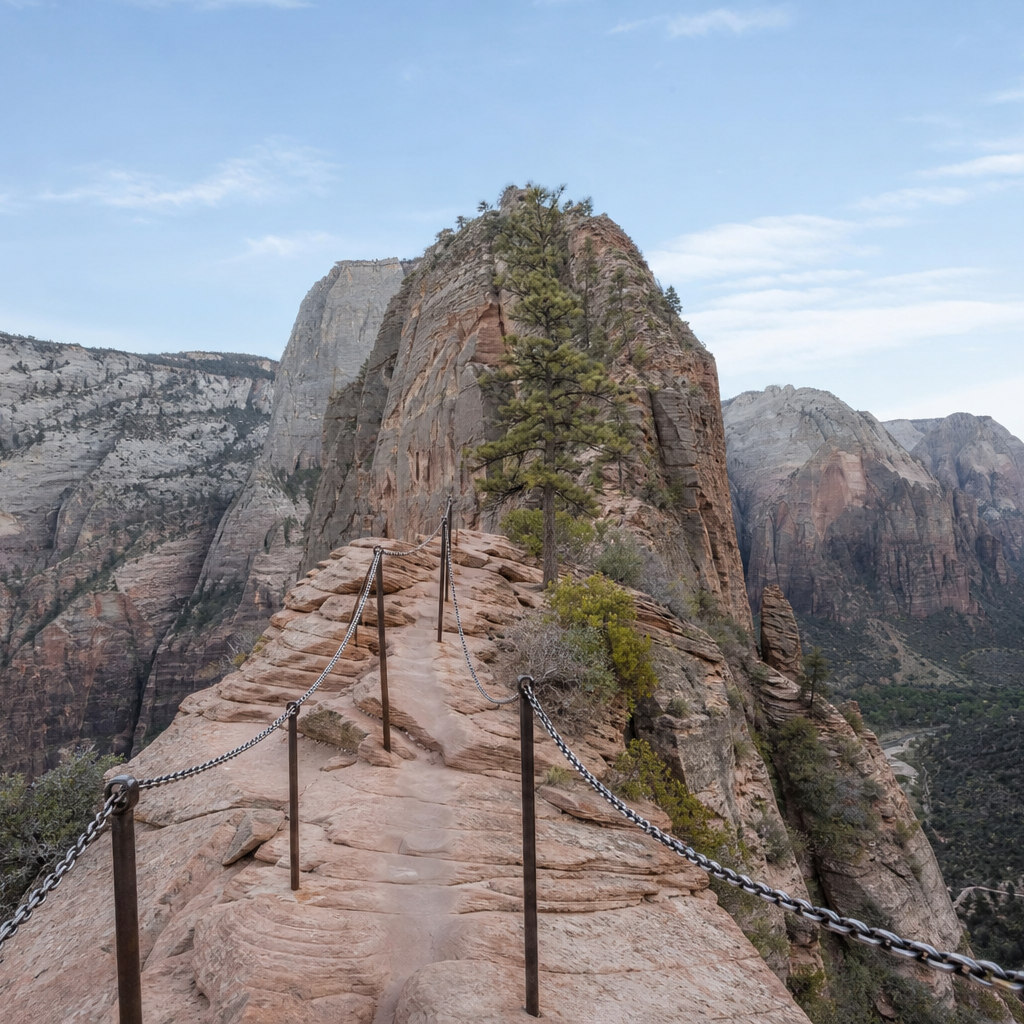
The final 0.8 kilometers (0.5 miles) involves a narrow ridge with steep drop-offs of approximately 300 meters (1,000 feet).
The Ridge Scramble. A defining feature of this route is the narrow sandstone bridge equipped with fixed iron chains for stability. Expedition accounts frequently cite the visual scale of Zion Canyon from the summit as a…
Mission Snapshot
Intensity Breakdown
Understanding what drives the overall route demand
Physical
27
Technical
52
Commitment
0
Primary driver: Technical seriousness
- Technical Terrain Exposure
Serious physical effort or sustained terrain friction. Demanding but not expedition-scale.
Full Route Breakdown
Complete stage overview with transparent route metrics. Values are shown as recorded in the route dataset and source links.
Distance
8.7 km
Ascent
453 m
Highest point
1,765 m
Start
The Grotto to Walter's Wiggles
Finish
The Fin and Summit
Use the KM / MI toggle in the main menu to switch units.
Route Profile
Out-and-back day-hike structure
Route Considerations
This route is generally safe, but these are the main factors to be aware of.
Extreme fall hazard
The final half-mile is highly exposed with serious drop-offs on both sides.
Impact
Route-specific
Likelihood
Context-dependent
Tip
Do not hike if you have vertigo. Do not hike in the rain, snow, or high winds. Maintain three points of contact on the chains.
Lightning
The peak is a lightning magnet during summer afternoon storms, and its exposed sandstone remains dangerous even after the main front passes.
Impact
Route-specific
Likelihood
Context-dependent
Tip
Start at first light to clear the ridge by midday; descend immediately if clouds build up; check specialized mountain forecasts before starting.
Crowd crush
The trail gets dangerously crowded, forcing people to pass each other on the narrowest sections of the chain.
Impact
Route-specific
Likelihood
Context-dependent
Tip
A highly competitive permit system was introduced in 2022 to regulate numbers. You should have a permit to hike past Scout Lookout.
Why hike this route?
LANDSCAPE
The vertical geometry of Zion Canyon. The Virgin River carved straight down, creating sheer cliffs rather than sloped mountains.
VARIETY
The transition from the cool, shaded Refrigerator Canyon to the blinding heat and exposure of the summit fin.
CULTURE & PLACE
The shared camaraderie (and terror) with fellow hikers on the chains.
STANDOUT
The Ridge Scramble. A defining feature of this route is the narrow sandstone bridge equipped with fixed iron chains for stability. Expedition accounts frequently cite the visual scale of Zion Canyon from the summit as a primary highlight. The experience provides direct observati…
Expert Verdict
“Technical Profile: Angels Landing is a documented Class 3 rock scramble on polished sandstone. Stage Breakdown: The initial ascent follows a paved path through Refrigerator Canyon to Scout Lookout via Walter's Wiggles. The final stage requires the use of fixed chains on a steep, narrow ridge. Hazard Assessment: The primary risk is the 300m vertical exposure. It is essential to use high-traction footwear and maintain focus during passing maneuvers on the chains. High temperatures and thunderstorms pose significant environmental stress. This route is typically more demanding in psychological load than technical climbing difficulty. Angels Landing's current record supports planning from 8.7km and 4-5 hours on foot, with 453 m of gain.”
Who This Is For
- INTERMEDIATE — While not technically difficult for a rock climber, it is extremely psychologically demanding due to the exposure. You should be comfortable with heights and scrambling.
- PHYSICAL — Medium. It is remarkably steep from start to finish.
- WATCH FOR — Hiking in the middle of a July afternoon. Over a dozen people are rescued annually due to severe heat exhaustion on the exposed fin.
- WATCH FOR — Rushing on the descent. Most serious falls occur on the way down when hikers are tired and descending slick rock.
Plan This Hike
Key things to arrange before starting this route—practical tips first, then buttons that open curated picks (gear, maps, stays) where we list them.
Permit Lottery
Practical next step for this hike:
Chain section requires Recreation.gov permit since 2022.
- Seasonal lottery + day-before lottery options
- Permit needed beyond Scout Lookout only
- Spring and fall dates most competitive
Exposure Prep
Practical next step for this hike:
Class 3 scramble on 300 m drop-offs.
- No hike in rain, snow, or high wind on the chains
- Sticky rubber footwear essential on polished sandstone
- Start early to avoid midday heat on the fin
Shuttle Access
Explore accommodation options for this trail:
Zion Canyon shuttle to The Grotto trailhead.
- Park at Springdale and ride shuttle in peak season
- Carry 2+ L water — no sources on route
- Afternoon thunderstorms close the ridge quickly
Essential Gear
Recommended preparation for this route:
Gloves optional; grip and hydration are not.
- High-traction approach shoes or hiking boots
- Sun protection — exposed ridge after Refrigerator Canyon
- Secure phone/bottle — drops endanger hikers below
Compare This Route
See how this route compares to similar hikes in overall demand and terrain profile.Compare routes by the shape of the effort, not only the headline score.
The Mist Trail
Closest overall match in demand profile
The Mist Trail is Yosemite's signature waterfall hike, providing an up-clos...
Intensity
Lower intensitySaxer Lücke
Lower overall intensity, similar terrain type
The Saxer Lücke is one of the most geographically dramatic points in the Al...
Intensity
Lower intensitySchäfler Ridge
Higher physical or technical demand
While the Ebenalp is most famous for the Aescher cliff-restaurant, the true...
Intensity
Higher intensityExplore Alternatives
Broaden the picture with easier, harder, and nearby options.
Looking for something easier?
Lower intensity — helpful if this route feels like a stretch right now.
Want more challenge?
Higher intensity — for when you are ready for a bigger physical or technical step.
More hikes in this region
Nearby and regionally relevant routes for the next step in your search.
Skyline Trail
Washington (Mount Rainier National Park) · usa
Distance
8.8 km
Ascent
520 m
The Wave
Arizona / Utah · usa
Distance
10.0 km
Ascent
200 m
Alum Cave Trail to Mount LeConte
Tennessee (Great Smoky Mountains) · usa
Distance
16.1 km
Ascent
850 m
Grinnell Glacier Trail
Montana (Glacier National Park) · usa
Distance
17.1 km
Ascent
560 m
Bright Angel Trail
Arizona (Grand Canyon National Park) · usa
Distance
30.6 km
Ascent
1,340 m
Coyote Gulch
Utah (Grand Staircase-Escalante) · usa
Distance
24.0 km
Ascent
300 m
Compare with any route
Pick any hike worldwide and open a full side-by-side comparison.
What You Need to Know
Essential answers about the demands, risks, and logistics of this route.
Q.How hard is this hike really?
Q.Do I need technical gear?
Q.Is water available on the route?
Q.What is the main risk?
Ready to hike Angels Landing?
A final decision point after reviewing the route, risks, logistics, and alternatives.
This route is a strong match if you're comfortable with the effort level implied by an Intensity Score around 47/100 (Hard), sustained hiking where this route requires it, and the terrain and exposure described in this guide.
Build your itinerary, stages, and logistics.
Looking for something easier, more challenging, or a different terrain profile?
Compare routes by intensity, terrain, and region.
Data: official trail documentation and topographic sources · About