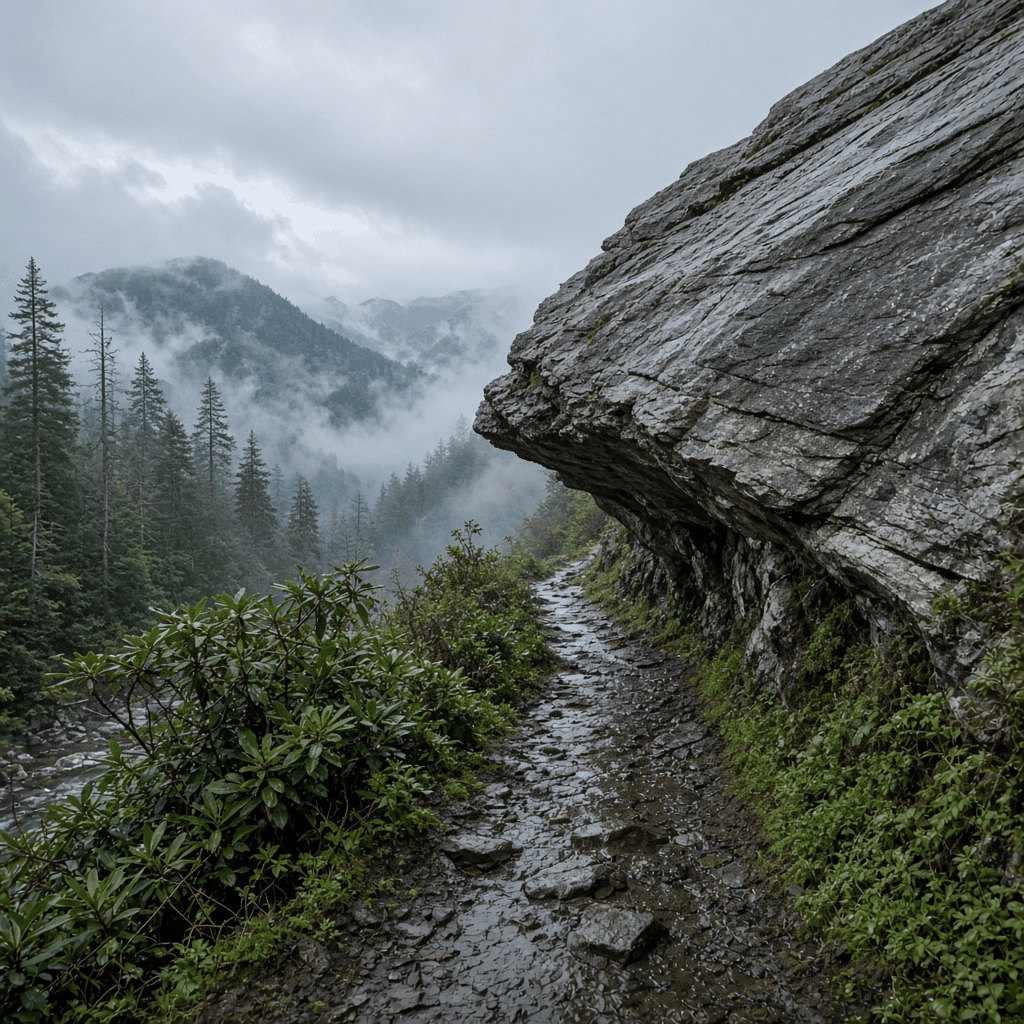
Alum Cave
Trail to Mount LeConte
16.1 km round-trip from Newfound Gap Road to High Top, with 850 m of rocky gain.
Duration
1 day
Route distance
16.1km
Vertical Gain
+850m
Max Altitude
2,010m
Mission Brief
Overview: The Alum Cave Trail is a primary route to the summit of Mount LeConte (2,010 m / 6,593 ft) in the Great Smoky Mountains National Park, Tennessee.
Geological Context: Unlike the dense forest cover typical of the region, this trail features distinctive geological formations including Arch Rock—a natural slate tunnel—and the Alum Cave Bluffs, a massive 80-foot high rock overhang. The high-elevation sections transition into a spruce-fir forest ecosystem similar to latitudes found in Canada. Booking & Logistics Reality: While the trail is a public day hike, staying at the summit requires advance reservations at the historic LeConte Lodge or a backcountry permit for the shelter.
The shortest, steepest walk to Mount LeConte, with Arch Rock and the Bluffs on the way.
Mission Snapshot
Intensity Breakdown
Understanding what drives the overall route demand
Physical
58
Technical
32
Commitment
22
Primary driver: Steep single-day Smokies climb with seasonal ice on cables
- 850 m gain on a 16 km rocky out-and-back
- Cable-assisted wet ledges above the Bluffs (Class 2, not ferrata)
- Ice and icicles into spring
- Parking-tag and dawn-lot logistics, not wilderness isolation
A hard day hike, not an expedition: rescue is likely on this crowded corridor, but the ledges and weather swing are real.
Full Route Breakdown
Complete stage overview with transparent route metrics. Values are shown as recorded in the route dataset and source links.
Distance
16.1 km
Ascent
850 m
Highest point
2,010 m
Start
Alum Cave Trailhead, Newfound Gap Road (US-441)
Finish
Alum Cave Trailhead (out-and-back)
Use the KM / MI toggle in the main menu to switch units.
Route Profile
Out-and-back day-hike structure
Operational Reality
Round-trip from Alum Cave Trailhead. Headline 16.1 km follows NPS (10 miles RT); one-way modelled at 8.05 km. Elevations 1,160–2,010 m and 850 m gain. Topography interpolates Arch Rock, the Bluffs, High Top, then the return. Sources: NPS Alum Cave / LeConte page and Hiking in the Smokys.
Route Considerations
This route is generally safe, but these are the main factors to be aware of.
Black bears
The Smokies are heavily populated with black bears. They are frequently seen near the trail and sometimes on it.
Impact
Route-specific
Likelihood
Context-dependent
Tip
Do not leave food unattended. Give bears wide clearance. Back away slowly; do not run.
Slippery rock ledges
Above Alum Cave Bluffs, the trail traverses exposed rock faces that are perpetually wet from seepingsprings or freezing rain.
Impact
Route-specific
Likelihood
Context-dependent
Tip
Hold the metal cables tightly. During winter or early spring, these ledges are covered in severe black ice requiring microspikes.
Terrain & conditions
Conditions change quickly on the ground. Slow down on wet rock and pay more attention where paths narrow or exposure increases.
Impact
Moderate
Likelihood
Variable
Tip
Refer to stage notes and expert briefings; maintain focus on slick or exposed sections.
Why hike this route?
LANDSCAPE
The dramatic cliff-face overhang of the Bluffs looking out over the densely forested valleys.
VARIETY
The incredible transition from a roaring rhododendron creek, to dry rocky ledges, to a dark, mossy spruce-fir forest.
CULTURE & PLACE
The historic LeConte Lodge at the summit, offering a sense of classic 1920s mountaineering hospitality.
WHY GO
The shortest, steepest walk to Mount LeConte, with Arch Rock and the Bluffs on the way.
Expert Verdict
“Technical Profile: The Alum Cave Trail is one of the most documented routes in the Great Smoky Mountains. Unlike the typical 'green tunnel' forest trails of the region, this route features exposed ledges and natural rock tunnels. Stage Breakdown: The journey transitions from low-elevation rhododendron creeks to high-altitude spruce-fir forests. Hazard Assessment: High-elevation weather can transition rapidly from temperate to sub-zero conditions. It is essential to use high-traction footwear for the rocky ledges and carry microspikes during winter months. The safer benchmark for Alum Cave Trail to Mount LeConte is its own sheet: 16.1 km round-trip, 5-8 walking hours, 850 m gain.”
Who This Is For
- INTERMEDIATE — Basic fitness for a steep 16 km round trip. Caution is needed when passing people on the narrow, cable-assisted ledges.
- PHYSICAL — Medium/High. The descent is strenuously hard on the knees due to the sheer volume of rocky, uneven steps.
- WATCH FOR — Wearing white sneakers. The lower section of the trail is often ankle-deep mud and horse manure (it is a stock trail).
- WATCH FOR — Failing to layer. Hikers sweating through cotton shirts on the climb freeze when the icy winds hit them at the 6,500-foot summit.
Plan This Hike
Key things to arrange before starting this route—practical tips first, then buttons that open curated picks (gear, maps, stays) where we list them.
Essential Gear
Recommended preparation for this route:
Waterproof boots and layers — the Smokies stay wet even in summer.
- Waterproof boots with real tread for slick rock
- Rain shell and a warm layer for the 2,010 m summit
- Microspikes from late fall through early spring
Stay Connected
Explore accommodation options for this trail:
Spotty cell; the trail is busy enough that help usually finds you.
- No reliable signal at the trailhead
- Carry water — Alum Cave Creek is the lower section only
- LeConte Lodge sells drinking water at the summit in season
Getting There
Travel and trail access for this route:
Alum Cave Trailhead on Newfound Gap Road, about 12 miles south of Gatlinburg.
- NPS parking tag required ($5/day as of 2023)
- The lot fills by 7 AM on summer and October weekends
- No park entrance fee; illegal parking is towed
Where to Stay
Explore accommodation options for this trail:
Day hikers base in Gatlinburg; the summit lodge books a year out.
- LeConte Lodge is walk-in only and uses a lottery
- The backcountry shelter needs an NPS reservation
- Gatlinburg cabins are the usual pre-dawn base
Compare This Route
See how this route compares to similar hikes in overall demand and terrain profile.Compare routes by the shape of the effort, not only the headline score.
Volcán Maderas
Closest overall match in demand profile
The green twin of Ometepe. Volcán Maderas (1,394m) is the smaller and more ...
Intensity
Higher intensityCerro Tronador
Lower overall intensity, similar terrain type
This two-day Patagonia hike leads to Refugio Otto Meiling on the slopes of ...
Intensity
Lower intensityPedra da Gávea
Higher physical or technical demand
Pedra da Gávea (844m) is often described locally as one of the largest coas...
Intensity
Higher intensityExplore Alternatives
Broaden the picture with easier, harder, and nearby options.
Looking for something easier?
Lower intensity — helpful if this route feels like a stretch right now.
Want more challenge?
Higher intensity — for when you are ready for a bigger physical or technical step.
More hikes in this region
Nearby and regionally relevant routes for the next step in your search.
Skyline Trail
Washington (Mount Rainier National Park) · usa
Distance
8.8 km
Ascent
520 m
The Wave
Arizona / Utah · usa
Distance
10.0 km
Ascent
200 m
Grinnell Glacier Trail
Montana (Glacier National Park) · usa
Distance
17.1 km
Ascent
560 m
Angels Landing
Utah (Zion National Park) · usa
Distance
8.7 km
Ascent
453 m
Grand Canyon Rim-to-Rim
arizona · usa
Distance
38.0 km
Ascent
1,400 m
The Highline Trail
Montana (Glacier National Park) · usa
Distance
18.6 km
Ascent
580 m
Compare with any route
Pick any hike worldwide and open a full side-by-side comparison.
What You Need to Know
Essential answers about the demands, risks, and logistics of this route.
Q.How hard is this hike really?
Q.Do I need technical gear?
Q.Is water available on the route?
Q.What is the main risk?
Ready to hike Alum Cave Trail to Mount LeConte?
A final decision point after reviewing the route, risks, logistics, and alternatives.
This route is a strong match if you're comfortable with the effort level implied by an Intensity Score around 52/100 (Hard), sustained hiking where this route requires it, and the terrain and exposure described in this guide.
Build your itinerary, stages, and logistics.
Looking for something easier, more challenging, or a different terrain profile?
Compare routes by intensity, terrain, and region.
Data: official trail documentation and topographic sources · About