Saxer
Lücke
13 km Staubern to Brülisau: a short climb, then 1,140 m of descent past Saxer Lücke and Fählensee.
Duration
1 day
Route distance
13.0km
Vertical Gain
+320m
Max Altitude
1,820m
Mission Brief
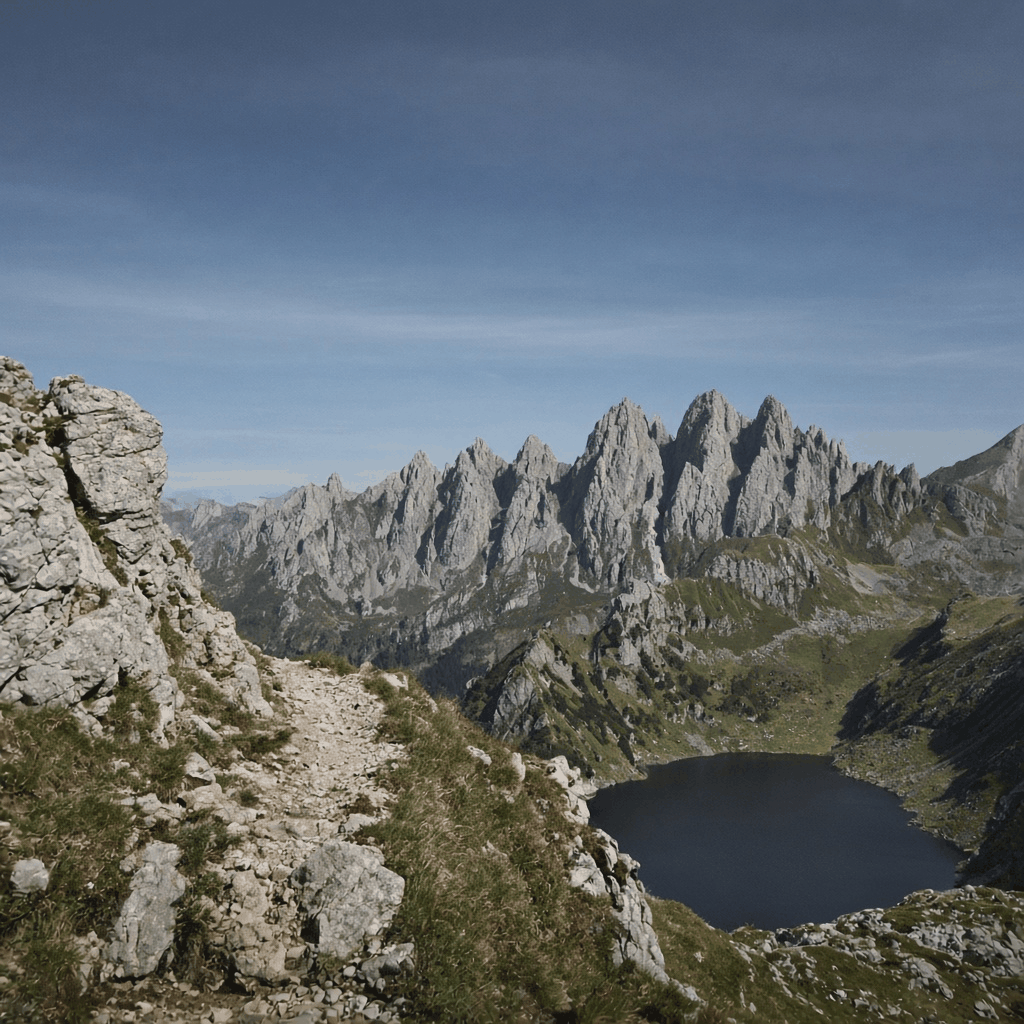
The Saxer Lücke is one of the most geographically dramatic points in the Alpstein massif.
This 'Lücke' (gap) sits between the vertical limestone 'teeth' of the Kreuzberge and the Rhine valley floor, nearly 1,200m below. The trail from the Staubern cable car station follows a spectacularly flat ridge-line path before descending into the gap. Beyond the gap, the trail drops further to the Fählensee, a dark, fjord-like lake surrounded by vertical rock walls.
The contrast between the rolling hills of Appenzell and the sheer, jagged limestone of the Saxer Lücke is staggering.
The Alpstein's limestone gateway: Kreuzberge teeth, an airy T2 ridge, and Fählensee on the long descent to Brülisau.
Mission Snapshot
Intensity Breakdown
Understanding what drives the overall route demand
Physical
42
Technical
22
Commitment
18
Primary driver: Airy Alpstein day hike with a long descent, not a via ferrata
- T2 airy ridge above the Rhine valley
- About 1,140 m of knee-loading descent
- Cable-car plus bus/return logistics
- Wind on the Staubern balcony
Serious physical effort or sustained terrain friction. Demanding but not expedition-scale.
Full Route Breakdown
Complete stage overview with transparent route metrics. Values are shown as recorded in the route dataset and source links.
Distance
13.0 km
Ascent
320 m
Highest point
1,820 m
Start
Berggasthaus Staubern (cable car from Frümsen)
Finish
Brülisau village
Use the KM / MI toggle in the main menu to switch units.
Route Profile
Single-day stage structure
Operational Reality
Point-to-point from Staubern to Brülisau. Headline 13 km is walking distance after the Frümsen–Staubern cable car. Elevations 921–1,820 m, 320 m gain and 1,140 m loss. Topography interpolates the balcony, Saxer Lücke, Bollenwees, and the forest descent. Sources: Staubern.ch and Bollenwees.ch.
Route Considerations
This route is generally safe, but these are the main factors to be aware of.
Steep descent fatigue
The descent from the Saxer Lücke to Fählensee is sharp and rocky, putting significant strain on the knees.
Impact
Route-specific
Likelihood
Context-dependent
Tip
Use trekking poles; take small, controlled steps on the switchbacks.
Exposure on ridge
While the path is wide, the drops into the Rhine valley are vertical and can trigger vertigo.
Impact
Route-specific
Likelihood
Context-dependent
Tip
Stay on the center of the path; those with severe vertigo should avoid the ridge variant and take the valley approach from Sax.
Terrain & conditions
Conditions change quickly on the ground. Slow down on wet rock and pay more attention where paths narrow or exposure increases.
Impact
Moderate
Likelihood
Variable
Tip
Refer to stage notes and expert briefings; maintain focus on slick or exposed sections.
Why hike this route?
LANDSCAPE
The jagged Kreuzberge 'teeth'.
VARIETY
High-ridge views and moody lake basins.
CULTURE & PLACE
Appenzell's mountain hospitality—the 'Rösti' at Bollenwees is iconic.
WHY GO
The Alpstein's limestone gateway: Kreuzberge teeth, an airy T2 ridge, and Fählensee on the long descent to Brülisau.
Expert Verdict
“If you want a Swiss limestone-needle experience, this is it. The Kreuzberge provide an architectural rock landscape that is unique in the country. For this itinerary, Saxer Lücke's own metrics set the effort band: 13 km Staubern to Brülisau, 320 m gain, about 1,140 m loss, and 5-6 hours on foot.”
Who This Is For
- INTERMEDIATE — Experience with sustained downhill walking and mountain terrain.
- PHYSICAL — Medium. The descent is the hardest part.
- WATCH FOR — Stopping at the gap and not walking down to the lake—it's worth the extra height loss.
- WATCH FOR — Underestimating the knees on the descent.
Plan This Hike
Key things to arrange before starting this route—practical tips first, then buttons that open curated picks (gear, maps, stays) where we list them.
Essential Gear
Recommended preparation for this route:
Ankle-support boots and poles — the descent is the hard part.
- Sturdy mountain boots with ankle support
- Trekking poles for the Saxer Lücke–Brülisau drop
- Wind layer for the Staubern ridge
Stay Connected
Explore accommodation options for this trail:
Signal is strong on the ridge and drops in the Fählensee basin.
- Ridge coverage is usually good
- Basin around Fählensee can go quiet
- Bollenwees is the reliable water and food stop
Getting There
Travel and trail access for this route:
Cable car from Frümsen to Staubern; finish on foot in Brülisau.
- Paid lot at the Frümsen valley station
- Plan a bus or second car for the Brülisau finish
- Do not start from Hoher Kasten — that is a much longer walk
Where to Stay
Explore accommodation options for this trail:
Bollenwees sits on Fählensee; Appenzell villages are the valley base.
- Berggasthaus Bollenwees is the classic lake overnight
- Staubern has a mountain inn at the cable-car top
- Brülisau and Appenzell cover pre- and post-hike beds
Compare This Route
See how this route compares to similar hikes in overall demand and terrain profile.Compare routes by the shape of the effort, not only the headline score.
Blue Ice Trail
Closest overall match in demand profile
The Blue Ice Trail is South Greenland's definitive day-hike, a 16km (10-mil...
Intensity
Higher intensityThe Grouse Grind
Lower overall intensity, similar terrain type
Vancouver’s “Mother Nature’s Stairmaster”: a 2.5 km one-way climb up the fa...
Intensity
Lower intensityCerro Tronador
Higher physical or technical demand
This two-day Patagonia hike leads to Refugio Otto Meiling on the slopes of ...
Intensity
Higher intensityExplore Alternatives
Broaden the picture with easier, harder, and nearby options.
Looking for something easier?
Lower intensity — helpful if this route feels like a stretch right now.
Want more challenge?
Higher intensity — for when you are ready for a bigger physical or technical step.
More hikes in this region
Nearby and regionally relevant routes for the next step in your search.
Schäfler Ridge
Appenzell, Alpstein · switzerland
Distance
10.5 km
Ascent
450 m
Meiringen to Grindelwald via Grosse Scheidegg
Bernese Oberland · switzerland
Distance
23.0 km
Ascent
1,500 m
Sonogno to Lavertezzo
Ticino · switzerland
Distance
14.0 km
Ascent
260 m
Riffelalp to Riffelberg
Zermatt, Valais · switzerland
Distance
7.5 km
Ascent
420 m
Kleine Scheidegg to Wengen
Jungfrau Region, Berner Oberland · switzerland
Distance
9.2 km
Ascent
50 m
Schynige Platte Panorama Trail
Interlaken, Berner Oberland · switzerland
Distance
6.0 km
Ascent
258 m
Compare with any route
Pick any hike worldwide and open a full side-by-side comparison.
What You Need to Know
Essential answers about the demands, risks, and logistics of this route.
Q.How hard is this hike really?
Q.Do I need technical gear?
Q.Is water available on the route?
Q.What is the main risk?
Ready to hike Saxer Lücke?
A final decision point after reviewing the route, risks, logistics, and alternatives.
This route is a strong match if you're comfortable with the effort level implied by an Intensity Score around 42/100 (Hard), sustained hiking where this route requires it, and the terrain and exposure described in this guide.
Build your itinerary, stages, and logistics.
Looking for something easier, more challenging, or a different terrain profile?
Compare routes by intensity, terrain, and region.
Data: official trail documentation and topographic sources · About