Mount
Hallasan
~18.3 km through-hike from Gwaneumsa to Seongpanak; typically requires 7–9 hours.
Duration
1 day
Route distance
18.3km
Vertical Gain
+1,380m
Max Altitude
1,947m
Mission Brief
The guardian of the island.
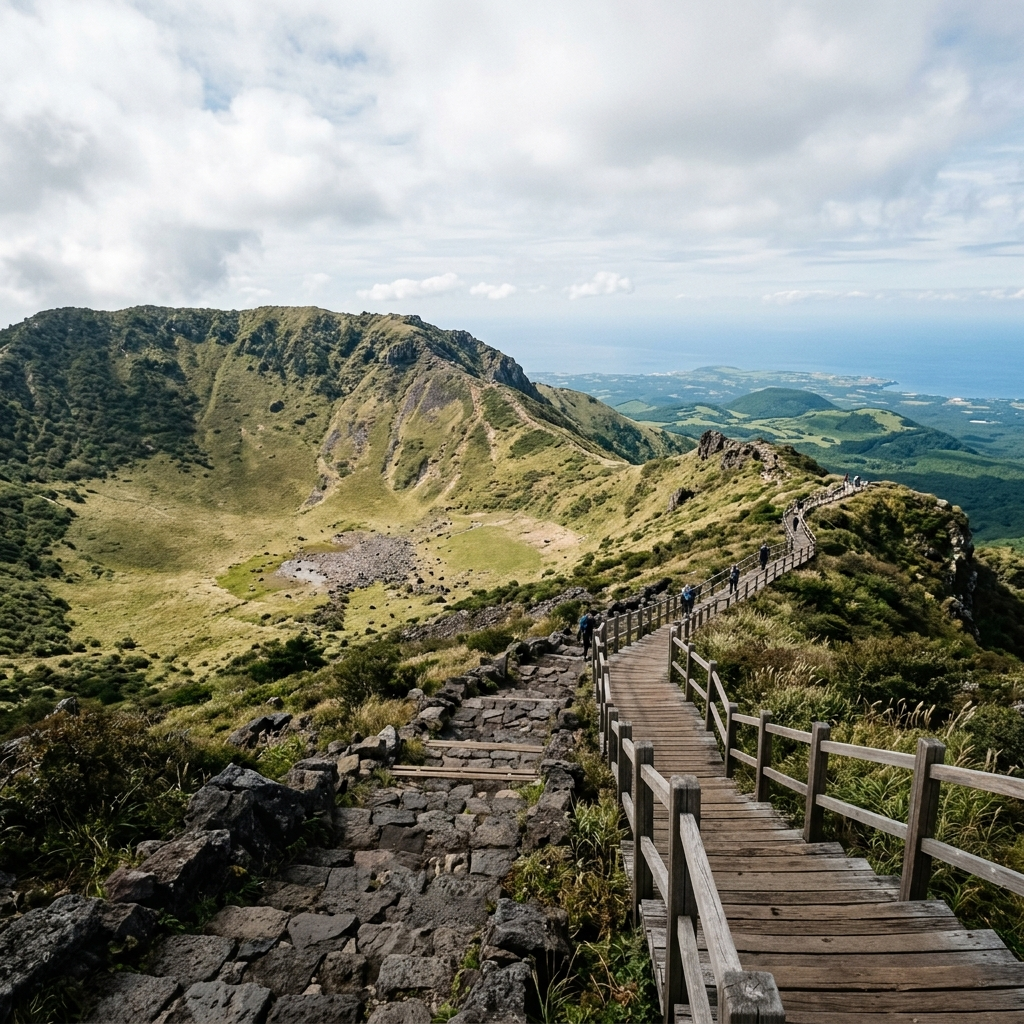
Mount Hallasan is a majestic shield volcano that forms the bulk of Jeju Island. As a UNESCO World Heritage site, it offers a beautifully maintained trail network through unique basaltic landscapes and diverse flora. The trek to the summit is a full-day commitment, ascending through ancient stone-oak and fir forests into a subalpine zone.
At the summit, hikers are rewarded with a direct view into the Baengnokdam—a vast crater and seasonal lake (White Deer Lake)—and, on clear days, panoramic views of the entire Jeju coastline and its surrounding volcanic 'oreums'.
The highest peak in South Korea—an iconic day-long pilgrimage to the summit of Jeju Island's massive shield volcano and its crater lake.
Mission Snapshot
Intensity Breakdown
Understanding what drives the overall route demand
Physical
47
Technical
22
Commitment
35
Primary driver: Physical load
- Standard Recreational Effort
Serious physical effort or sustained terrain friction. Demanding but not expedition-scale.
Full Route Breakdown
Complete stage overview with transparent route metrics. Values are shown as recorded in the route dataset and source links.
Distance
18.3 km
Ascent
1,380 m
Highest point
1,947 m
Start
Gwaneumsa Trailhead
Finish
The Summit Rim (Baengnokdam)
Use the KM / MI toggle in the main menu to switch units.
Route Profile
Single-day stage structure
Operational Reality
Itinerary assumes ascending via the steeper Gwaneumsa trail and descending via the more gradual Seongpanak route. Not survey-grade GPS.
Route Considerations
Sudden mountain weather swings (gale-force winds, thick fog) and joint fatigue from hard basalt stairs.
Weather and visibility
Jeju's weather is notoriously fickle; thick fog and heavy wind can obscure the trail and the summit views in minutes.
Impact
Route-specific
Likelihood
Context-dependent
Tip
Check the Hallasan mountain webcam and weather report before starting; carry a windproof shell even in summer; use the trail markers which are reliably placed even in low visibility.
Strict checkpoint times
To ensure hikers return before dark, there are strict cut-off times at mid-way shelters (e.g., Jindallaebat). If you arrive late, you will be denied access to the summit.
Impact
Route-specific
Likelihood
Context-dependent
Tip
Start your hike at the crack of dawn (before 7 AM); maintain a steady pace; check the current seasonal cut-off times on the National Park website before departure.
Terrain & conditions
Conditions change quickly on the ground. Slow down on wet rock and pay more attention where paths narrow or exposure increases.
Impact
Moderate
Likelihood
Variable
Tip
Refer to stage notes and expert briefings; maintain focus on slick or exposed sections.
Why hike this route?
LANDSCAPE
The perfectly preserved volcanic crater (Baengnokdam) and the unique Jeju 'oreums' (satellite cones) dotting the landscape below.
VARIETY
Passing through three distinct climate zones—temperate forest, subalpine firs, and the raw volcanic summit rim.
CULTURE & PLACE
The shared sense of purpose among Korean hikers—the summit is a place of celebration, photos, and 'Kimchi-style' camaraderie.
WHY GO
The highest peak in South Korea—an iconic day-long pilgrimage to the summit of Jeju Island's massive shield volcano and its crater lake.
Expert Verdict
“Hallasan is a masterclass in trail management. Experienced hikers often suggest ascending via the Gwaneumsa trail and descending via Seongpanak. Gwaneumsa is much steeper but spectacular, featuring deep canyons and vertical cliffs that the Seongpanak route misses. Bring a small thermos of hot water and a cup-ramen. While the shelters no longer sell food, eating hot noodles at the summit while looking into the crater is the unofficial Korean hiking 'rite of passage'. Also, buy a pair of lightweight knee-braces; the basalt steps have no 'give' and will punish your joints by the 15th kilometer. The route is straightforward, but the logistics and hard stair descent make it a full-value day.”
Who This Is For
- INTERMEDIATE — For active travelers who want to conquer South Korea's highest peak. You don't need technical skills, but you need significant stamina for a 9-hour day of stair-climbing. It is an extremely well-organized trail, perfect for those who appreciate infrastructure and safety over raw…
- PHYSICAL — High. Hallasan is a 'staircase to heaven'. The trail consists of thousands of uneven basalt stones and wooden steps. It is relentless on the knees, particularly on the 10km descent.
- WATCH FOR — Showing up without a QR-code reservation; the rangers at the entrance gate are strict and will not let you pass.
- WATCH FOR — Missing the 12:30 PM or 1:00 PM (seasonal vary) cut-off at the Jindallaebat shelter; if you are one minute late, the gate to the summit will be locked.
Plan This Hike
Key things to arrange before starting this route—practical tips first, then buttons that open curated picks (gear, maps, stays) where we list them.
Essential Gear
Recommended preparation for this route:
Joint protection, wind shell, and reservation QR code.
- Lightweight knee-braces to cushion basalt steps
- Windbreaker and rain shell—Jeju is known for intense wind
- QR code reservation (printed or on phone)—required at gates
Stay Connected
Explore accommodation options for this trail:
Excellent cell signal across the entire volcano.
- South Korean mobile networks work even at the summit
- Webcams at the summit can be checked online before starting
- Download KakaoMap or Naver Map for local Jeju transit
Getting There
Travel and trail access for this route:
Jeju City to Gwaneumsa or Seongpanak trailheads.
- Take Bus 281 or 181 from Jeju City to Seongpanak trailhead
- Short taxi ride (10 mins) connects the two trailheads
- Arrive before 7:30 AM to secure trailhead parking slots
Where to Stay
Explore accommodation options for this trail:
No camping allowed. Stay in Jeju City or Seogwipo.
- Jeju City has excellent hotels and transport links
- Camping and overnight stays on Hallasan are strictly illegal
- Book summit reservation slot at least 3-4 weeks in advance
Compare This Route
See how this route compares to similar hikes in overall demand and terrain profile.Compare routes by the shape of the effort, not only the headline score.
Mount Fitz Roy
Closest overall match in demand profile
The trek to Laguna de los Tres is one of the primary day activities in Los ...
Intensity
Higher intensityTiger Fern Trail
Lower overall intensity, similar terrain type
A strenuous jungle route within the Cockscomb Basin Wildlife Sanctuary. The...
Intensity
Lower intensityMount Fitz Roy
Higher physical or technical demand
The trek to Laguna de los Tres is one of the primary day activities in Los ...
Intensity
Higher intensityExplore Alternatives
Broaden the picture with easier, harder, and nearby options.
Looking for something easier?
Lower intensity — helpful if this route feels like a stretch right now.
Want more challenge?
Higher intensity — for when you are ready for a bigger physical or technical step.
More hikes in this region
Nearby and regionally relevant routes for the next step in your search.
Compare with any route
Pick any hike worldwide and open a full side-by-side comparison.
What You Need to Know
Essential answers about the demands, risks, and logistics of this route.
Q.How hard is this hike really?
Q.Do I need technical gear?
Q.Is water available on the route?
Q.What is the main risk?
Ready to hike Mount Hallasan?
A final decision point after reviewing the route, risks, logistics, and alternatives.
This route is a strong match if you're comfortable with the effort level implied by an Intensity Score around 45/100 (Hard), sustained hiking where this route requires it, and the terrain and exposure described in this guide.
Build your itinerary, stages, and logistics.
Looking for something easier, more challenging, or a different terrain profile?
Compare routes by intensity, terrain, and region.
Data: official trail documentation and topographic sources · About