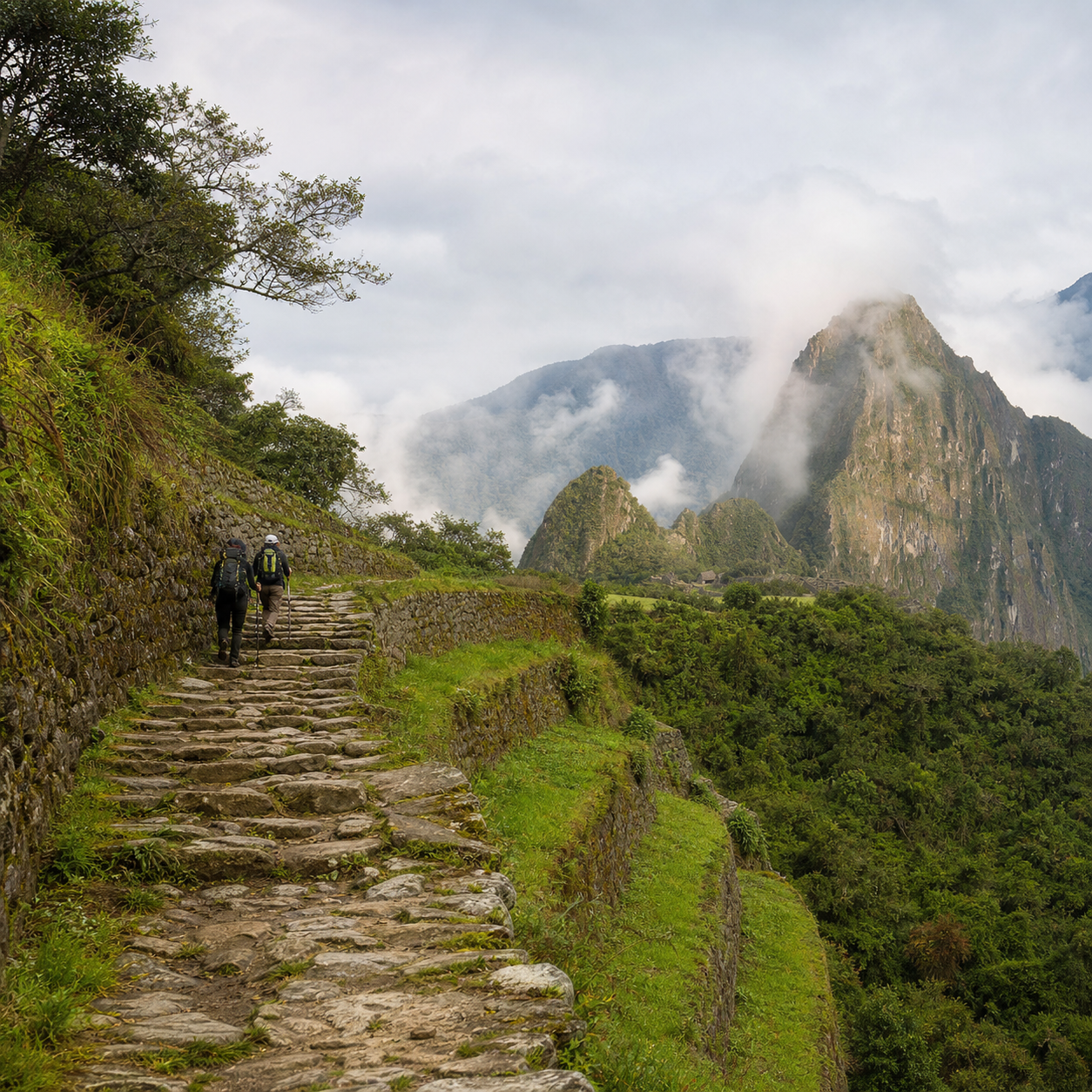
The Classic
Inca Trail
The journey begins at Km 82, where the crossing of the Urubamba River marks the transition from the modern world to the ancient empire of the Sun.
Duration
4 days
Route distance
42.0km
Vertical Gain
+2,200m
Max Altitude
4,215m
Mission Brief
The pilgrimage of the Sun.
The Classic Inca Trail is 42km (26 miles) of ancient stone path connecting the Sacred Valley with the citadel of Machu Picchu. Built by the Incas as a ceremonial route, it traverses three high Andean passes, winds through lush humid forest, and passes numerous archeological sites (Runkurakay, Sayacmarca, Phuyupatamarca) that can only be reached by foot. The climax is the arrival at Inti Punku (the Sun Gate), providing the first and most legendary aerial view of Machu Picchu.
The narrative shifts into humid Andean forest on the third day, a sequence of hidden archeological gems like Sayacmarca and Phuyupatamarca that appear like ghosts in the mist. The path becomes narrower and more lush, su…
Mission Snapshot
Intensity Breakdown
Understanding what drives the overall route demand
Physical
70
Technical
64
Commitment
83
Primary driver: Commitment
- Sustained Physical Output
- Significant Vertical Gain
- Technical Terrain Exposure
- High Remote Commitment
Advanced multi-day effort: heavy fatigue, logistics, or movement friction—not necessarily alpine exposure.
Full Route Breakdown
Complete stage overview with transparent route metrics. Values are shown as recorded in the route dataset and source links.
Distance
42.0 km
Ascent
2,200 m
Highest point
4,215 m
Start
The Valley Floor
Finish
Machu Picchu
Use the KM / MI toggle in the main menu to switch units.
Route Profile
Multi-day stage structure
Route Considerations
This route is generally safe, but these are the main factors to be aware of.
Logistical lockout
Permits are strictly limited (500/day including staff) and often sell out 6-9 months in advance.
Impact
Route-specific
Likelihood
Context-dependent
Tip
Book your trek as soon as permits go on sale (usually October/November for the following year); work only with licensed operators.
Altitude and knee strain
The trek is a sequence of thousands of ancient, uneven stone steps that are strenuous on the knees.
Impact
Route-specific
Likelihood
Context-dependent
Tip
Use trekking poles with rubber tips (often required); take plenty of time for acclimatization in Cusco (3 days min); wear sturdy boots with good cushioning.
Altitude Warning
Potential altitude-related conditions include AMS, HAPE, and HACE. Adequate acclimatization is essential.
Impact
Route-specific
Likelihood
Context-dependent
Tip
Strict adherence to hydration and gradual ascent protocols (climb high, sleep low).
Why hike this route?
LANDSCAPE
Cloud forests, orchids, and massive Andean peaks. It's like walking through a National Geographic cover.
VARIETY
You go from dusty valley floors to jagged passes and finally into the lush, emerald green of the high jungle.
CULTURE & PLACE
The sheer awe of seeing how the Incas built a road system that still holds up 500 years later.
STANDOUT
Crossing Dead Woman's Pass and the Sun Gate Reveal. The 'X-Factor' is the emotional journey. Reaching the summit of Warmiwañusca (Dead Woman's Pass) at 4,215 meters—the highest and hardest point—is a moment of pure triumph. However, nothing compares to Day 4 at dawn: walking thr…
Expert Verdict
“The Inca Trail is a victim of its own success—it's crowded. But there's a reason for it. No other trek gives you that pre-dawn entrance through the Sun Gate. My cut your toenails short before Day 3; the long descent into Winay Wayna after the third pass is where long nails go to die. The Classic Inca Trail's planning margin comes from the record data itself: 42km, 2200 m up and E2 exposure.”
Who This Is For
- INTERMEDIATE — You don't need to be a pro, but you shouldn't be a stranger to hiking. Experience with steep stairs and mountain weather is key.
- PHYSICAL — Moderate. It's the 'Dead Woman's Pass' that earns the trail its reputation. The constant up-and-down on hard stone steps is a major test for your quadriceps and knees.
- WATCH FOR — Booking your flights before securing your trail permit.
- WATCH FOR — Arriving in Cusco and trying to hike the next day (AMS will hit you hard).
Plan This Hike
Key things to arrange before starting this route—practical tips first, then buttons that open curated picks (gear, maps, stays) where we list them.
Essential Gear
Recommended preparation for this route:
Stone steps, cold camps and wet forest demand practical kit.
- Bring trekking poles with rubber tips for the long stone descents.
- Pack layers for hot valleys, cold camps and wet forest sections.
- Carry your passport and permit details for checkpoints on the route.
Stay Connected
Explore accommodation options for this trail:
Permits, offline maps and operator contacts are the essentials.
- Phone coverage is unreliable between camps; keep offline maps and operator contacts.
- Confirm permit, guide and campsite allocation before booking flights.
- Use a small dry bag for documents and electronics during rain-heavy sections.
Getting There
Travel and trail access for this route:
Cusco staging and Km 82 access shape the whole itinerary.
- Stage from Cusco and transfer with your operator to the Km 82 trailhead.
- Plan several days in Cusco before the trek for altitude acclimatization.
- Return logistics usually run by train from Machu Picchu Pueblo back toward Cusco.
Where to Stay
Explore accommodation options for this trail:
Overnights are permit-linked campsites, not flexible lodging.
- Overnights are in designated campsites assigned through the permit system.
- Book early for dry-season dates because daily trail capacity is tightly limited.
- Keep a post-trek night flexible in Cusco or the Sacred Valley for transport delays.
Compare This Route
See how this route compares to similar hikes in overall demand and terrain profile.Compare routes by the shape of the effort, not only the headline score.
Condoriri Trek
Closest overall match in demand profile
Shadowing the immense peaks of the Cordillera Real north of La Paz, the Con...
Intensity
≈ same difficultyAlpe Adria Trail
Lower overall intensity, similar terrain type
The Alpe Adria Trail is a long-distance hiking route from Kaiser-Franz-Jose...
Intensity
Lower intensityHuemul Circuit
Higher physical or technical demand
The Huemul Circuit is a ~65 km, 4–5 day self-supported trek near El Chaltén...
Intensity
Higher intensityExplore Alternatives
Broaden the picture with easier, harder, and nearby options.
Looking for something easier?
Lower intensity — helpful if this route feels like a stretch right now.
Want more challenge?
Higher intensity — for when you are ready for a bigger physical or technical step.
More hikes in this region
Nearby and regionally relevant routes for the next step in your search.
Santa Cruz Trek
cordillera-blanca · peru
Distance
50.0 km
Ascent
2,000 m
Volcán Misti Ascent
arequipa-department-southern-andes · peru
Distance
16.0 km
Ascent
2,420 m
Lares Trek
cusco-sacred-valley · peru
Distance
33.0 km
Ascent
1,800 m
Colca Canyon
arequipa-department-southern-andes · peru
Distance
20.0 km
Ascent
1,200 m
Salkantay Trek
cusco · peru
Distance
74.0 km
Ascent
3,200 m
Manu Biosphere Reserve
amazon-basin · peru
Distance
40.0 km
Ascent
200 m
Compare with any route
Pick any hike worldwide and open a full side-by-side comparison.
What You Need to Know
Essential answers about the demands, risks, and logistics of this route.
Q.How hard is this hike really?
Q.Do I need technical gear?
Q.Is water available on the route?
Q.What is the main risk?
Ready to hike The Classic Inca Trail?
A final decision point after reviewing the route, risks, logistics, and alternatives.
This route is a strong match if you're comfortable with the effort level implied by an Intensity Score around 73/100 (Very Hard), sustained hiking where this route requires it, and the terrain and exposure described in this guide.
Build your itinerary, stages, and logistics.
Looking for something easier, more challenging, or a different terrain profile?
Compare routes by intensity, terrain, and region.
Data: official trail documentation and topographic sources · About