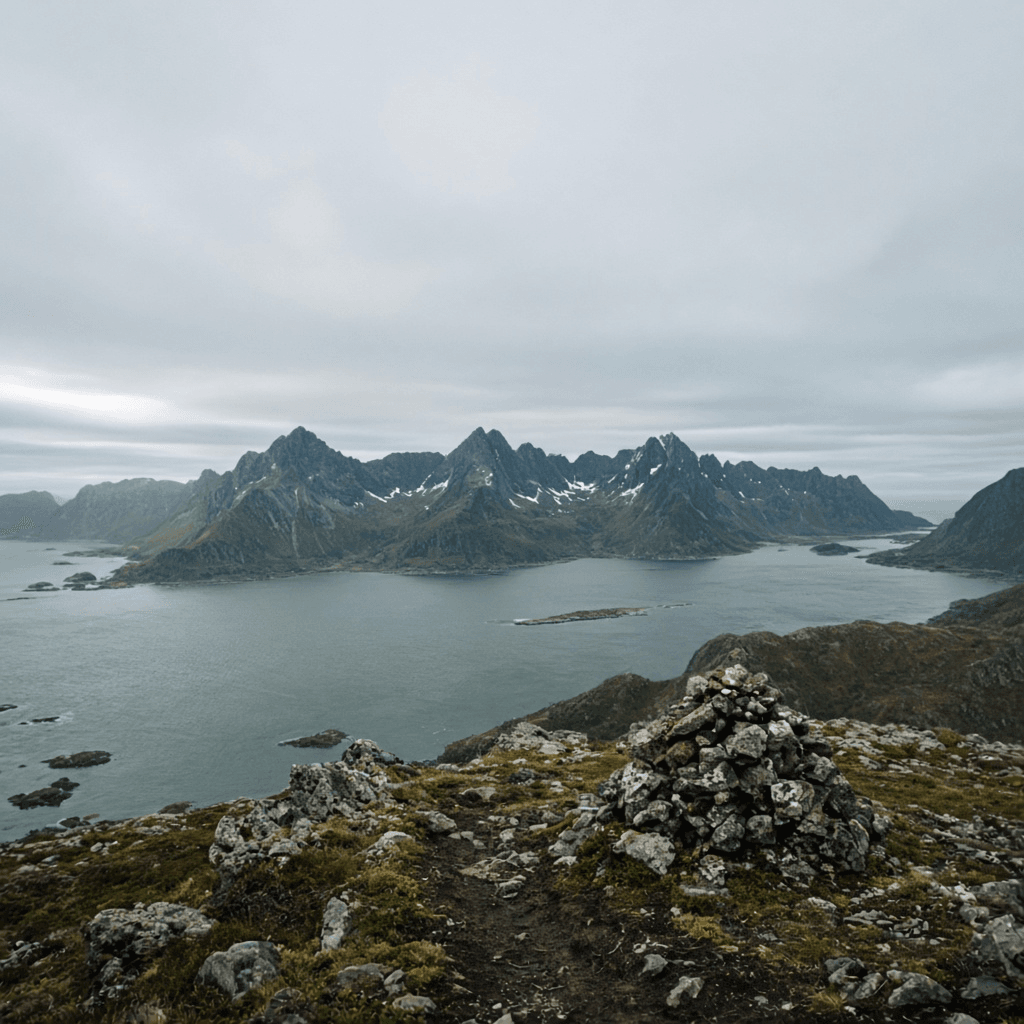
Offersøykammen
2.6 km round-trip on the Skreda line from the E10 rest area: 436 m gain to a 436 m cairn.
Duration
1 day
Route distance
2.6km
Vertical Gain
+436m
Max Altitude
436m
Mission Brief
Offersøykammen is a 436 m summit on Vestvågøya in the Lofoten Islands. The Skreda line is a 2.6 km round-trip that starts at the Skreda rest area on the E10, about a ten-minute drive from Leknes. No park authority or other official publisher issues route statistics for this mountain.
The walk begins at Skreda, follows the E10 a short way east to the original dirt start (about 600 m along the highway in the 68 North notes), then climbs steeply through low scrub and mud to a relatively flat summit plateau and a stone cairn. There are no stone stairs and no switchbacks worth naming. Elevation gain is 436 m from near sea level to the 436 m summit height published by 68 North and Peakbook. Walking time on the Skreda line is 1–2 hours round-trip.
A separate route, the Nappstraumen-tunnel variant, is about 6 km and less steep. It is not the same outing as the Skreda line and is not mixed into the 2.6 km or 1–2 hour figures.
From the plateau the view looks down onto the Nappstraumen strait and across to the mountains of Flakstadøya. The north-west side of the plateau drops as a cliff; stay back from that edge. The plateau is wide enough that the northern horizon is not blocked by taller peaks on this ridge, so it is an open midnight-sun viewpoint in late May to mid-July.
Himmeltindan (himmeltindan-lofoten), the hikeable south summit at 931 m, is 2.1× the height of Offersøykammen's 436 m top, on a 7.5 km route with 945 m of gain — 2.9× the Skreda distance and 2.2× the gain. Reinebringen (reinebringen-lofoten) is a separate Lofoten viewpoint on a built stair.
A 2.6 km Skreda out-and-back from the E10 to a 436 m plateau above the Nappstraumen, in 1–2 hours.
Mission Snapshot
Intensity Breakdown
Understanding what drives the overall route demand
Physical
38
Technical
14
Commitment
8
Primary driver: Short steep Vestvågøya day hike on mud, not an alpine day
- 436 m gain on 2.6 km of steep dirt
- Mud and a western cliff edge, not a scramble pitch
- E10 start ten minutes from Leknes
- 1–2 hours, out-and-back
Active effort required, but no significant risk. Suitable for recreational hikers.
Full Route Breakdown
Complete stage overview with transparent route metrics. Values are shown as recorded in the route dataset and source links.
Distance
2.6 km
Ascent
436 m
Highest point
436 m
Start
Skreda rest area, E10, Vestvågøya
Finish
Skreda rest area (out-and-back)
Use the KM / MI toggle in the main menu to switch units.
Route Profile
Single-night summit push structure
Operational Reality
Headline 2.6 km and 1–2 hours are the Skreda line from the Skreda rest area on the E10, including the short highway walk to the dirt start. Stage distances 0.6 + 0.7 + 1.3 km sum to 2.6 km. The Nappstraumen-tunnel variant (~6 km, less steep) is not in the itinerary. Elevations 10–436 m and 436 m gain. Sources: 68 North guide and Peakbook 436 m.
Route Considerations
This route is generally safe, but these are the main factors to be aware of.
Relentless mud
The Skreda line is a raw dirt path through low alpine shrubs. After rain it turns into a slick, ankle-deep mud slope with no stone stairs.
Impact
Route-specific
Likelihood
Context-dependent
Tip
Waterproof boots with deep lugs. Trekking poles help on the descent. Do not treat this as a dry-shoe walk.
Edge exposure
The western side of the summit plateau drops as a sheer cliff toward the Nappstraumen.
Impact
Route-specific
Likelihood
Context-dependent
Tip
Stay back from the western edge, especially in wind or when taking photos. The walking line to the cairn does not require that edge.
Terrain & conditions
Conditions change quickly on the ground. Slow down on wet rock and pay more attention where paths narrow or exposure increases.
Impact
Moderate
Likelihood
Variable
Tip
Refer to stage notes and expert briefings; maintain focus on slick or exposed sections.
Why hike this route?
LANDSCAPE
Looking down onto the Nappstraumen strait and across to Flakstadøya from a 436 m plateau.
VARIETY
A short, steep mud climb that opens onto a flat summit you can walk without continuing to climb.
CULTURE & PLACE
A local Vestvågøya hill off the E10 rather than a ticketed stair.
WHY GO
A 2.6 km Skreda out-and-back from the E10 to a 436 m plateau above the Nappstraumen, in 1–2 hours.
Expert Verdict
“Offersøykammen on the Skreda line is a 2.6 km, 1–2 hour dirt climb from the E10 rest area to a 436 m plateau above the Nappstraumen. The 436 m gain matches the Peakbook and 68 North summit height. The Nappstraumen-tunnel variant (~6 km, less steep) is a different route and is not mixed into those figures. Himmeltindan (himmeltindan-lofoten) is a longer Vestvågøya climb: 7.5 km, 945 m gain, hikeable 931 m. Reinebringen (reinebringen-lofoten) is a separate stair viewpoint. If you have one afternoon near Leknes and want the strait view, this is the Skreda outing — mud, cliff edge, no stairs.”
Who This Is For
- BEGINNER / INTERMEDIATE — Average fitness, waterproof boots, and comfort on a steep muddy slope. Hands are not required on the track; the western cliff is a fall hazard, not a scramble pitch.
- PHYSICAL — Short and steep. 436 m of gain on a 2.6 km Skreda round-trip is a hard hour, then it is over.
- WATCH FOR — Parking on the E10 shoulder instead of the Skreda rest area.
- WATCH FOR — Treating the Nappstraumen-tunnel variant (~6 km) as the same hike as the 2.6 km Skreda line.
Plan This Hike
Key things to arrange before starting this route—practical tips first, then buttons that open curated picks (gear, maps, stays) where we list them.
Essential Gear
Recommended preparation for this route:
Waterproof boots — the Skreda path is dirt and mud, not stairs.
- Deep-lug waterproof boots
- Trekking poles for the 436 m muddy descent
- Wind layer on the 436 m plateau
Stay Connected
Explore accommodation options for this trail:
The line sits above the E10 near Leknes; coverage is typically strong near the highway.
- No streams — carry about 1 L
- Skreda rest area has toilets
- Treat the western cliff as a fall hazard, not a viewpoint rail
Getting There
Travel and trail access for this route:
Start at the Skreda rest area on the E10, ten minutes from Leknes.
- Park at Skreda, not on the E10 shoulder
- Original dirt start is about 600 m east along the highway
- Nappstraumen-tunnel start is a different, ~6 km line
Where to Stay
Explore accommodation options for this trail:
Leknes is the Vestvågøya hub for this outing.
- Hotels and shops in Leknes
- Campsites and rorbu rentals nearby
- Summit-plateau camping is possible; stay off the western edge
Compare This Route
See how this route compares to similar hikes in overall demand and terrain profile.Compare routes by the shape of the effort, not only the headline score.
The Three Calanques — Port-Miou to En-Vau
Closest overall match in demand profile
Widely considered the most iconic hike in the Parc National des Calanques, ...
Intensity
Higher intensityKrimml Waterfalls — The Vertical Mist
Lower overall intensity, similar terrain type
The Krimml Waterfalls are the tallest in Europe, dropping 380 meters in thr...
Intensity
Lower intensityThe Grouse Grind
Higher physical or technical demand
Vancouver’s “Mother Nature’s Stairmaster”: a 2.5 km one-way climb up the fa...
Intensity
Higher intensityExplore Alternatives
Broaden the picture with easier, harder, and nearby options.
Looking for something easier?
Lower intensity — helpful if this route feels like a stretch right now.
Want more challenge?
Higher intensity — for when you are ready for a bigger physical or technical step.
More hikes in this region
Nearby and regionally relevant routes for the next step in your search.
Reinebringen
Lofoten Islands · norway
Distance
2.0 km
Ascent
448 m
Preikestolen
lysefjord · norway
Distance
8.0 km
Ascent
350 m
Gaustatoppen
Telemark · norway
Distance
9.2 km
Ascent
700 m
Himmeltindan
Lofoten Islands · norway
Distance
7.5 km
Ascent
945 m
Brekkefossen Waterfall
Sogn og Fjordane (Flåm) · norway
Distance
5.0 km
Ascent
155 m
Skåla
Nordfjord (Jostedalsbreen National Park) · norway
Distance
16.0 km
Ascent
1,800 m
Compare with any route
Pick any hike worldwide and open a full side-by-side comparison.
What You Need to Know
Essential answers about the demands, risks, and logistics of this route.
Q.How hard is this hike really?
Q.Do I need technical gear?
Q.Is water available on the route?
Q.What is the main risk?
Ready to hike Offersøykammen?
A final decision point after reviewing the route, risks, logistics, and alternatives.
This route is a strong match if you're comfortable with the effort level implied by an Intensity Score around 32/100 (Moderate), sustained hiking where this route requires it, and the terrain and exposure described in this guide.
Build your itinerary, stages, and logistics.
Looking for something easier, more challenging, or a different terrain profile?
Compare routes by intensity, terrain, and region.
Data: official trail documentation and topographic sources · About