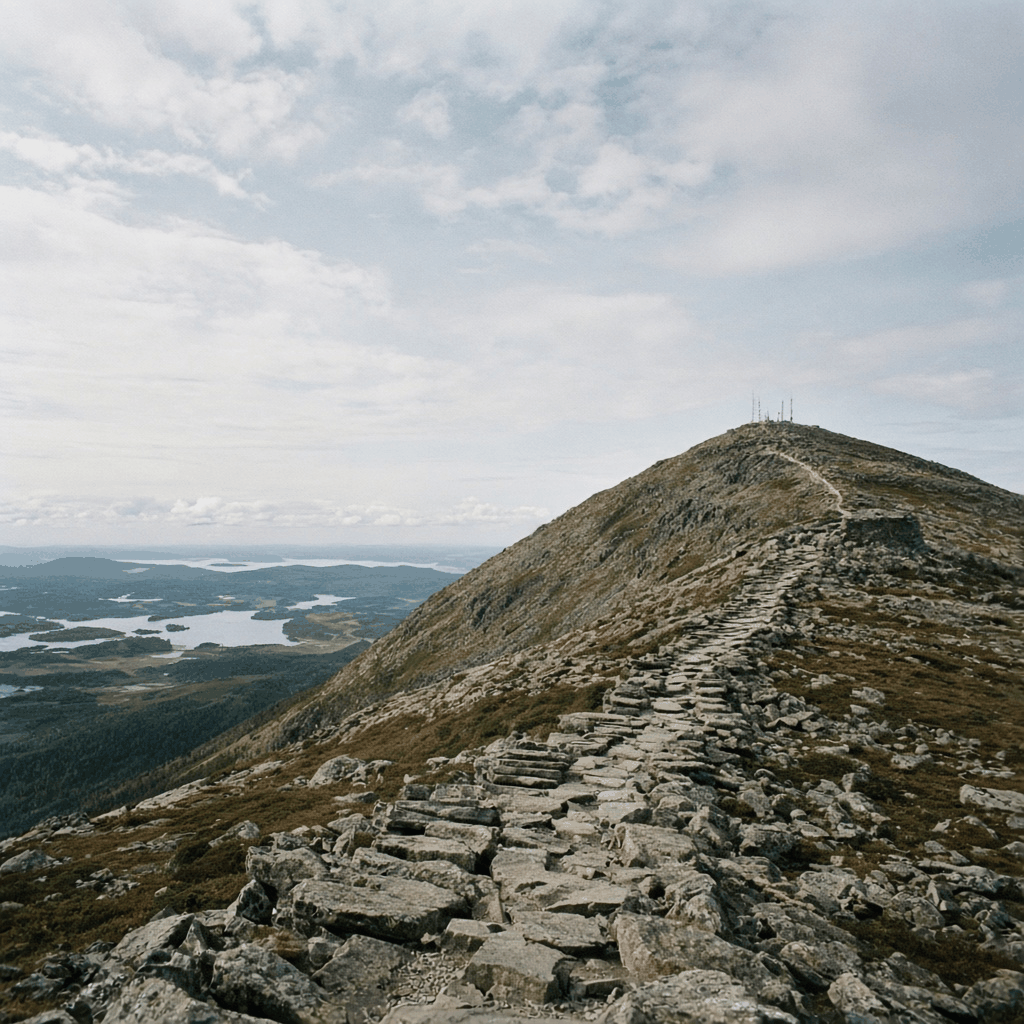
Gaustatoppen
9.2 km round-trip from Stavsro: 4.6 km of boulder stairs and 700 m gain to 1,883 m.
Duration
1 day
Route distance
9.2km
Vertical Gain
+700m
Max Altitude
1,883m
Mission Brief
Gaustatoppen (1,883m) is frequently cited as the most beautiful mountain in Norway.
A soaring, isolated stratovolcano-like cone in the Telemark region, it offers an astonishing reward: on a clear day, standing at the summit allows you to see 60,000 square kilometers—roughly one-sixth of the entire Norwegian mainland. The most popular hiking route begins at Stavsro, a steady, 2.7-mile (4.6km) rocky ascent up the mountain's wide shoulder. For an extra dose of adventure (or for those with mobility issues), you can use the 'Gaustabanen,' a Cold War-era funicular tram built inside a secret tunnel running straight up through the core of the mountain to the summit plateua.
Southern Norway's highest isolated cone, with a waffle cabin and a Cold War train inside the mountain.
Mission Snapshot
Intensity Breakdown
Understanding what drives the overall route demand
Physical
48
Technical
18
Commitment
12
Primary driver: Short, steep Telemark day hike on rocks, not an alpine expedition
- 700 m gain in 4.6 km on a boulder staircase
- Optional Class 2 ridge beyond the DNT cabin
- Wind and a 15–20 °C drop at the isolated summit
- Paid lot and weekend shuttle logistics, not wilderness isolation
Serious physical effort or sustained terrain friction. Demanding but not expedition-scale.
Full Route Breakdown
Complete stage overview with transparent route metrics. Values are shown as recorded in the route dataset and source links.
Distance
9.2 km
Ascent
700 m
Highest point
1,883 m
Start
Stavsro parking, Fv651 above Rjukan
Finish
Stavsro (out-and-back; optional Gaustabanen descent)
Use the KM / MI toggle in the main menu to switch units.
Route Profile
Out-and-back day-hike structure
Operational Reality
Round-trip from Stavsro. Headline 9.2 km is 4.6 km one way. Elevations 1,170–1,883 m and 700 m gain. Topography interpolates the boulder shoulder, DNT cabin, and ridge. Sources: Gausta.com and UT.no.
Route Considerations
This route is generally safe, but these are the main factors to be aware of.
Ankle sprains on boulder fields
The entire trail is effectively a steep staircase made of loose, uneven, and sometimes sharp rocks. There is very little flat, smooth dirt walking.
Impact
Route-specific
Likelihood
Context-dependent
Tip
Stiff hiking boots with strong ankle support are often required. Trekking poles are highly recommended for the descent.
Weather exposure
Because it is the highest isolated peak for hundreds of kilometers, it catches all regional weather systems. Near-freezing temperatures and high winds at the summit are common in August.
Impact
Route-specific
Likelihood
Context-dependent
Tip
Prepare for a 15-20°C drop in temperature from the parking lot to the summit. Pack windproof winter layers.
Terrain & conditions
Conditions change quickly on the ground. Slow down on wet rock and pay more attention where paths narrow or exposure increases.
Impact
Moderate
Likelihood
Variable
Tip
Refer to stage notes and expert briefings; maintain focus on slick or exposed sections.
Why hike this route?
LANDSCAPE
The uninterrupted sightlines covering lakes, forests, and distant snow-capped mountains spanning one-sixth of the country.
VARIETY
The novelty of hiking up a mountain and taking a military funicular train through a tunnel to get back down.
CULTURE & PLACE
The communal, joyful atmosphere of hundreds of hikers eating jam-and-sour-cream waffles at the stone cabin on top.
WHY GO
Southern Norway's highest isolated cone, with a waffle cabin and a Cold War train inside the mountain.
Expert Verdict
“Gaustatoppen provides the greatest effort-to-view ratio in southern Norway. It is highly accessible, visually stunning from the valley floor, and the history of the Cold War tunnel train adds a unique Bond-villain element to the trip. Because it is so accessible, the trail will be packed with thousands of Norwegians and their dogs on a sunny July weekend. Eat the Norwegian 'vaffel' at the DNT cabin—it is a local cultural tradition. For this itinerary, Gaustatoppen's own metrics set the effort band: 9.2 km round-trip, 700 m gain and 4-5 hours on foot.”
Who This Is For
- BEGINNER / INTERMEDIATE — Suitable for active families and older children. You do not need alpine skills, just the stamina to walk up a rocky hill for 2.5 hours.
- PHYSICAL — Medium. A 700m climb over 4.5km is strenuous, but the path is wide and you can take as many breaks as you want.
- WATCH FOR — Attempting it in lightweight running shoes. Your feet will be bruised by the rocks.
- WATCH FOR — Forgetting a jacket because it is a hot 25°C day in Oslo. The peak will be freezing and windy.
Plan This Hike
Key things to arrange before starting this route—practical tips first, then buttons that open curated picks (gear, maps, stays) where we list them.
Essential Gear
Recommended preparation for this route:
Stiff boots — the whole trail is a boulder staircase.
- Broken-in hiking boots with ankle support
- Trekking poles for the rocky descent
- Wind layer and beanie; the summit is often near freezing in August
Stay Connected
Explore accommodation options for this trail:
Cell coverage is strong because of the summit telecom tower.
- Signal is typically excellent from Stavsro to the peak
- No reliable streams — carry water up the rock face
- DNT cabin sells drinks and waffles in season
Getting There
Travel and trail access for this route:
Stavsro sits on the high Fv651 pass, about 2.5–3 hours from Oslo.
- Paid parking at Stavsro (about 200 NOK)
- The lot fills early on July weekends; shuttles run from lower lots
- Gaustabanen is the optional descent through the mountain
Where to Stay
Explore accommodation options for this trail:
Rjukan and Gaustablikk are the usual bases.
- Hotels and cabins in Rjukan or at Gaustablikk
- Summit DNT cabin is spartan and books months ahead
- Day hikers typically sleep in the valley and start at dawn
Compare This Route
See how this route compares to similar hikes in overall demand and terrain profile.Compare routes by the shape of the effort, not only the headline score.
The High Descent — Kaiser-Franz-Josef-Höhe to Heiligenblut
Closest overall match in demand profile
This is Stage 1 of the world-famous Alpe-Adria-Trail. Starting at the drama...
Intensity
Lower intensitySulphur Skyline
Lower overall intensity, similar terrain type
The hike to the summit of Sulphur Skyline is a pure test of steady cardiova...
Intensity
Lower intensityMount Hallasan
Higher physical or technical demand
The guardian of the island. Mount Hallasan is a majestic shield volcano tha...
Intensity
Higher intensityExplore Alternatives
Broaden the picture with easier, harder, and nearby options.
Looking for something easier?
Lower intensity — helpful if this route feels like a stretch right now.
Want more challenge?
Higher intensity — for when you are ready for a bigger physical or technical step.
More hikes in this region
Nearby and regionally relevant routes for the next step in your search.
Himmeltindan
Lofoten Islands · norway
Distance
7.5 km
Ascent
945 m
Reinebringen
Lofoten Islands · norway
Distance
2.0 km
Ascent
448 m
Offersøykammen
Lofoten Islands · norway
Distance
2.6 km
Ascent
436 m
Skåla
Nordfjord (Jostedalsbreen National Park) · norway
Distance
16.0 km
Ascent
1,800 m
Brekkefossen Waterfall
Sogn og Fjordane (Flåm) · norway
Distance
5.0 km
Ascent
155 m
Besseggen Ridge
Jotunheimen National Park · norway
Distance
14.0 km
Ascent
1,100 m
Compare with any route
Pick any hike worldwide and open a full side-by-side comparison.
What You Need to Know
Essential answers about the demands, risks, and logistics of this route.
Q.How hard is this hike really?
Q.Do I need technical gear?
Q.Is water available on the route?
Q.What is the main risk?
Ready to hike Gaustatoppen?
A final decision point after reviewing the route, risks, logistics, and alternatives.
This route is a strong match if you're comfortable with the effort level implied by an Intensity Score around 40/100 (Hard), sustained hiking where this route requires it, and the terrain and exposure described in this guide.
Build your itinerary, stages, and logistics.
Looking for something easier, more challenging, or a different terrain profile?
Compare routes by intensity, terrain, and region.
Data: official trail documentation and topographic sources · About