Tongariro Alpine
Crossing
Walking through Mordor.
Duration
1 day
Route distance
19.4km
Vertical Gain
+800m
Max Altitude
1,886m
Mission Brief
Walking through Mordor.
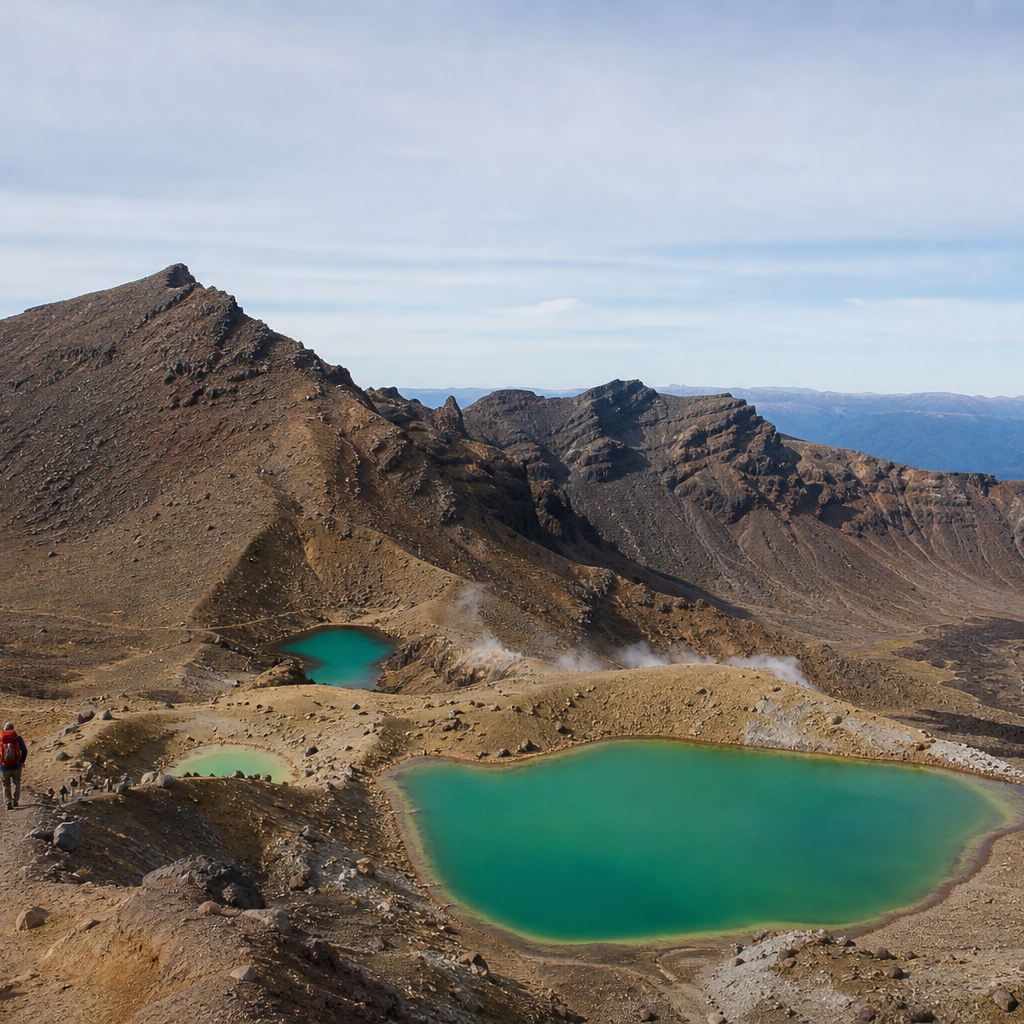
The Tongariro Alpine Crossing (19.4km / 12 miles) is widely considered the best one-day hike in New Zealand. Located in the dual-status UNESCO World Heritage site of Tongariro National Park, the trail traverses a stark, volcanic landscape that served as the filming location for Mordor in The Lord of the Rings. You climb between Mount Tongariro and the perfect volcanic cone of Mount Ngauruhoe (Mount Doom), passing active steam vents, ancient lava flows, and the brilliantly colored Emerald Lakes.
The Emerald Lakes and the Steam Vents. The 'X-Factor' is the surreal, alien beauty of the Red Crater and Emerald Lakes. Reaching the summit of Red Crater (1,886m) reveals a view unlike any other on Earth: the deep dark…
Mission Snapshot
Intensity Breakdown
Understanding what drives the overall route demand
Physical
44
Technical
36
Commitment
50
Primary driver: Commitment
- Standard Recreational Effort
Serious physical effort or sustained terrain friction. Demanding but not expedition-scale.
Full Route Breakdown
Complete stage overview with transparent route metrics. Values are shown as recorded in the route dataset and source links.
Distance
19.4 km
Ascent
800 m
Highest point
1,886 m
Start
Devil's Staircase
Finish
Emerald Lakes
Use the KM / MI toggle in the main menu to switch units.
Route Profile
Single-day stage structure
Route Considerations
This route is generally safe, but these are the main factors to be aware of.
Alpine weather extremes
People have died on this track in summer due to exposure when the weather turned from sun to blizzard in 30 minutes.
Impact
Route-specific
Likelihood
Context-dependent
Tip
Check the specialized DOC high-altitude forecast for Tongariro; always carry a waterproof jacket and thermals, even if it looks hot at the start; turn back at the South Crater if the wind is high.
Volcanic activity
The mountains are active volcanoes. Mount Tongariro last erupted in 2012.
Impact
Route-specific
Likelihood
Context-dependent
Tip
Follow all safety signage regarding volcanic hazard zones; if sirens sound or an eruption occurs, move immediately out of valley bottoms and away from steam vents.
Terrain & conditions
Conditions change quickly on the ground. Slow down on wet rock and pay more attention where paths narrow or exposure increases.
Impact
Moderate
Likelihood
Variable
Tip
Refer to stage notes and expert briefings; maintain focus on slick or exposed sections.
Why hike this route?
LANDSCAPE
Surreal volcanic peaks, active steam vents, and the vibrant, chemical colors of the Emerald Lakes.
VARIETY
Passing through three types of lava flows, alpine deserts, and ending in a lush temperate forest.
CULTURE & PLACE
The spiritual significance of the peaks to Ngāti Tūwharetoa and the pop-culture fame from Lord of the Rings.
STANDOUT
The Emerald Lakes and the Steam Vents. The 'X-Factor' is the surreal, alien beauty of the Red Crater and Emerald Lakes. Reaching the summit of Red Crater (1,886m) reveals a view unlike any other on Earth: the deep dark red of the volcanic soil contrasting with the neon-turquoise…
Expert Verdict
“The Tongariro Crossing is the significant day-hike, providing 'Mordor' vibes and otherworldly colors. Experienced hikers often suggest that you don't skimp on water—there is none on the track and the sulfur smell makes you thirstier. Use trekking poles for the descent from Red Crater to the Emerald Lakes; it's like skiing on rocks, and your knees will thank you. Tongariro Alpine Crossing should be paced from its own numbers: 19.4km (12 miles) and about 800 m of gain make the 7-9 walking-hour rhythm the useful planning anchor.”
Who This Is For
- INTERMEDIATE — For fit individuals who want a spectacular day hike. You don't need technical climbing skills, but you need the stamina for a 20km march over rugged volcanic terrain.
- PHYSICAL — High. The 'Devil's Staircase' is a long, steady climb, and the descent from Red Crater is a steep, slippery walk down loose volcanic gravel that is tough on the knees.
- WATCH FOR — Wearing sneakers: The volcanic rock is sharp and the scree is slippery; you need boots.
- WATCH FOR — Not bringing a wind-proof layer: It's always 10°C colder at the top than at the shuttle drop-off.
Plan This Hike
Key things to arrange before starting this route—practical tips first, then buttons that open curated picks (gear, maps, stays) where we list them.
Shuttle Booking
Explore accommodation options for this trail:
Point-to-point day hike — book transport both ends.
- Mangatepōpō to Ketetahi shuttles run peak season
- 4-hour parking limits at trailheads — don't self-drive both ends
- Book 1–2 days ahead in summer
Alpine Weather
Practical next step for this hike:
Red Crater wind can exceed 45 km/h.
- Check DOC high-altitude forecast before starting
- Turn back at South Crater if peaks are in cloud
- Carry waterproof shell + fleece even on sunny mornings
Volcanic Hazards
Practical next step for this hike:
Active volcanic zone — heed DOC signage.
- Mount Tongariro last erupted 2012
- Stay out of valley bottoms if sirens sound
- Do not approach active steam vents off-trail
Essential Gear
Recommended preparation for this route:
No water on track — carry 2–3 L minimum.
- Sturdy boots for sharp volcanic scree
- Trekking poles help Red Crater descent
- Full sun protection — no shade for 19 km
Compare This Route
See how this route compares to similar hikes in overall demand and terrain profile.Compare routes by the shape of the effort, not only the headline score.
Mount Fitz Roy
Closest overall match in demand profile
The trek to Laguna de los Tres is one of the primary day activities in Los ...
Intensity
Slightly higher intensitySaxer Lücke
Lower overall intensity, similar terrain type
The Saxer Lücke is one of the most geographically dramatic points in the Al...
Intensity
Lower intensitySchäfler Ridge
Higher physical or technical demand
While the Ebenalp is most famous for the Aescher cliff-restaurant, the true...
Intensity
Higher intensityExplore Alternatives
Broaden the picture with easier, harder, and nearby options.
Looking for something easier?
Lower intensity — helpful if this route feels like a stretch right now.
Want more challenge?
Higher intensity — for when you are ready for a bigger physical or technical step.
More hikes in this region
Nearby and regionally relevant routes for the next step in your search.
Rakiura Track
stewart-island-rakiura · new-zealand
Distance
32.0 km
Ascent
450 m
Abel Tasman Coastal Track
nelson-tasman · new-zealand
Distance
60.0 km
Ascent
700 m
Paparoa Track
west-coast-south-island · new-zealand
Distance
55.0 km
Ascent
1,800 m
Queen Charlotte Track
marlborough-sounds · new-zealand
Distance
71.0 km
Ascent
1,800 m
Routeburn Track
fiordland-mount-aspiring · new-zealand
Distance
32.0 km
Ascent
1,300 m
Heaphy Track
kahurangi-national-park-nelson-west-coast · new-zealand
Distance
78.4 km
Ascent
1,200 m
Compare with any route
Pick any hike worldwide and open a full side-by-side comparison.
What You Need to Know
Essential answers about the demands, risks, and logistics of this route.
Q.How hard is this hike really?
Q.Do I need technical gear?
Q.Is water available on the route?
Q.What is the main risk?
Ready to hike Tongariro Alpine Crossing?
A final decision point after reviewing the route, risks, logistics, and alternatives.
This route is a strong match if you're comfortable with the effort level implied by an Intensity Score around 47/100 (Hard), sustained hiking where this route requires it, and the terrain and exposure described in this guide.
Build your itinerary, stages, and logistics.
Looking for something easier, more challenging, or a different terrain profile?
Compare routes by intensity, terrain, and region.
Data: official trail documentation and topographic sources · About