Routeburn
Track
The significant alpine link.
Duration
3 days
Route distance
32.0km
Vertical Gain
+1,300m
Max Altitude
1,255m
Mission Brief
The significant alpine link.
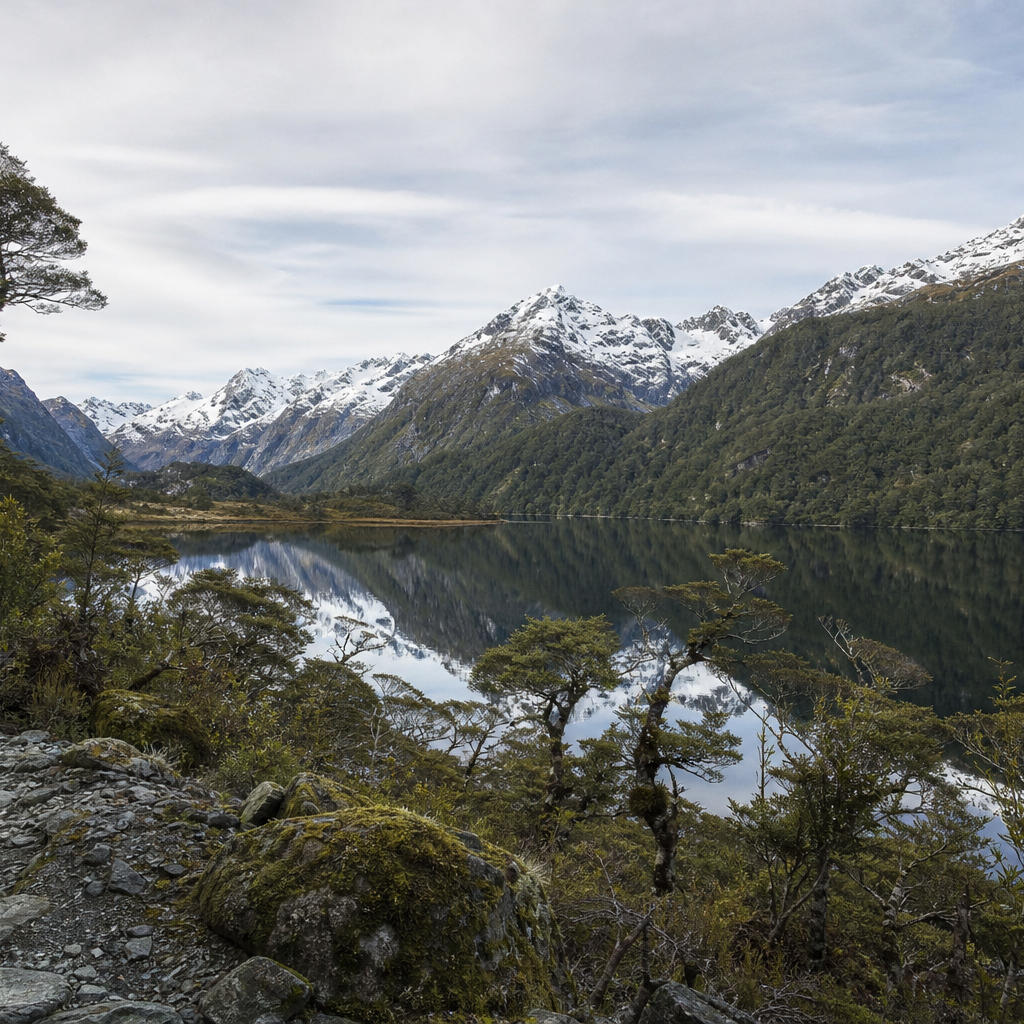
The Routeburn Track (32km / 20 miles) is one of New Zealand's famous Great Walks, connecting the Mount Aspiring and Fiordland National Parks. Unlike some of the longer tracks, the Routeburn reaches its high point early, taking you across exposed alpine plateaus with staggering views of the Darran Mountains and the Tasman Sea. The trail winds through ancient beech forests and past jewel-like glacial lakes (Lake Harris, Lake Mackenzie), offering a concentrated experience of the best Southern Alps landscapes.
Harris Saddle and the View of the Tasman. The 'X-Factor' is the perspective from the Harris Saddle. Crossing from the Routeburn Valley into the Hollyford Valley at 1,255 meters, the view expands to include massive ice-c…
Mission Snapshot
Intensity Breakdown
Understanding what drives the overall route demand
Physical
56
Technical
42
Commitment
83
Primary driver: Commitment
- High Remote Commitment
Serious physical effort or sustained terrain friction. Demanding but not expedition-scale.
Full Route Breakdown
Complete stage overview with transparent route metrics. Values are shown as recorded in the route dataset and source links.
Distance
32.0 km
Ascent
1,300 m
Highest point
1,255 m
Start
Routeburn Flats
Finish
The Divide Finish
Use the KM / MI toggle in the main menu to switch units.
Route Profile
Multi-day stage structure
Route Considerations
This route is generally safe, but these are the main factors to be aware of.
Rapid alpine exposure
The track is highly exposed to the Southern Ocean's weather; snow and gale-force winds can occur even in mid-summer.
Impact
Route-specific
Likelihood
Context-dependent
Tip
Check the DOC weather forecast at the trailhead; carry a full set of waterproof and thermal clothing regardless of the initial forecast; if snow is predicted, do not attempt to cross Harris Saddle.
Logistical shuttle dependency
The track is not a loop; the road distance between the two trailheads is over 350km (a 5-hour drive).
Impact
Route-specific
Likelihood
Context-dependent
Tip
Pre-arrange a car relocation service or use a dedicated shuttle bus (e.g. InfoTrack) to meet you at the distant finish line.
Terrain & conditions
Conditions change quickly on the ground. Slow down on wet rock and pay more attention where paths narrow or exposure increases.
Impact
Moderate
Likelihood
Variable
Tip
Refer to stage notes and expert briefings; maintain focus on slick or exposed sections.
Why hike this route?
LANDSCAPE
Vast alpine basins (The Key Summit), turquoise lakes (Harris), and mossy beech forests.
VARIETY
Changing from the drier east (Aspiring) to the wet west (Fiordland) in a single pass.
CULTURE & PLACE
A polite, well-organized 'Great Walk' atmosphere that feels social and safe.
STANDOUT
Harris Saddle and the View of the Tasman. The 'X-Factor' is the perspective from the Harris Saddle. Crossing from the Routeburn Valley into the Hollyford Valley at 1,255 meters, the view expands to include massive ice-carved peaks and, on a clear day, the distant horizon of the…
Expert Verdict
“The Routeburn is 'The Scenic Option'. If you only have 3 days, this is the one. Experienced hikers often suggest that you take the side trip to Conical Hill for a 360-degree view of the Hollyford Valley and the Tasman Sea. It's the best 1-hour investment on the track. For this itinerary, Routeburn Track's own metrics set the effort band: 32km (20 miles), 1300 m gain and 5-7 hours on foot.”
Who This Is For
- INTERMEDIATE — Great for families and first-time multi-day hikers who want the best alpine scenery with high-quality infrastructure. You should have basic mountain awareness.
- PHYSICAL — Moderate. The paths are spectacular, but Day 2's climb to Harris Saddle and the long descent to Lake Mackenzie is sustained work.
- WATCH FOR — Rushing through Day 2; Harris Saddle is the climax, don't just walk over it.
- WATCH FOR — Underestimating the descent from Harris Saddle to Lake Mackenzie—it's steep and long.
Plan This Hike
Key things to arrange before starting this route—practical tips first, then buttons that open curated picks (gear, maps, stays) where we list them.
DOC Hut Booking
Explore accommodation options for this trail:
Great Walk huts sell out months ahead.
- Book Routeburn Falls + Lake Mackenzie huts on DOC website
- Peak season (Dec–Feb) fills fastest
- Camping permitted at designated sites with permit
Shuttle Logistics
Explore accommodation options for this trail:
Point-to-point — 350 km between trailheads.
- Pre-book InfoTrack or similar shuttle between Divide and Routeburn Shelter
- Car relocation services available from Queenstown/Te Anau
- Allow full day for transport on either end
Alpine Weather
Practical next step for this hike:
Harris Saddle is fully exposed.
- Check DOC forecast at trailhead each morning
- Carry full waterproof + thermal layers in summer
- Do not cross Harris Saddle if snow is forecast
Essential Gear
Recommended preparation for this route:
Fiordland rain + sandflies at lower elevations.
- Quality rain shell — among world's wettest regions
- Merino thermal layers for hut evenings
- Sandfly repellent for beech-forest sections
Compare This Route
See how this route compares to similar hikes in overall demand and terrain profile.Compare routes by the shape of the effort, not only the headline score.
Huayna Potosi
Closest overall match in demand profile
Huayna Potosi (6,088m / 19,974ft) is often described by Bolivian guide serv...
Intensity
Higher intensitySchäfler Ridge
Lower overall intensity, similar terrain type
While the Ebenalp is most famous for the Aescher cliff-restaurant, the true...
Intensity
Lower intensityGreat Ocean Walk
Higher physical or technical demand
The Great Ocean Walk is a 104km point-to-point coastal trekking route in Vi...
Intensity
Higher intensityExplore Alternatives
Broaden the picture with easier, harder, and nearby options.
Looking for something easier?
Lower intensity — helpful if this route feels like a stretch right now.
Want more challenge?
Higher intensity — for when you are ready for a bigger physical or technical step.
More hikes in this region
Nearby and regionally relevant routes for the next step in your search.
Paparoa Track
west-coast-south-island · new-zealand
Distance
55.0 km
Ascent
1,800 m
Queen Charlotte Track
marlborough-sounds · new-zealand
Distance
71.0 km
Ascent
1,800 m
Abel Tasman Coastal Track
nelson-tasman · new-zealand
Distance
60.0 km
Ascent
700 m
Lake Waikaremoana Track
te-urewera-north-island · new-zealand
Distance
46.0 km
Ascent
1,200 m
Rakiura Track
stewart-island-rakiura · new-zealand
Distance
32.0 km
Ascent
450 m
Milford Track
fiordland · new-zealand
Distance
53.5 km
Ascent
1,200 m
Compare with any route
Pick any hike worldwide and open a full side-by-side comparison.
What You Need to Know
Essential answers about the demands, risks, and logistics of this route.
Q.How hard is this hike really?
Q.Do I need technical gear?
Q.Is water available on the route?
Q.What is the main risk?
Ready to hike Routeburn Track?
A final decision point after reviewing the route, risks, logistics, and alternatives.
This route is a strong match if you're comfortable with the effort level implied by an Intensity Score around 57/100 (Hard), sustained hiking where this route requires it, and the terrain and exposure described in this guide.
Build your itinerary, stages, and logistics.
Looking for something easier, more challenging, or a different terrain profile?
Compare routes by intensity, terrain, and region.
Data: official trail documentation and topographic sources · About