Milford
Track
The finest walk in the world.
Duration
4 days
Route distance
53.5km
Vertical Gain
+1,200m
Max Altitude
1,154m
Mission Brief
The finest walk in the world.
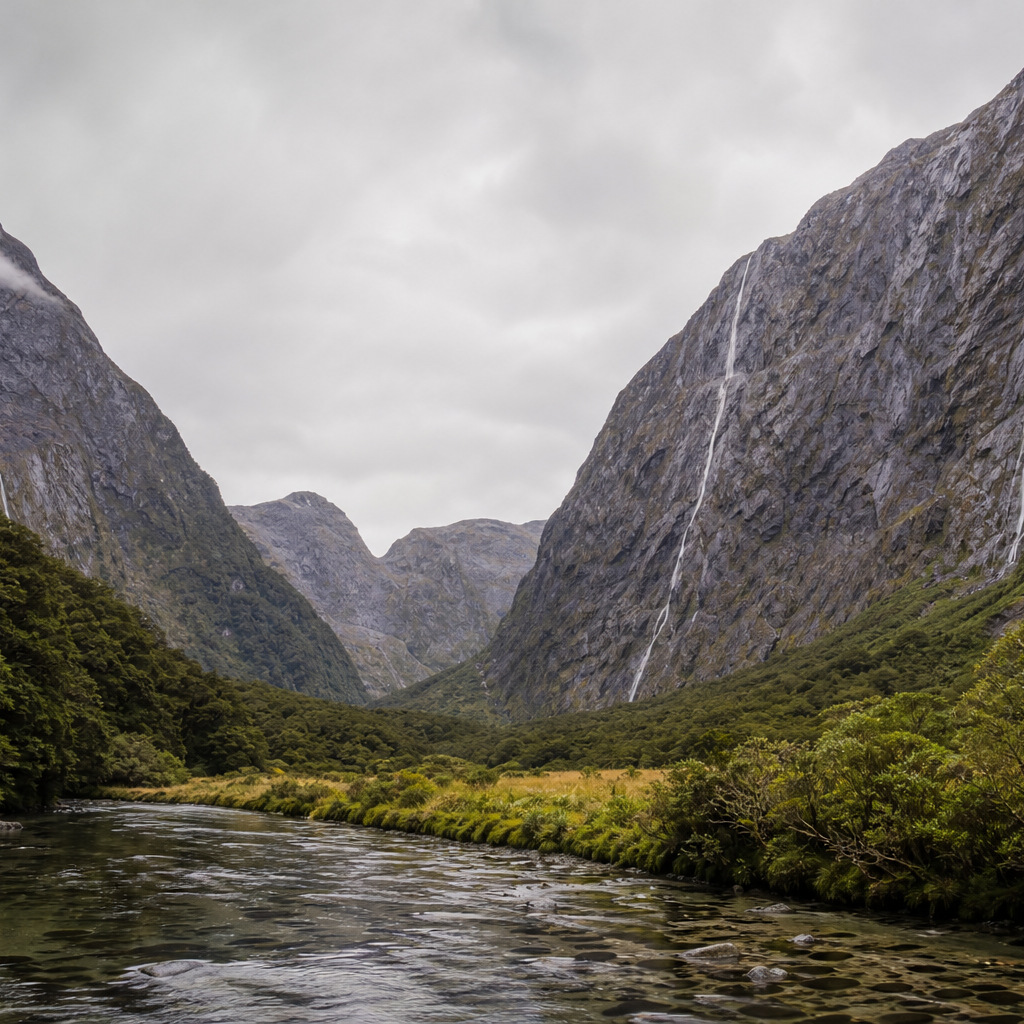
The Milford Track (53.5km / 33 miles) is New Zealand's most famous trekking route, limited to just 40 independent walkers per day. Starting with a boat journey across Lake Te Anau, the trail traces the Clinton and Arthur Valleys, crossing the legendary Mackinnon Pass (1,154m). The track is characterized by massive U-shaped glacial valleys, vertical granite walls, and hundreds of waterfalls—including Sutherland Falls, the tallest in New Zealand.
It ends at Sandfly Point, where a final boat takes you to the iconic Milford Sound.
Mackinnon Pass and the Waterfall Chaos. The 'X-Factor' of the Milford is the sense of absolute enclosure by nature. Standing on the Mackinnon Pass between the Clinton and Arthur valleys, you are surrounded by mountains…
Mission Snapshot
Intensity Breakdown
Understanding what drives the overall route demand
Physical
65
Technical
51
Commitment
100
Primary driver: Commitment
- Sustained Physical Output
- Technical Terrain Exposure
- High Remote Commitment
Advanced multi-day effort: heavy fatigue, logistics, or movement friction—not necessarily alpine exposure.
Full Route Breakdown
Complete stage overview with transparent route metrics. Values are shown as recorded in the route dataset and source links.
Distance
53.5 km
Ascent
1,200 m
Highest point
1,154 m
Start
The Clinton Valley
Finish
Milford Sound Finish
Use the KM / MI toggle in the main menu to switch units.
Route Profile
Multi-day stage structure
Route Considerations
This route is generally safe, but these are the main factors to be aware of.
Extreme flooding and rainfall
Fiordland receives up to 8 meters of rain annually. Trails can become waist-deep in water within hours.
Impact
Route-specific
Likelihood
Context-dependent
Tip
Follow ranger instructions at the huts; if the trail is flooded, stay at the hut until it's safe to move; carry 100% waterproof liners for all your gear; expect to be wet for 4 days.
Sandfly menace
Sandflies at the end of the track (Sandfly Point) are legendary for their intensity.
Impact
Route-specific
Likelihood
Context-dependent
Tip
Apply strong DEET or Picaridin repellent before reaching the final day; keep moving; wear long sleeves and pants.
Terrain & conditions
Conditions change quickly on the ground. Slow down on wet rock and pay more attention where paths narrow or exposure increases.
Impact
Moderate
Likelihood
Variable
Tip
Refer to stage notes and expert briefings; maintain focus on slick or exposed sections.
Why hike this route?
LANDSCAPE
Jurassic Park scale. 1,000-meter vertical walls and glacial rivers so clear they look like air.
VARIETY
From lush valley-floor beech forests to alpine herb fields and waterfall-drenched granite cliffs.
CULTURE & PLACE
A sense of communal adventure in the DOC huts, where everyone has survived the same rainstorm.
STANDOUT
Mackinnon Pass and the Waterfall Chaos. The 'X-Factor' of the Milford is the sense of absolute enclosure by nature. Standing on the Mackinnon Pass between the Clinton and Arthur valleys, you are surrounded by mountains that rise 1,500m straight up from the valley floor. If it ra…
Expert Verdict
“The Milford is called the 'finest walk in the world' for a reason, but it's not the 'hardest' or the 'wildest'. It's a curated wilderness experience. Experienced hikers often suggest that you consider including the side trip to Sutherland Falls—it's the tallest in NZ and standing at its base in the spray is a primal experience. And bring the strongest sandfly repellent you can find; Sandfly Point at the end is no exaggeration. Day 3 over Mackinnon Pass is the crux — plan 7 hours and don't rush the memorial viewpoint.”
Who This Is For
- INTERMEDIATE — You need to be prepared for the psychological challenge of walking in heavy rain for four days straight. Previous experience with multi-day hiking is recommended.
- PHYSICAL — Moderate. Day 3 (Mackinnon Pass) is a sustained climb and a long, rocky descent. The rest of the trail is relatively flat, but the distances are significant (up to 18km/day).
- WATCH FOR — Not having a 100% waterproof pack liner—your dry clothes should stay dry.
- WATCH FOR — Rushing the Mackinnon Pass; take time at the memorial to look back at the Clinton valley.
Plan This Hike
Key things to arrange before starting this route—practical tips first, then buttons that open curated picks (gear, maps, stays) where we list them.
Great Walk Booking
Practical next step for this hike:
40 independent walkers per day — bookings sell out fast.
- DOC hut lottery opens May/June for the season
- Clinton, Mintaro, Dumpling huts — no camping allowed
- Coordinate boat from Te Anau Downs + return bus from Milford
Rain Gear
Recommended preparation for this route:
Fiordland averages up to 8 m rain/year.
- 100% waterproof pack liner mandatory
- Heavy-duty rain shell — waterfalls multiply in rain
- Expect wet boots for most of 4 days
Sandfly Defense
Practical next step for this hike:
Sandfly Point lives up to its name.
- Strong DEET or Picaridin on final day
- Long sleeves and pants at Sandfly Point
- Keep moving through the worst sections
Getting There
Travel and trail access for this route:
Boat + bus logistics bookend the track.
- Boat from Te Anau Downs to Glade Wharf (Day 1)
- Boat from Sandfly Point to Milford Sound (Day 4)
- Bus Milford Sound → Te Anau for car pickup
Compare This Route
See how this route compares to similar hikes in overall demand and terrain profile.Compare routes by the shape of the effort, not only the headline score.
The Jura Crest Trail
Closest overall match in demand profile
The Grande Traversée du Jura (GTJ / GR509) is a premier 400km long-distance...
Intensity
Higher intensityPuyehue Traverse
Lower overall intensity, similar terrain type
A journey through fire and forest. The Puyehue Traverse is a stunning multi...
Intensity
Lower intensityTonquin Valley
Higher physical or technical demand
Wilderness in its purest form. The Tonquin Valley in Jasper National Park i...
Intensity
Higher intensityExplore Alternatives
Broaden the picture with easier, harder, and nearby options.
Looking for something easier?
Lower intensity — helpful if this route feels like a stretch right now.
Want more challenge?
Higher intensity — for when you are ready for a bigger physical or technical step.
More hikes in this region
Nearby and regionally relevant routes for the next step in your search.
Kepler Track
fiordland-te-anau · new-zealand
Distance
60.0 km
Ascent
2,200 m
Lake Waikaremoana Track
te-urewera-north-island · new-zealand
Distance
46.0 km
Ascent
1,200 m
Tuatapere Hump Ridge Track
southland-fiordland · new-zealand
Distance
61.0 km
Ascent
1,850 m
Routeburn Track
fiordland-mount-aspiring · new-zealand
Distance
32.0 km
Ascent
1,300 m
Paparoa Track
west-coast-south-island · new-zealand
Distance
55.0 km
Ascent
1,800 m
Queen Charlotte Track
marlborough-sounds · new-zealand
Distance
71.0 km
Ascent
1,800 m
Compare with any route
Pick any hike worldwide and open a full side-by-side comparison.
What You Need to Know
Essential answers about the demands, risks, and logistics of this route.
Q.How hard is this hike really?
Q.Do I need technical gear?
Q.Is water available on the route?
Q.What is the main risk?
Ready to hike Milford Track?
A final decision point after reviewing the route, risks, logistics, and alternatives.
This route is a strong match if you're comfortable with the effort level implied by an Intensity Score around 65/100 (Very Hard), sustained hiking where this route requires it, and the terrain and exposure described in this guide.
Build your itinerary, stages, and logistics.
Looking for something easier, more challenging, or a different terrain profile?
Compare routes by intensity, terrain, and region.
Data: official trail documentation and topographic sources · About