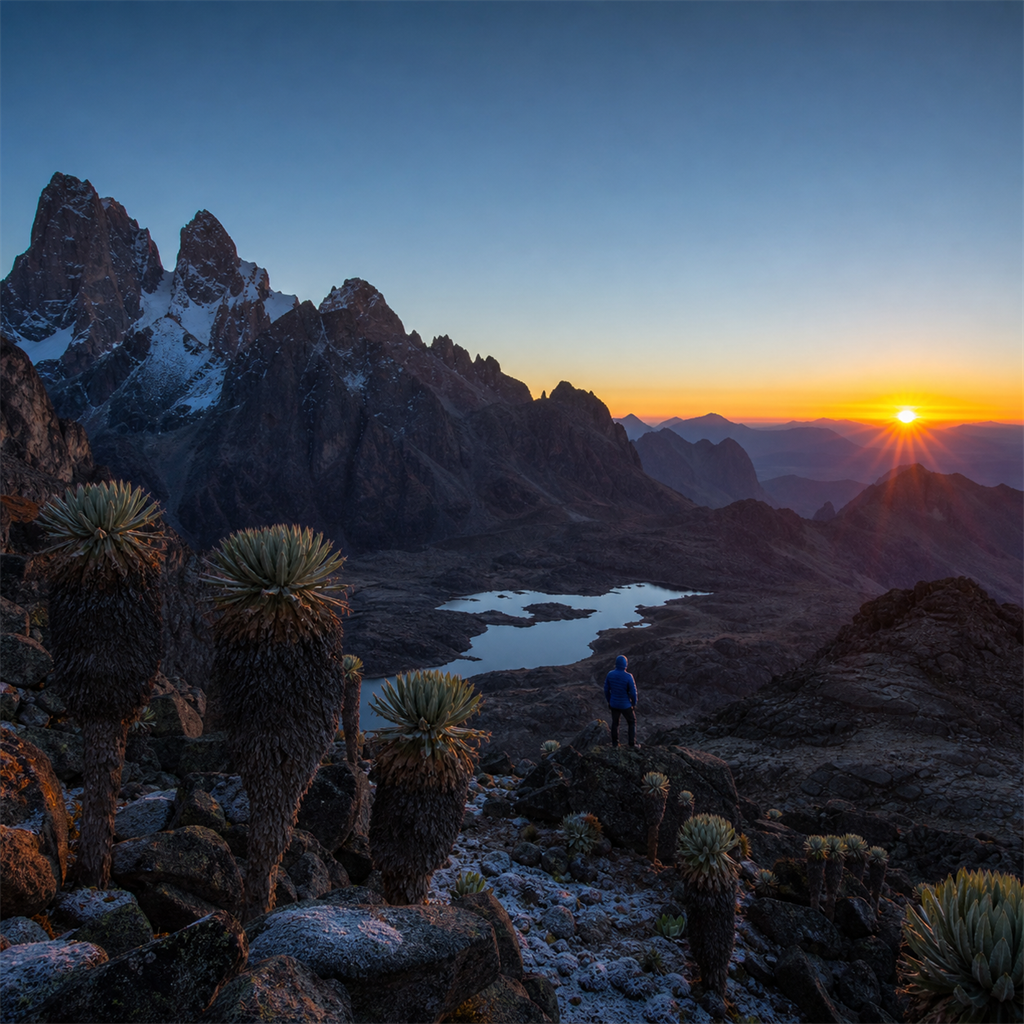
Mount Kenya
Traverse
Mount Kenya, Africa’s second-highest peak at 5,199m, is frequently cited by high-altitude trekkers as one of East Africa's most aesthetically diverse mountain objectiv…
Duration
5 days
Route distance
55.0km
Vertical Gain
+2,000m
Max Altitude
4,985m
Mission Brief
Mount Kenya, Africa’s second-highest peak at 5,199m, is frequently cited by high-altitude trekkers as one of East Africa's most aesthetically diverse mountain objectives.
The 'Chogoria to Sirimon' traverse is the definitive way to experience the mountain, crossing the massif from the dramatic eastern cliffs to the gentler western slopes. Unlike the popular Naro Moru route, which is faster but often considered less scenic, the Chogoria approach takes hikers through magnificent bamboo forests and along the rim of the Gorges Valley, where 300-meter drops lead down to the turquoise waters of Lake Michaelson. This route is strategically favored for its superior acclimatization profile, as the gradual gain from the east allows the body more time to adjust before the push to Point Lenana (4,985m), the mountain's highest trekking summit.
While the true peaks of Batian and Nelion require technical rock climbing, Point Lenana offers a challenging but non-technical alpine experience for fit hikers. The region is notable for its unique Afro-alpine vegetation, including the endemic giant lobelias and groundsels that thrive in the 'summer every day, winter every night' climate of the equator.
In just five days, hikers move from tropical bamboo forests to a glacial alpine world of vertical granite and ancient ice. The sunrise from Point Lenana provides one of the most iconic views in Africa, with Batian and N…
Mission Snapshot
Intensity Breakdown
Understanding what drives the overall route demand
Physical
4
Technical
3
Commitment
4
Primary driver: Altitude & Exposure
- Equatorial altitude (4,985m)
- Rocky ridge scrambling
- Sustained cold/exposure
High commitment routes with serious consequence, remote terrain, or sustained objective hazard.
Full Route Breakdown
Complete stage overview with transparent route metrics. Values are shown as recorded in the route dataset and source links.
Distance
55.0 km
Ascent
2,000 m
Highest point
4,985 m
Start
Chogoria Gate to Mt Kenya Bandas (2950m)
Finish
Out via Sirimon Gate
Use the KM / MI toggle in the main menu to switch units.
Route Profile
Fixed backcountry campground structure for this route
Route Considerations
This route is generally safe, but these are the main factors to be aware of.
Altitude
Summit (Lenana) is nearly 5000m. AMS is a real risk.
Impact
Route-specific
Likelihood
Context-dependent
Tip
Climb high, sleep low. Take an extra day at Mintos or Shiptons if needed.
Weather
Located on the equator but has glaciers. Snow and hail common year-round.
Impact
Route-specific
Likelihood
Context-dependent
Tip
Quality 3-layer system (base, fleece, shell) is non-negotiable.
Altitude Warning
Potential altitude-related conditions include AMS, HAPE, and HACE. Adequate acclimatization is essential.
Impact
Route-specific
Likelihood
Context-dependent
Tip
Strict adherence to hydration and gradual ascent protocols (climb high, sleep low).
Why hike this route?
LANDSCAPE
Vertical cliffs, glacial tarns, and unique afro-alpine moorland with giant lobelias.
VARIETY
Passing through three distinct ecological zones in a single trek.
CULTURE & PLACE
Interacting with the local Kikuyu, Ameru, and Embu cultures who consider the mountain the home of God (Ngai).
STANDOUT
In just five days, hikers move from tropical bamboo forests to a glacial alpine world of vertical granite and ancient ice. The sunrise from Point Lenana provides one of the most iconic views in Africa, with Batian and Nelion catching the first light above a sea of cloud.
Expert Verdict
“Based on aggregated guide reports and climber accounts, Mount Kenya offers a significantly more varied ecological experience than many higher African peaks. The East-to-West traverse via Chogoria is widely recognized for superior aesthetics, particularly the dramatic approach along the rim of the Gorges Valley. Regional experts suggest that the gradual ascent from the Chogoria side provided by this itinerary allows for a natural acclimatization rhythm, often resulting in a more comfortable summit experience at Point Lenana. It is essential to verify current KWS permit structures and seasonal safety updates before departure. Given the equatorial location, radiant heat is high during the day, but summit temperatures frequently plummet below freezing; high-quality windproof and insulating layers are mandatory for the final push.”
Who This Is For
- INTERMEDIATE — Designed for fit hikers seeking a diverse and less crowded alpine experience. Previous experience with multi-day trekking and overnight camps is essential, as is a thorough understanding of cold-weather layer management and high-altitude pacing.
- PHYSICAL — High. The traverse involves sustained daily movement over 4,000m. The summit day is particularly taxing, requiring a pre-dawn vertical gain of nearly 800m on loose talus and scree, followed by a long descent through Mac…
- WATCH FOR — Attempting to rush the ascent to Point Lenana too quickly and getting hit by AMS.
- WATCH FOR — Underestimating the steepness of the final scree push during the summit night.
Plan This Hike
Key things to arrange before starting this route—practical tips first, then buttons that open curated picks (gear, maps, stays) where we list them.
Essential Gear
Recommended preparation for this route:
Equatorial altitude means sun, hail and summit cold in one trip.
- Pack a warm summit layer, waterproof shell and gloves for the Point Lenana push.
- Use sturdy boots and poles for scree, rocky ridges and long valley descents.
- Carry high-UV protection for exposed afro-alpine sections above 4,000m.
Stay Connected
Explore accommodation options for this trail:
Your guide team and offline tools are the real safety layer.
- Expect patchy coverage once you leave the gates; keep offline maps available.
- Confirm that the crew has a clear evacuation plan for altitude symptoms.
- Keep permit details, insurance contacts and gate logistics accessible offline.
Getting There
Travel and trail access for this route:
The east-to-west traverse needs transport on both sides.
- Stage from Nairobi or Nanyuki, then transfer to the Chogoria side of the mountain.
- Pre-arrange pickup at Sirimon Gate because the finish is far from the start.
- Build in buffer time for road transfers and weather delays near the gates.
Where to Stay
Explore accommodation options for this trail:
Basic mountain huts and camps shape the pacing plan.
- Use Bandas, Mintos, Shiptons and Old Moses huts or nearby camps depending on itinerary.
- Add a night if altitude symptoms appear before the summit push.
- Sleep in Nanyuki or Nairobi after the trek to absorb transfer uncertainty.
Compare This Route
See how this route compares to similar hikes in overall demand and terrain profile.Compare routes by the shape of the effort, not only the headline score.
The Chomolhari Trek
Closest overall match in demand profile
The Chomolhari Trek is a 7–9 day high-altitude route through the Jigme Dorj...
Intensity
Slightly higher intensityTrolltunga
Lower overall intensity, similar terrain type
The Troll's Tongue. Trolltunga is one of Norway's most spectacular scenic c...
Intensity
Lower intensityYading Nature Reserve
Higher physical or technical demand
The 'Big Kora' is an advanced outer circumambulation route rarely undertake...
Intensity
Higher intensityExplore Alternatives
Broaden the picture with easier, harder, and nearby options.
Looking for something easier?
Lower intensity — helpful if this route feels like a stretch right now.
Want more challenge?
Higher intensity — for when you are ready for a bigger physical or technical step.
More hikes in this region
Nearby and regionally relevant routes for the next step in your search.
Compare with any route
Pick any hike worldwide and open a full side-by-side comparison.
What You Need to Know
Essential answers about the demands, risks, and logistics of this route.
Q.How hard is this hike really?
Q.Do I need technical gear?
Q.Is water available on the route?
Q.What is the main risk?
Ready to hike Mount Kenya Traverse?
A final decision point after reviewing the route, risks, logistics, and alternatives.
This route is a strong match if you're comfortable with the effort level implied by an Intensity Score around 84/100 (Severe), sustained hiking where this route requires it, and the terrain and exposure described in this guide.
Build your itinerary, stages, and logistics.
Looking for something easier, more challenging, or a different terrain profile?
Compare routes by intensity, terrain, and region.
Data: official trail documentation and topographic sources · About