Ancient Tea
Horse Road
The Ancient Tea Horse Road (Chamagudao) is a historic network of caravan paths that once connected the tea-growing regions of Yunnan with high-altitude trade towns on…
Duration
6 days
Route distance
150.0km
Vertical Gain
+6,000m
Max Altitude
4,200m
Mission Brief
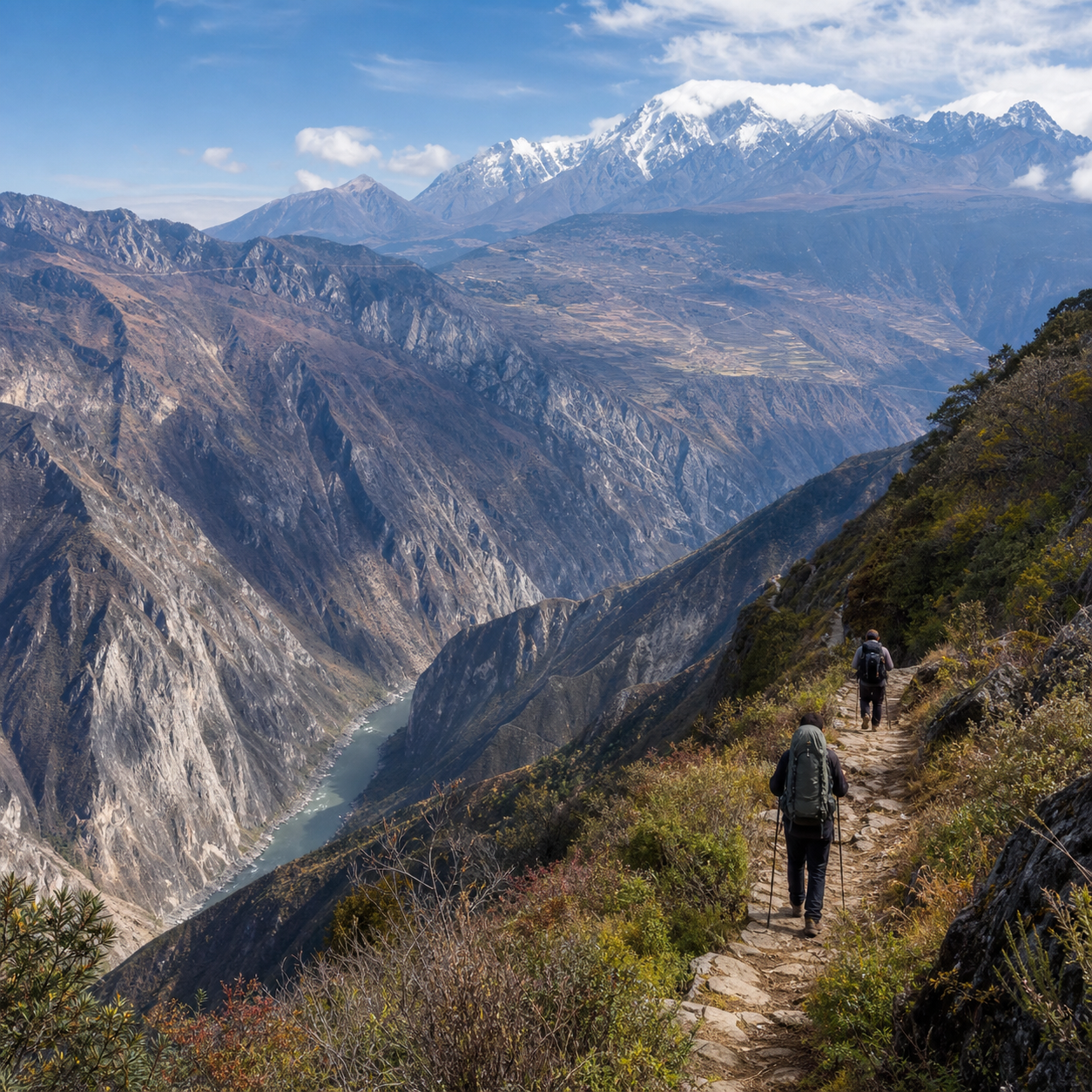
The Ancient Tea Horse Road (Chamagudao) is a historic network of caravan paths that once connected the tea-growing regions of Yunnan with high-altitude trade towns on the eastern Himalayan plateau.
This modern trekking segment focuses on the 'Upper Tea Horse Road' between Lijiang and the Shangri-La plateau, passing through some of the most dramatic canyon landscapes in the world, including the Tiger Leaping Gorge. The route traverses high-altitude passes at 4,000m+, traditional Naxi and Tibetan villages, and deep river gorges. It is an immersive journey through the Silk Road's southwestern equivalent, combining high-altitude endurance with deep historical and cultural significance.
Himalayan Vertical Scale. The defining characteristic of the Chamagudao trek is the sheer vertical drama of the Jinsha River (Upper Yangtze) cutting through the Jade Dragon and Haba Snow Mountains. The trek takes hikers…
Mission Snapshot
Intensity Breakdown
Understanding what drives the overall route demand
Physical
79
Technical
58
Commitment
65
Primary driver: Physical load
- Sustained Physical Output
- Significant Vertical Gain
- Technical Terrain Exposure
- High Remote Commitment
High commitment routes with serious consequence, remote terrain, or sustained objective hazard.
Full Route Breakdown
Complete stage overview with transparent route metrics. Values are shown as recorded in the route dataset and source links.
Distance
150.0 km
Ascent
6,000 m
Highest point
4,200 m
Start
Qiaotou
Finish
Shangri-La
Use the KM / MI toggle in the main menu to switch units.
Route Considerations
This route is generally safe, but these are the main factors to be aware of.
Acute mountain sickness (AMS)
Crossing passes at 4,000m-4,200m presents a significant risk for unacclimatized hikers starting from Lijiang (2,400m).
Impact
Route-specific
Likelihood
Context-dependent
Tip
Incorporate at least two rest days in Lijiang or Qiaotou before starting the main ascent stages. Carry hydration with electrolytes and monitor symptoms closely on the High Path.
Rockfall and shale slides
The 'High Path' segments of Tiger Leaping Gorge are subject to minor rockfall, especially after heavy monsoon rains (July-August).
Impact
Route-specific
Likelihood
Context-dependent
Tip
Avoid trekking during peak monsoon months (July-August). Use cautious footing on the '28 Bends' and the narrow limestone segments of the Upper Path.
Terrain & conditions
Conditions change quickly on the ground. Slow down on wet rock and pay more attention where paths narrow or exposure increases.
Impact
Moderate
Likelihood
Variable
Tip
Refer to stage notes and expert briefings; maintain focus on slick or exposed sections.
Why hike this route?
LANDSCAPE
The sunrise over the Jade Dragon Snow Mountain glaciers from the High Path.
VARIETY
The total cultural shift from the Naxi people of the gorge to the Tibetan people of the plateau.
CULTURE & PLACE
Experiencing the literal path of the ancient tea caravans—walking the same stones used for over 1,000 years.
STANDOUT
Himalayan Vertical Scale. The defining characteristic of the Chamagudao trek is the sheer vertical drama of the Jinsha River (Upper Yangtze) cutting through the Jade Dragon and Haba Snow Mountains. The trek takes hikers from the subtropical depths of the gorge to the high, arid…
Expert Verdict
“The Chamagudao Trek is a Class 2 high-altitude endurance route that tests physiological resilience more than technical climbing skill. It is one of the world's most dramatic 'vertical gap' experiences. Our intensity model accounts for the **Altitude Boost** and the **Elevation Density Bonus (+2)** for the steep gorge sectors. The transition from the Yangtze banks to the 4,200m plateau edge represents a core continental transition. For Ancient Tea Horse Road, use the listed 6-8 per day walking-time band against 150km (93 miles) high-altitude point-to-point and 6000 m of ascent.”
Who This Is For
- ADVANCED — High-altitude trekking experience (3,500m+) and solid baseline fitness capable of sustaining 1,500m+ ascent days. Comfort with narrow cliff paths.
- PHYSICAL — Very High. The altitude boost (+0.6 on v2.9 scale) and the consistent 2,500m+ base elevation create significant physiological stress.
- WATCH FOR — Descending to the Jinsha river bed without accounting for the massive return climb.
- WATCH FOR — Rushing the acclimatization—Lijiang to Walnut Garden in one day is a common cause of AMS.
Plan This Hike
Key things to arrange before starting this route—practical tips first, then buttons that open curated picks (gear, maps, stays) where we list them.
Essential Gear
Recommended preparation for this route:
Rocky gorge paths and high plateau weather set the kit list.
- Use sturdy boots for shale, limestone steps and long gorge traverses.
- Pack strong sun protection for 3,500-4,200 m plateau sections.
- Carry warm layers because nights above the gorge can fall below freezing.
Stay Connected
Explore accommodation options for this trail:
Offline navigation matters once the route leaves the gorge villages.
- Download offline maps before leaving Lijiang or Shangri-La.
- Expect weak coverage in side valleys and high-pass sections.
- Keep local guesthouse contacts and a Chinese-address backup for transfers.
Getting There
Travel and trail access for this route:
Lijiang access and a Shangri-La exit make this a point-to-point plan.
- Fly or train into Lijiang, then transfer toward Qiaotou for the gorge trailhead.
- Use Shangri-La as the practical exit base for the higher plateau finish.
- Avoid monsoon-heavy months when rockfall and landslide risk increase.
Where to Stay
Explore accommodation options for this trail:
Guesthouses cover the gorge; higher stages need confirmation.
- Use family-run guesthouses in the Tiger Leaping Gorge section.
- Expect simpler village lodges or camping support on the higher caravan-route stages.
- Confirm seasonal openings before committing to a point-to-point itinerary.
Compare This Route
See how this route compares to similar hikes in overall demand and terrain profile.Compare routes by the shape of the effort, not only the headline score.
Markha Valley Trek
Closest overall match in demand profile
The Markha Valley Trek is a significant multi-day route within the Hemis Na...
Intensity
Lower intensityTrolltunga
Lower overall intensity, similar terrain type
The Troll's Tongue. Trolltunga is one of Norway's most spectacular scenic c...
Intensity
Lower intensityYading Nature Reserve
Higher physical or technical demand
The 'Big Kora' is an advanced outer circumambulation route rarely undertake...
Intensity
Higher intensityExplore Alternatives
Broaden the picture with easier, harder, and nearby options.
Looking for something easier?
Lower intensity — helpful if this route feels like a stretch right now.
Want more challenge?
Higher intensity — for when you are ready for a bigger physical or technical step.
More hikes in this region
Nearby and regionally relevant routes for the next step in your search.
Mount Emei
Sichuan · china
Distance
40.0 km
Ascent
2,500 m
Mount Huashan
Shaanxi · china
Distance
12.0 km
Ascent
1,700 m
Chinese Muur
Beijing / Hebei · china
Distance
10.0 km
Ascent
800 m
Xishuangbanna Jungle Trek
yunnan-xishuangbanna · china
Distance
42.0 km
Ascent
500 m
Wugong Mountain
Jiangxi · china
Distance
30.0 km
Ascent
1,800 m
Huangshan
Anhui · china
Distance
15.0 km
Ascent
1,800 m
Compare with any route
Pick any hike worldwide and open a full side-by-side comparison.
What You Need to Know
Essential answers about the demands, risks, and logistics of this route.
Q.How hard is this hike really?
Q.Do I need technical gear?
Q.Is water available on the route?
Q.What is the main risk?
Ready to hike Ancient Tea Horse Road?
A final decision point after reviewing the route, risks, logistics, and alternatives.
This route is a strong match if you're comfortable with the effort level implied by an Intensity Score around 84/100 (Severe), sustained hiking where this route requires it, and the terrain and exposure described in this guide.
Build your itinerary, stages, and logistics.
Looking for something easier, more challenging, or a different terrain profile?
Compare routes by intensity, terrain, and region.