Three Capes
Track
The Three Capes Track is approximately 48km point-to-point, typically completed over 4 days with a total of 1,400m cumulative elevation gain.
Duration
4 days
Route distance
48.0km
Vertical Gain
+1,400m
Max Altitude
457m
Mission Brief
The Three Capes Track is a 48km point-to-point trekking route within Tasman National Park, Tasmania.
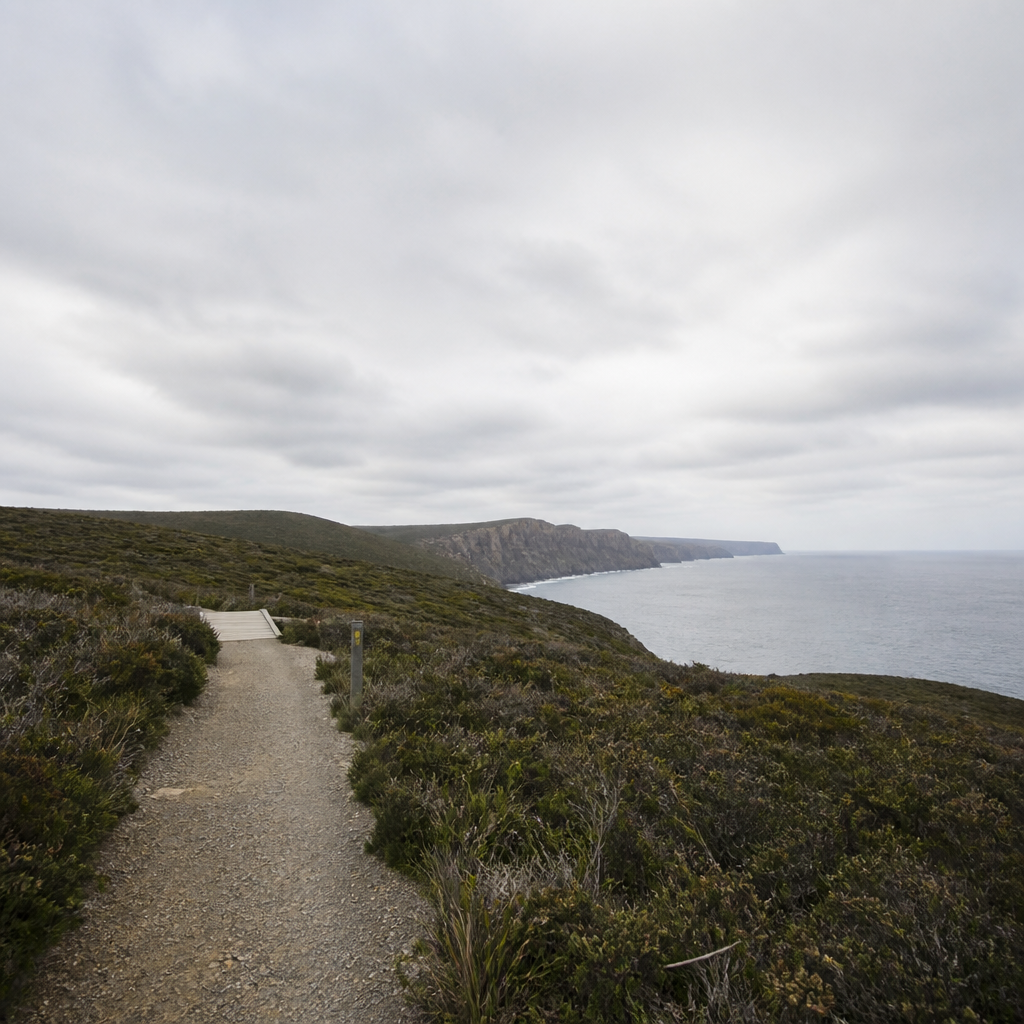
Starting at the Port Arthur Historic Site with a marine transfer across the bay to Denmans Cove, the route traverses the high sea cliffs of the Tasman Peninsula. The track is highly engineered, featuring wide gravel paths and boardwalks that provide safe access to vertical dolerite columns reaching 300 meters above the Southern Ocean. Management is handled by the Tasmania Parks & Wildlife Service, with a regulated north-to-south flow.
The route transitions through diverse environments including coastal heathland, dry sclerophyll forest, and temperate rainforest.
A highly accessible multi-day coastal traverse through the Tasmanian Wilderness, supported by established cabin infrastructure and significant geological landforms.
Mission Snapshot
Intensity Breakdown
Understanding what drives the overall route demand
Physical
63
Technical
14
Commitment
35
Primary driver: Physical load
- Sustained Physical Output
Serious physical effort or sustained terrain friction. Demanding but not expedition-scale.
Full Route Breakdown
Complete stage overview with transparent route metrics. Values are shown as recorded in the route dataset and source links.
Distance
48.0 km
Ascent
1,400 m
Highest point
457 m
Start
Denmans Cove (boat from Port Arthur Historic Site)
Finish
Fortescue Bay
Use the KM / MI toggle in the main menu to switch units.
Route Profile
Multi-day stage structure
Operational Reality
Headline 48 km and stage distances 4 / 11 / 19 / 14 km (sum 48). Elevation 0–457 m and 1,400 m gain. Point-to-point southbound. Sources: Parks Tasmania Three Capes Track page and Parks Tasmania walk notes.
Route Considerations
This route is generally safe, but these are the main factors to be aware of.
Maritime wind exposure
The Tasman Peninsula is directly exposed to Southern Ocean frontal systems, which can deliver high-velocity gusts and sudden thermal shifts.
Impact
Route-specific
Likelihood
Context-dependent
Tip
Carry reliable windproof and waterproof layers even in summer. Utilize the shelter of forested segments during passing squalls and remain on the marked path in exposed cliff nodes.
Topographical exposure
Portions of the track follow cliff lines reaching 300 meters. While the path is wide, these sections remain unfenced in several areas.
Impact
Route-specific
Likelihood
Context-dependent
Tip
Maintain focus on the track surface. In extremely high winds, hikers are advised to lower their center of gravity and wait for gusts to dissipate before moving through narrow sections like 'The Blade'.
Terrain & conditions
Conditions change quickly on the ground. Slow down on wet rock and pay more attention where paths narrow or exposure increases.
Impact
Moderate
Likelihood
Variable
Tip
Refer to stage notes and expert briefings; maintain focus on slick or exposed sections.
Why hike this route?
LANDSCAPE
Vertical dolerite columns dropping into the high-energy Southern Ocean swell at Cape Pillar.
VARIETY
Transitions between architectural eco-hubs, prehistoric rainforests, and exposed wind-swept moorlands.
CULTURE & PLACE
The connection to the Port Arthur Historic Site and the unique boat-based entry sequence at Denmans Cove.
WHY GO
A highly accessible multi-day coastal traverse through the Tasmanian Wilderness, supported by established cabin infrastructure and significant geological landforms.
Expert Verdict
“Three Capes Track is Australia's premier infrastructure-supported walk. It offers immense coastal exposure with minimal technical barriers. Success is defined by staying dry (sweat and rain) and maintaining pacing to ensure arrival at hubs before nightfall.”
Who This Is For
- INTERMEDIATE — Suitable for beginner to intermediate multi-day hikers. The developed infrastructure reduces navigational complexity but demands moderate endurance for Day 3.
- PHYSICAL — Moderate. Consecutive days of 10-19km movement, primarily on unyielding gravel surfaces, require adequate physical preparation.
- WATCH FOR — Bringing heavy gas canisters or cooking pans; these are already provided in the eco-hubs.
- WATCH FOR — Underestimating the effect of wind-chill on 'The Blade' compared to the sheltered forest sections.
Plan This Hike
Key things to arrange before starting this route—practical tips first, then buttons that open curated picks (gear, maps, stays) where we list them.
Essential Gear
Recommended preparation for this route:
Dry-boot gravel walking plus four days of food; hubs supply mattresses and stoves.
- Supportive hiking footwear for gravel and stone stairs
- Windproof/waterproof shell for Southern Ocean cliff gusts
- Sleeping bag — mattresses are provided in the eco-hubs
Stay Connected
Explore accommodation options for this trail:
Reception is inconsistent; often available on elevated cliff-tops.
- Treat tank water at hubs before drinking
- Rangers are present at each hub node
- Download maps before the boat leaves Port Arthur
Getting There
Travel and trail access for this route:
Check in at Port Arthur; boat to Denmans Cove; bus back from Fortescue Bay.
- Permit package includes boat and return shuttle
- Southbound only — 48 departures per day
- Secure long-term parking at Port Arthur
Where to Stay
Explore accommodation options for this trail:
Three managed eco-hubs; independent camping is prohibited on the track.
- Surveyors, Munro and Retakunna hubs in sequence
- Solar-powered facilities, mattresses and gas cooktops
- Book well ahead — the walk is capped
Compare This Route
See how this route compares to similar hikes in overall demand and terrain profile.Compare routes by the shape of the effort, not only the headline score.
Abel Tasman Coastal Track
Closest overall match in demand profile
Golden sands and coastal magic. The Abel Tasman Coastal Track (60km / 37 mi...
Intensity
Higher intensityKaisertal — The Stairway to Heaven
Lower overall intensity, similar terrain type
Voted Austria’s most beautiful place in a national poll in 2016, the Kaiser...
Intensity
Lower intensityMirador Las Torres
Higher physical or technical demand
Located inside Torres del Paine National Park in southern Chilean Patagonia...
Intensity
Higher intensityExplore Alternatives
Broaden the picture with easier, harder, and nearby options.
Looking for something easier?
Lower intensity — helpful if this route feels like a stretch right now.
Want more challenge?
Higher intensity — for when you are ready for a bigger physical or technical step.
More hikes in this region
Nearby and regionally relevant routes for the next step in your search.
Great Ocean Walk
victoria-otways · australia
Distance
104.0 km
Ascent
2,400 m
Thorsborne Trail
queensland-hinchinbrook-island · australia
Distance
32.0 km
Ascent
1,200 m
Fraser Island
queensland-kgari · australia
Distance
90.0 km
Ascent
1,400 m
Overland Track
tasmania-cradle-mountain · australia
Distance
65.0 km
Ascent
1,461 m
Wilderness Coast Walk
nsw-victoria-border · australia
Distance
100.0 km
Ascent
800 m
Bondi to Bronte Coastal Walk
nsw-sydney · australia
Distance
2.0 km
Ascent
50 m
Compare with any route
Pick any hike worldwide and open a full side-by-side comparison.
What You Need to Know
Essential answers about the demands, risks, and logistics of this route.
Q.How hard is this hike really?
Q.Do I need technical gear?
Q.Is water available on the route?
Q.What is the main risk?
Ready to hike Three Capes Track?
A final decision point after reviewing the route, risks, logistics, and alternatives.
This route is a strong match if you're comfortable with the effort level implied by an Intensity Score around 46/100 (Hard), sustained hiking where this route requires it, and the terrain and exposure described in this guide.
Build your itinerary, stages, and logistics.
Looking for something easier, more challenging, or a different terrain profile?
Compare routes by intensity, terrain, and region.
Data: official trail documentation and topographic sources · About